For the first time in nearly a century, archaeologists uncovered what may be the true tomb of Pharaoh Thutmose II, and the discovery immediately raised more questions than answers.
Hidden in the cliffs near Deir el-Bahari, the tomb had remained untouched for thousands of years. When researchers finally entered, they expected the solemn order of a royal burial. Instead, they found disorder, damage, and signs that something had gone terribly wrong.
The chambers appeared unstable. Objects seemed to have been dragged away in haste. The layout did not match the dignity expected for a king of Egypt. Rather than a peaceful resting place, the tomb felt abandoned, disturbed, and almost deliberately erased.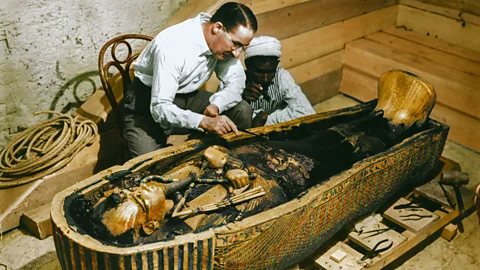
The mystery surrounding Thutmose II had already haunted Egyptology for generations. His mummy had not been found in his own tomb, but in a hidden royal cache discovered in the late nineteenth century. That cache, uncovered near Deir el-Bahari, contained the remains of some of Egypt’s greatest rulers, including Ramesses II and Seti I. These kings had been moved there by priests centuries after their deaths to protect them from tomb robbers.
But when Thutmose II’s body was examined, it shocked researchers.
His remains were badly damaged. Limbs had been torn away, his body showed signs of severe post-mortem destruction, and his skin bore disturbing evidence of illness. Later studies suggested he had suffered from serious physical conditions, including spinal deformity, foot problems, and possible heart disease. He died young, likely before the age of thirty, yet his body looked like that of a man who had endured years of suffering.
The greatest mystery was not only his condition, but his absence from his original burial place.
Thutmose II had been a weak king in a dangerous position. His claim to power was fragile because he was the son of a secondary wife. To secure the throne, he married his half-sister Hatshepsut, the daughter of the main royal line. From the beginning, she held enormous influence.
After his death, Hatshepsut moved quickly. She did not simply act as a grieving widow. She used the burial of Thutmose II to strengthen her own claim to rule. Soon, she declared herself pharaoh, took on royal titles, appeared in monuments with the symbols of male kingship, and presented herself as chosen by the god Amun.
As her power grew, Thutmose II faded.
His monuments were unfinished, altered, or overshadowed. His name appeared less and less. In many ways, the man who had been king became a footnote beneath the reign of the woman who followed him.
That is why the discovery of his tomb matters so deeply.
When archaeologists entered the chamber, they were not simply opening another ancient burial site. They were stepping into a broken chapter of royal history. The damaged structure, missing objects, and chaotic condition suggested that the tomb had suffered ancient disturbance, flooding, collapse, or hurried removal of burial goods.
Rather than solving the mystery, the tomb made it darker.
Why was the burial so incomplete? Why had the king’s body been removed? Was the tomb abandoned because of structural failure, robbery, political neglect, or deliberate erasure? And how much of Thutmose II’s memory was lost because those who came after him had a reason to let him disappear?
The discovery forces historians to reconsider not only the death of one pharaoh, but the brutal politics of memory in ancient Egypt.
Kings were not only buried in stone. They were preserved through names, images, monuments, and rituals. To remove a name was to attack eternity itself.
Thutmose II may have ruled Egypt, but his afterlife was marked by damage, displacement, and silence.
After more than 3,500 years, his tomb has finally emerged from the cliffs. But what it revealed was not a simple royal treasure.
It revealed a king whose body was broken, whose tomb was disturbed, and whose place in history may have been deliberately buried beneath the ambition of others.