The ground in the Middle East does not lie, and for decades, it has been telling a story that challenges the very foundation of modern civilization. Archaeologists, sifting through ancient graves, have unearthed two distinct sets of human remains that serve as a stark biological ledger of our past. The first skeleton, belonging to a hunter-gatherer, is tall, with thick bones and clean joints, a testament to a life of varied movement and nutritious food.
The second, a farmer from a later era, is a wreck: teeth riddled with cavities, a spine crushed by arthritis, and evidence of repetitive, grinding labor that wore the body down before its time.
 The discovery is not an anomaly. Across the globe, from the Fertile Crescent to the Americas, the same pattern emerges whenever humanity transitioned from foraging to farming. The advent of agriculture, long hailed as the cornerstone of progress, actually resulted in shorter, sicker, and more painful lives for the generations that adopted it.
The bones are a diary, and they record that the people with nothing but spears were living healthier, less physically punishing lives than those who came after them with plows and granaries.
This biological evidence sets the stage for a profound question that has haunted anthropologists for generations: if the physical toll of ancient life was lighter, what did a normal day actually look like? The answer, painstakingly reconstructed through ethnographic studies and archaeological finds, paints a picture of life that is almost unrecognizable to the modern worker. It is a life where the sun, not a machine, dictates the start of the day, and where the concept of “having to be somewhere” does not exist.
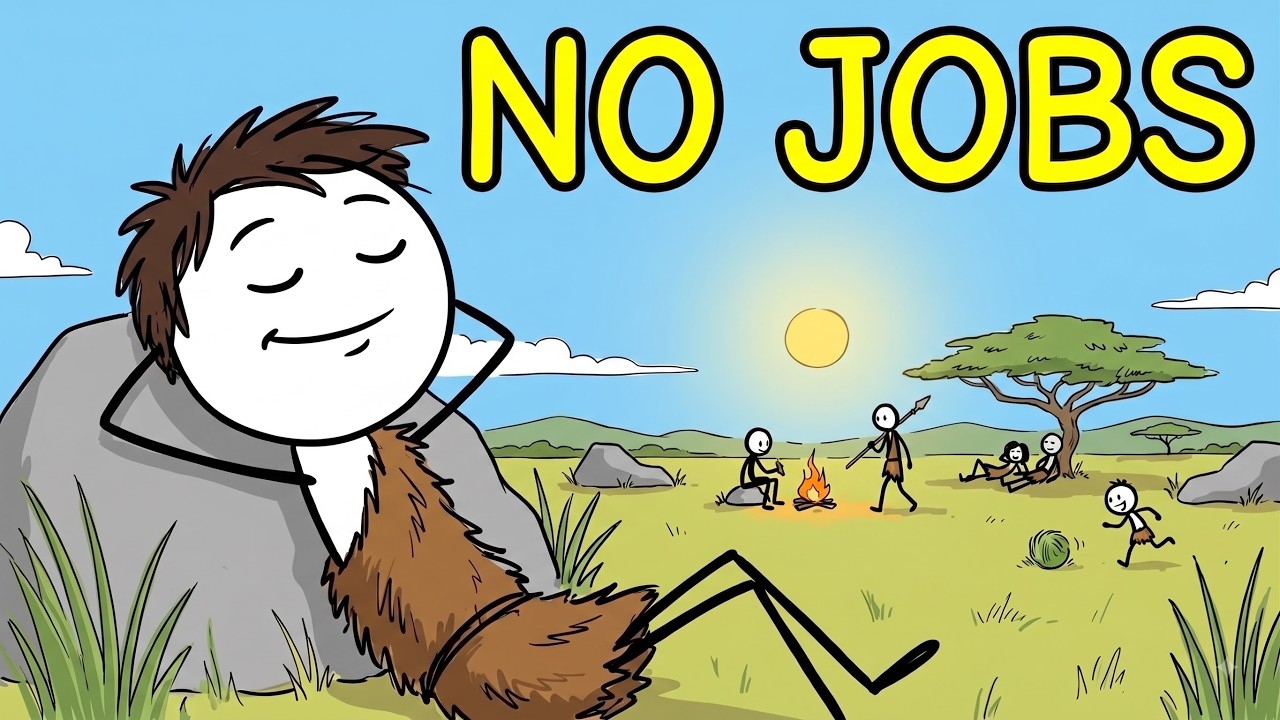
Imagine waking at dawn, your sleep cycle naturally complete, with no alarm screaming in your ear. The fire from the previous night still crackles, and the camp is already stirring. The morning “meeting” is a casual conversation around the flames, discussing the location of water sources and the tracks of animals.
The day’s plan is not a mandate from a boss but a collective decision made by the group. If the last hunt was successful, the day might not involve hunting at all, but rather tool sharpening, hide working, or simply socializing.
This is not a romantic fantasy; it is a documented reality. In 1963, anthropologist Richard Lee traveled to the Kalahari Desert to study the Ju/’hoansi, one of the last groups living a traditional hunter-gatherer lifestyle. Expecting to find a desperate struggle for survival, he instead found something that shattered the academic consensus.
Armed with a stopwatch, Lee meticulously recorded how the Ju/’hoansi spent their time. The result was staggering: they spent an average of just 17 hours per week securing food.
That number, roughly two and a half days of work, was met with disbelief. Yet, when researchers repeated the study with the Hadza in Tanzania, the Ache in Paraguay, and the Martu in Australia, the results were remarkably consistent, always falling between 15 and 20 hours a week. For the modern worker, that is the equivalent of being done with your job by Wednesday afternoon, with the rest of the week entirely your own.
 The narrative of the “brutal, short, and desperate” prehistoric life was not just wrong; it was inverted.
The hours that followed the work were not wasted. They were, in fact, the most crucial part of the day. The “lazy” afternoons spent sitting in the shade, talking, and grooming were not indolence but an investment in the only safety net that existed.
In a world without money, police, or courts, survival depended entirely on social bonds. If you were liked, you were fed when you were sick or injured. If you were not, you starved.
The six hours a day spent on social time were the equivalent of building a bank account, a hospital, and a pension plan all at once.
The material culture of these societies proves that this free time was not just used for survival logistics. At Blombos Cave in South Africa, archaeologists found 70,000-year-old shell beads, carefully drilled and strung, requiring hours of patient, skilled labor for no purpose other than beauty. In Germany, a 40,000-year-old flute carved from a vulture’s wing bone demonstrates a sophisticated understanding of music and the leisure time to master it.
These were not the artifacts of a people scraping by; they were the products of a people with time to create.
The most profound revelation, however, comes from what happened after the sun went down. A 2014 study by anthropologist Polly Wiessner analyzed decades of recorded Ju/’hoansi conversations and found a stark divide between day and night talk. Daytime conversation was practical, focused on logistics, resources, and social grievances.
 But at night, around the fire, the conversation transformed. A staggering 81% of firelight talk was dedicated to storytelling—myths, legends, and jokes.
These stories, filled with gods, spirits, and ancestors, could only emerge from a mind that was full and safe. The fire did more than cook food and ward off predators; it created the first hours in human history where the mind was completely free. Wiessner argues that this is precisely where human culture was born—not in the fields of labor, but in the quiet, creative hours of the evening.
Even sleep was different, occurring in two distinct four-hour blocks with a calm, wakeful period in between, a rhythm that modern “insomnia” might actually be echoing.
So, where did all this time go? The answer lies in a seed planted about 10,000 years ago in the Fertile Crescent. Farming, on paper, was an upgrade.
It promised more food and control over the environment. But it was a trap. More food led to more babies, which led to a larger population, which required even more food, which demanded more fields and more work.
Once the population grew too large to be supported by hunting and gathering, there was no going back. The lock clicked shut.
The workload exploded. Plowing, planting, weeding, harvesting, storing, and guarding became a relentless, year-round cycle. The second skeleton, the farmer with the ruined spine and rotten teeth, is the physical evidence of this new life.
 The first farmers worked harder and lived worse than their hunter-gatherer ancestors, and they were trapped. The trap then tightened further. Villages grew into cities, which brought specialists, soldiers, priests, and eventually, tax collectors.
For the first time in history, an individual’s hours could belong to someone else, sold for food they no longer knew how to find themselves.
Your time was not stolen in a single dramatic night. It was traded away slowly, generation by generation, in a deal no one alive today ever had the chance to refuse. The alarm clock that screams at you this morning is the latest installment on that ancient debt.
You spend roughly 90,000 hours of your life working, hoping for a retirement that promises to give you back the time you lost. You network for career advantage, while they spent six hours a day with people they loved, and it counted as survival.
You chase a finish line where you finally get your time back, but they were born on that finish line. Every morning, they woke up with no schedule and asked themselves a question you have never been free to ask: “What should I do today?” You are working your entire existence to someday retire into a life they lived from their first day to their last.
They would find it deeply strange that you traded all of it away for a screaming alarm and a promise. The skeletons in the ground suggest they were the ones who got it right.


