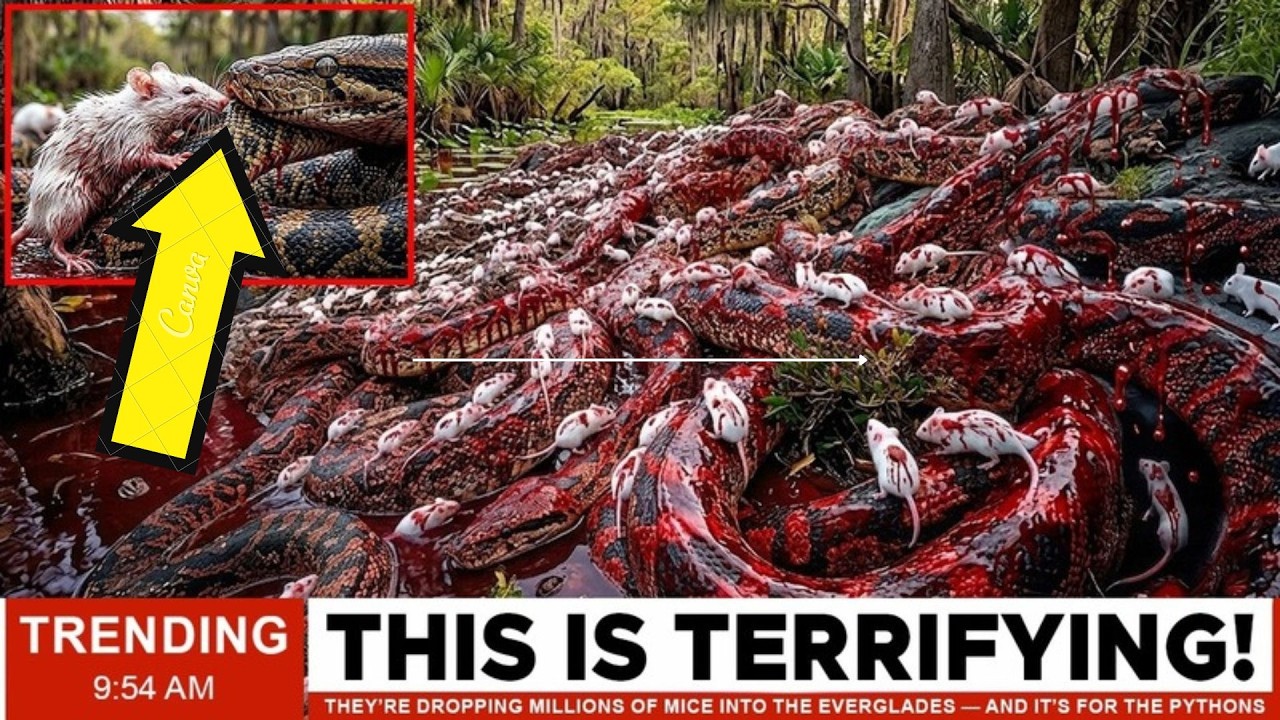
In a groundbreaking yet controversial move, Florida officials have begun deploying millions of acetaminophen-laced dead mice from helicopters over the Everglades to combat an invasive Burmese python crisis that threatens the region’s delicate ecosystem and indigenous species. This unprecedented wildlife management strategy sparks urgent debate over ecological safety and effectiveness.
The Burmese python invasion in the Everglades is a full-scale environmental disaster, traced back to escaped pets in the 1970s. These giant constrictors have rewritten the food web, decimating native mammals and causing sharp declines in raccoon, rabbit, and deer populations. Despite decades of removal efforts, the python population grows unchecked.
Conventional tactics such as hunting, trapping, and detection dogs have failed to slow the python’s spread. With adult females capable of laying up to 100 eggs per clutch, existing control measures cannot keep pace with their rapid reproduction. The snake’s cryptic nature in challenging terrain further hampers eradication attempts.
The new strategy, inspired by successful efforts in Guam, involves dropping dead mice injected with acetaminophen—an everyday human painkiller deadly to snakes—into the python habitat. Juvenile pythons, who actively climb and hunt in tree canopies, consume these laced mice, leading to fatal poisoning designed to reduce populations over time.
This approach capitalizes on the snake’s metabolic vulnerability: acetaminophen causes their red blood cells to fail in oxygen transport, resulting in death within days. In Guam, the method collapsed invasive brown tree snake numbers by 80%, saving native bird species from near-extinction and stabilizing the ecosystem.
However, the Everglades presents unique challenges. Unlike Guam’s already devastated ecosystem, the Everglades is a biodiversity hotspot housing over 350 bird species, 60 reptiles, and endangered mammals like the Florida panther. The risk of secondary poisoning to non-target wildlife elevates ecological concerns surrounding this tactic.
Critics warn that native species—including threatened raptors, water snakes, and the Florida panther—might ingest acetaminophen via direct consumption or scavenging poisoned prey. Panthers, particularly vulnerable to even minimal doses of acetaminophen, occupy the same shrinking range as pythons, raising the specter of unintended population declines.
Even the Eastern indigo snake, a native predator known to hunt juvenile pythons, faces potential exposure. Conservationists emphasize this species’ already fragile status and the lack of research on its susceptibility to acetaminophen, underscoring the intricate balancing act of deploying an indiscriminate poison in a complex ecosystem.
The scale of the operation is staggering, with millions of baited mice planned for aerial dispersal over 7,800 square miles multiple times annually. This extensive coverage increases the likelihood of collateral damage to non-target species, prompting fierce debate about the acceptable ecological cost in the fight against invasive pythons.
Florida’s experience with biotech mosquito control reveals the public’s strong response to unconventional biological interventions, often accompanied by legal challenges and community unrest. Introducing mass poison drops into a beloved national treasure like the Everglades risks igniting even more intense public backlash amid scientific uncertainty.
Environmentalists recall Australia’s use of aerial poisons for invasive mammals, which yielded both successes and unintended deaths among native species, illustrating that large-scale chemical interventions invariably produce collateral damage. Florida faces a similar quandary: can they accept some ecosystem harm to halt the python crisis?
Despite the controversy, removal programs in 2025 have set new records, eliminating thousands of pythons through coordinated hunting and competitive events. These victories demonstrate progress but are insufficient to stem the invasive population’s exponential growth in the wild Everglades.
Researchers are exploring complementary tools such as pheromone lures, pathogen-based biological controls, and genetic strategies to target python reproduction specifically. Yet, none are ready for large-scale deployment. The mice drop remains the only method combining operational simplicity with measurable impact on juvenile python mortality.
The ecological stakes are immense. The Everglades, a UNESCO World Heritage Site, supports one of the most diverse wetland habitats in the world, where the extinction of key species could trigger a catastrophic cascade. Preserving this ecosystem demands careful scrutiny of intervention risks versus invasive species damage.
Wildlife officials, scientists, and conservation groups are urgently convening to assess whether the python bait drop program can be refined with safeguards to protect vulnerable native species. The debate underscores the complex ethical dilemmas of using chemical weapons against invasive species in shared habitats.
Meanwhile, juvenile pythons continue to thrive amid the sawgrass. Every effort to curtail their numbers faces the dual challenge of biological resilience and environmental sensitivity. The Everglades stands at a crossroads: protect its intricate web of life or risk losing it through well-intended but perilous interventions.
As helicopters fly low over the patchwork of water and grass, the fate of the Everglades’ iconic wildlife hangs in the balance. The question lingers: can science innovate solutions that save this fragile ecosystem without becoming the catalyst of its further unraveling? The answer will define conservation for generations.