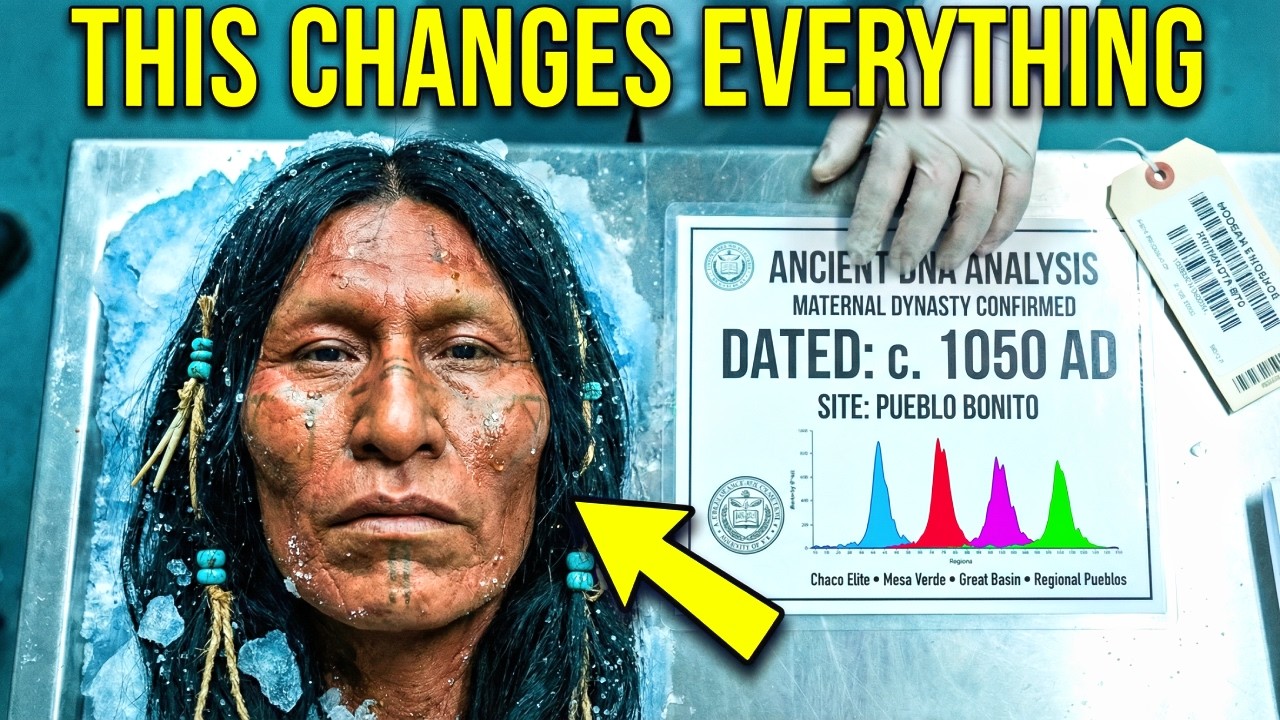
New genetic revelations from an ancient sealed crypt in Chaco Canyon have shattered longstanding beliefs about Southwestern leadership, uncovering a single maternal bloodline that held power for over 300 years within Pueblo Bonito. This breakthrough dramatically reshapes our understanding of hereditary authority, migration, and social hierarchy in early America.
Deep within the labyrinthine ruins of Pueblo Bonito, the largest structure in Chaco Canyon, lay secrets long buried beneath centuries of desert sands. In 1896, explorers uncovered a hidden crypt, Room 33, where fourteen individuals were interred over three centuries with lavish artifacts, signaling unmistakable elite status.
The crypt’s contents stunned archaeologists: over 11,000 turquoise beads, rare shells from distant coasts, silver ornaments, ceremonial flutes, and carved staffs, all meticulously arranged inside sealed chambers accessible only through narrow passageways. This concentration of wealth pointed to a powerful, privileged lineage at the heart of a vast trade and social network.
Fast forward decades, modern science took center stage. In 2017, archaeologist Douglas Kennett led a cutting-edge DNA analysis of nine individuals from Room 33, extracting mitochondrial DNA despite the century-old remains. The results were revolutionary: every individual shared the exact same maternal DNA lineage, preserved unchanged for over 330 years.
This mitochondrial haplogroup B2 lineage indicated that leadership was inherited strictly through the maternal line, resolving decades-long debates about whether Chacoan rulers gained authority by ceremony or by birthright. This was an unprecedented confirmation of a dynastic matrilineal elite within a society previously considered more egalitarian.
Further nuclear DNA analysis revealed direct maternal relationships—mothers, daughters, grandmothers, even grandsons—cementing the idea of a hereditary ruling class deeply rooted in bloodlines. Their burials, elevated in status and guarded with extravagant goods, underscored a tightly held dynastic tradition central to Chacoan society’s power structure.
This discovery ripples beyond archaeology, linking ancient makers of Pueblo Bonito to modern Pueblo peoples. The haplogroup B2 lineage persists today among them, echoing matrilineal traditions preserved in oral histories of the Zuni, Hopi, and Acoma tribes. The ancestral bloodline is living history, not merely archaeological relic.
Geochemical isotope studies offered further insight into migration patterns. Teeth enamel analysis revealed that while most crypt occupants were local, a significant minority originated from distant regions up to 100 kilometers away. These elites were integrated into Chaco’s highest echelons, suggesting a network that extended far beyond the canyon walls.
Excavated artifacts strengthened this picture of a vast exchange network. Cacao residues on pottery and scarlet macaw feathers imported from tropical Mesoamerica, along with shells from the Pacific and Gulf coasts, demonstrated orchestrated long-distance trade controlled by this powerful maternal dynasty.
Connecting these findings, archaeologists mapped over 400 kilometers of engineered roads radiating from Chaco Canyon, facilitating the flow of goods, people, and ideas across the Southwest. These routes united outlying great houses, mining camps, and far-flung communities under a centralized elite governance centered in Pueblo Bonito.
Yet, despite centuries of splendor, this dynasty’s reign ended abruptly around 1130 CE amid a devastating regional drought. Tree ring data reveal a severe environmental downturn, collapsing agricultural productivity and destabilizing social structures. Skeletal remains bear scars of famine and disease, signaling a harsh decline in living conditions.
Remarkably, Room 33’s burials stopped at this environmental tipping point. The genetic line that had maintained power for over three centuries vanished from the archaeological record. Outlying settlements abandoned monumental construction, and the intricate trade networks unraveled as survival became paramount.
This slow decay marked the twilight of Chaco’s monumental era. Leadership based on blood and wealth could not endure the relentless grip of climate change. What followed was a dispersal of peoples and cultures, as new communities arose, reshaping the Southwest’s social landscape away from centralized dynasties.
For indigenous descendants today, the revelations carry profound meaning. Maria Sanchez, a Koma Pueblo elder, sees the findings as a living connection to ancestors whose lineage and traditions persist in contemporary pueblos. The DNA confirmation aligns with oral histories of migration and maternal descent, affirming cultural continuity across millennia.
After lengthy negotiations, the American Museum of Natural History began repatriating the ancestral remains to Pueblo descendants in 2024, respecting both scientific inquiry and the sovereignty of Native communities. This milestone bridges the past and present, honoring the enduring legacy of Chaco Canyon’s original inhabitants.
What unfolded inside the shadowy crypt at Pueblo Bonito is more than a tale of ancient elites; it is a narrative of identity, resilience, and cultural survival. Modern genetics has not just rewritten history—it has reignited living connections between past and present, reshaping how we comprehend power and heritage in America’s Southwest.
As science peels back millennia of silence, the story of Chaco Canyon is emerging strand by strand, inviting us to rethink the origins of leadership, societal organization, and migration in North America. Its lessons press urgently upon us: history is alive, written in our genes, and demanding recognition.