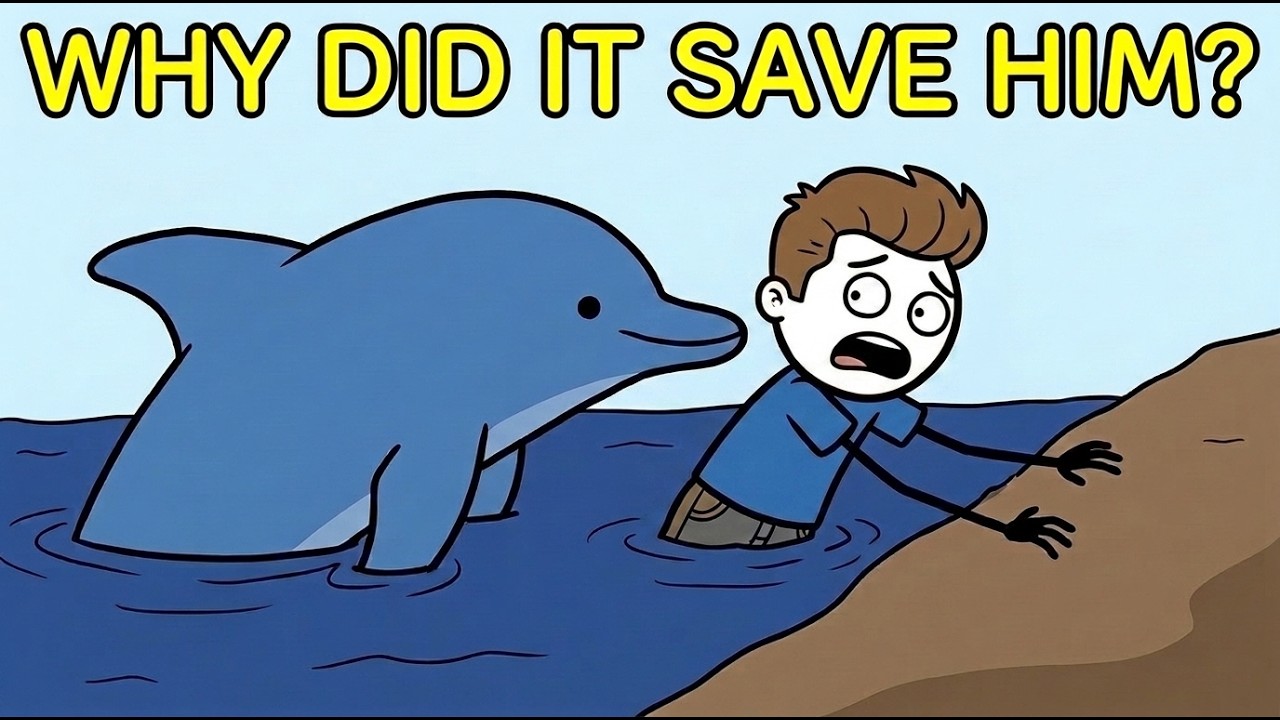
Whenever a story circulates about a wild animal saving a human life, it triggers an immediate emotional response. A dolphin nudging a drowning swimmer to shore, a whale lifting a diver to the surface, or an elephant pulling someone from danger all seem to point to a single, comforting conclusion: the animal recognized the human’s distress and chose to help. Biologists, however, caution that the reality is far more complex. The definition of a true rescue requires behavior directed at an individual in danger, an action suited to removing that danger, a cost or risk accepted by the helper, and no immediate obvious reward.
By that standard, many celebrated cases may not qualify. A buffalo that charges a lion and inadvertently drops a human may be defending its own calf or herd, not performing a rescue. The outcome is salvation, but the motivation may be eviction. Intent is particularly difficult to measure because scientists cannot ask an animal what it was thinking.
They must reconstruct cognition from behavior, looking for signs that the animal detected distress, identified a specific obstacle, chose a targeted action, and adjusted its tactics as the situation changed. This distinction separates genuine helping from a lucky collision. Even insects can pass surprisingly demanding versions of this test. Ants rescue trapped nestmates by digging them out, pulling exposed limbs, and biting through entangling material.
Florida carpenter ants have been observed amputating badly injured legs to improve survival rates. Yet few researchers argue that ants feel sorrow. Their behavior is driven by chemical signals and inherited rules shaped by natural selection, because keeping a worker alive benefits the colony. The ant does not need a philosophy of suffering; it needs the correct smell.
This reveals the first route to rescue: a simple rule can produce a sophisticated result. For social animals, another individual is an investment. Kin selection favors helping relatives who share genes. Reciprocity allows help now to be repaid later.
Mutualism means helping another immediately helps the actor, such as when animals mob a predator to protect the whole group. None of these systems evolved for the benefit of humans, but the machinery can spill across species. Dolphins provide a clear example. Their brains are built to notice when another dolphin cannot swim normally, because cetaceans must surface to breathe.
Mothers support newborn calves, and dolphins have been observed assisting sick or injured companions by swimming beneath them or keeping them afloat. This caregiving is called epimeletic behavior. A struggling human in the water may activate the same response. The dolphin does not need to understand our species fully; it may only recognize a body failing to stay at the surface.
That makes dolphin rescue stories biologically plausible, even though most are isolated observations rather than controlled experiments. The dolphin may have been investigating, playing, herding, or responding to a shark rather than protecting the human. A circle that feels like a shield to a swimmer may be a defensive formation centered on the dolphins themselves. The distinction exposes a common mistake: assuming that if the animal did not consciously think about saving the human, the rescue was somehow fake.
But human rescues also rely on automatic systems. A parent moves before forming a sentence. Intent is not an on-off switch. It has layers.
Rat experiments show why scientists argue about this. Rats have learned to open restrainers holding distressed companions, and they are more likely to help individuals from familiar social groups. Researchers interpret this as empathically motivated helping. Critics point out that the trapped rat’s distress may create an unpleasant state in the free rat, and opening the container stops that state.
The rescuer may be seeking relief from its own agitation rather than representing the victim’s needs. But this criticism does not eliminate empathy; it reveals how empathy may work. In humans, another person’s distress also makes us uncomfortable. Emotional contagion motivates action before sophisticated perspective-taking arrives.
Many mammals share the neural and hormonal systems involved in bonding, fear, care, and stress. Parental care is probably one of the deepest foundations of helping behavior. A helpless young mammal produces calls, movements, and odors that trigger approach, retrieval, and protection. Once a caregiving response exists, it can broaden.
Adults may assist unrelated young, console distressed companions, or even care for offspring of another species. Evolution works with categories rather than legal identification: small, vulnerable, calling, retrieve it. This can create spectacular interspecies behavior, and it can also create an animal attempting to mother an object or prey it would normally eat. Large-brained social mammals add more flexibility.
Elephants respond to distressed companions with vocalizations and physical contact, and they have been observed helping calves over obstacles. Some reports describe elephants aiding humans, though viral examples often involve captive or habituated animals. An animal familiar with humans has years of cross-species learning. A sanctuary elephant responding to a trusted caretaker is not evidence that every wild elephant views humans as herd members.
Wild elephants may flee from us, threaten us, or attack, and they have excellent reasons. Intelligence does not automatically create kindness. It creates options. The same is true of great apes.
Chimpanzees and bonobos can provide tools suited to another individual’s goal, cooperate, console, and sometimes assist strangers. Their helping depends on context and relationship. Apes have been known to protect human children who fell into zoo enclosures, but those animals were captive, and similar encounters have produced aggression or death. One protective event establishes capacity, not a species-wide rescue policy.
Humpback whales make the mystery much larger. Researchers compiled more than 100 interactions between humpbacks and killer whales, finding that humpbacks frequently approached mammal-eating killer whales that were attacking or feeding. In most of those encounters, the prey was not a humpback. It was seals, sea lions, other cetaceans, or even a fish.
Humpback intervention sometimes allowed the prey to escape. In one observation, a humpback placed itself near a seal and lifted the smaller animal away from attacking killer whales. This looks outrageously heroic. The likely mechanism, however, begins with a simpler rule.
Humpbacks may hear the sounds associated with mammal-hunting killer whales and approach before knowing what is being attacked. A response designed to defend humpback calves activates. Once the whale arrives and discovers a seal instead, it continues attacking its ancient enemy. From the whale’s perspective, the target may be the killer whale, not the victim.
The seal receives excellent service anyway. This is a byproduct benefit: a behavior evolved for one reason helps someone else. Yet the humpback case refuses to become completely mechanical. Some whales remain engaged long after the identity of the prey should be obvious.
They spend time and energy, expose themselves to risk, and direct behavior around the endangered animal. Researchers could not rule out interspecific altruism, even if the rescue began through a generalized anti-predator response. The honest answer is not that the whale definitely felt compassion. It is that several explanations can operate at once.
This combination may explain many apparent rescues of humans. First, an animal notices an abnormal pattern: splashing, screaming, immobility, or a predator. Curiosity brings it closer. Second, the human activates a familiar template.
A drowning person resembles a struggling calf. A shark resembles a threat worth mobbing. Third, the animal applies a behavior from its normal life: push upward, stand beside, pull, guard, or circle. Fourth, the human interprets the behavior through narrative.
We never observe behavior without interpretation, and humans strongly prefer agents, intentions, and moral plots. That tendency is called anthropomorphism, attributing human traits to non-human beings. Scientists warn against it because it can turn a curious animal into a paramedic and a defensive charge into a hug. But the opposite error also exists, sometimes called anthropodenial: refusing to recognize shared traits merely because they occur in another species.
If mammals share evolutionary histories and homologous brain systems, insisting that only humans can feel concern is not caution. The goal is to ask what level of explanation the evidence supports. At the lowest level, the animal accidentally helps. Above that, it responds to a cue through a fixed rule.
Then it recognizes distress and performs a learned response. At the richest level, it may share some emotional state and accept a cost to improve another’s welfare. Different rescues belong on different levels, and even within one species, different individuals may act for different reasons. A bold dolphin investigates where a cautious one leaves.
A mother with strong caregiving responses may react differently from a young male. Wild animals are not a collective consciousness. They have biographies. Those biographies sometimes create cross-species relationships.
Humans and dolphins cooperate in traditional fisheries, coordinating the movement and capture of fish. Honeyguide birds lead human honey hunters toward bee nests, and both sides benefit. Wolves and early humans may have approached shared hunting opportunities before domestication produced dogs. In such systems, helping a human is less mysterious.
The human is a known partner within a repeated exchange. But many famous rescue stories involve no established partnership. Why help a complete stranger of another species? Because evolution cannot demand a birth certificate before every response.
A system narrow enough to help only perfectly identified relatives may fail during urgent situations. The cost of occasionally helping the wrong individual can be lower than the cost of ignoring one’s own calf because visibility was poor or panic changed its movement. Natural selection often favors generous error margins. A smoke detector screams at burnt toast because missing one house fire is worse than producing many annoying breakfasts.
Caregiving and defensive systems may work similarly: respond broadly first, sort out the details later. There is also no rule stating that compassion must be produced directly by natural selection for every recipient. Human empathy evolved inside social groups, yet people rescue unfamiliar animals and feel grief for fictional characters. A capacity can escape the narrow conditions that originally favored it.
Perhaps other animals experience smaller versions of the same overflow. This does not mean nature is secretly gentle. Most wild animals do not rescue most humans. They avoid us, exploit us, or kill us.
Even animals involved in celebrated rescues remain powerful and unpredictable. A dolphin that supported one swimmer can injure another. An elephant that comforts a calf can crush a person. Treating rescue stories as proof that wild animals are safe is dangerous.
Rescue is rare partly because encounters are rare. Emergencies are confusing, and helping is costly. An animal that approaches distress may meet a predator or waste energy. Selection should favor help where the expected benefit has historically outweighed the cost.
Humans usually fall outside that calculation, which is why the exceptions feel so powerful. They expose capacities built for one social world reaching into another. The deepest answer, then, is not that wild animals occasionally recognize human goodness and return it. Nature does not run a moral loyalty program.
It is that social life repeatedly creates the need to detect vulnerability, respond to distress, defend others, and solve urgent problems. Those abilities evolved because relatives mattered, partners mattered, and groups mattered. Then a human entered the water. The animal may have seen a stranger, shaped incorrectly and smelling unfamiliar.
But the emergency itself was ancient. A body was sinking. A predator was closing in. Something vulnerable could not escape.
For one brief moment, the border between species mattered less than the pattern of distress crossing it. The animal did not have to become human to help. It only had to recognize a problem older than humanity and decide, for reasons we may never fully recover, not to swim away.