Most people have heard of Voyager 2.
They know it became only the second human-made object to enter interstellar space. They know it has traveled farther than almost any machine ever built and continues sending data home nearly half a century after launch.
But very few people understand what Voyager 2 has actually discovered.
The measurements hidden inside its transmissions tell a story far stranger than the headlines suggest. They reveal that the boundary surrounding our solar system is nothing like scientists once imagined, and that the space between the stars is far more active, structured, and dynamic than decades of theoretical models had predicted.
Voyager 2 is unlike any spacecraft ever built.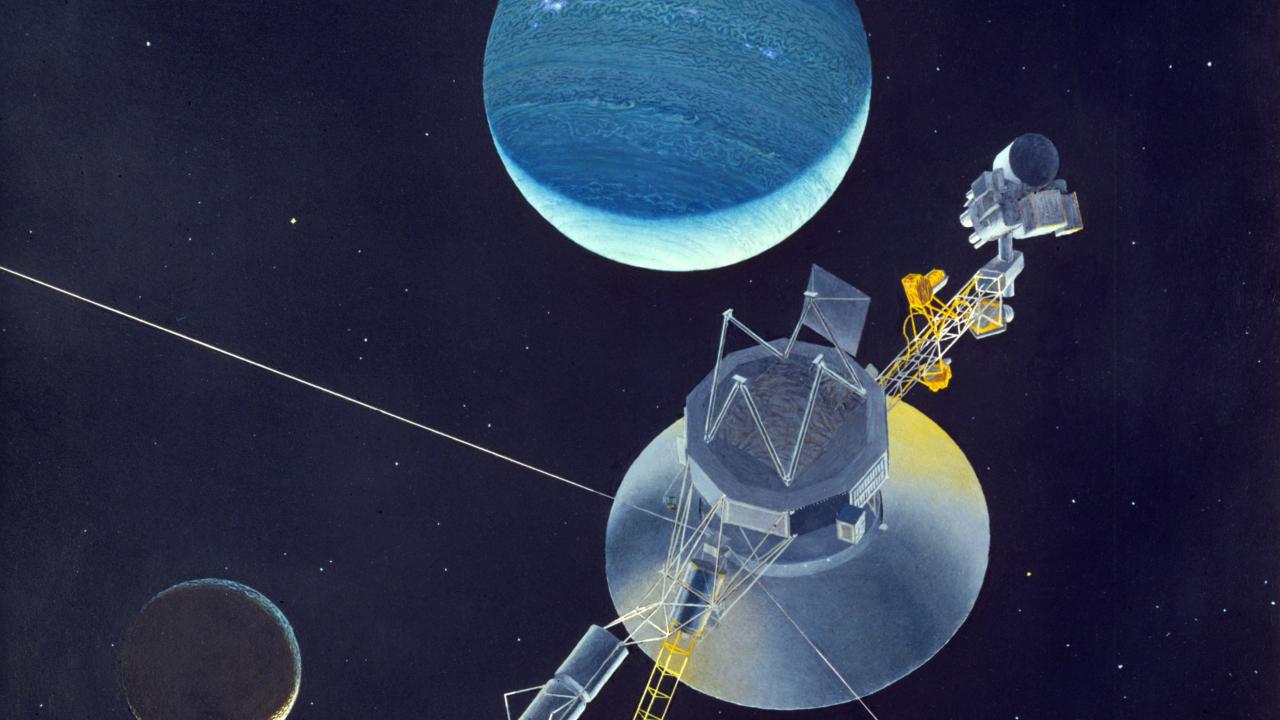
Launched on August 20, 1977, it was originally expected to survive for only a few years. Its mission was simple: fly past Jupiter and Saturn, then, if the spacecraft remained healthy, continue onward to Uranus and Neptune.
Instead, it became the only spacecraft in history to visit all four giant planets.
After completing its historic Grand Tour, Voyager 2 continued outward toward the very edge of the Sun’s influence. Today, it is more than 20 billion kilometers (12 billion miles) from Earth, traveling at roughly 56,000 kilometers per hour (35,000 mph). A radio signal moving at the speed of light now takes more than 18 hours to travel one way between Earth and the spacecraft.
Despite that immense distance, Voyager 2 still whispers information back across the darkness.
Those whispers have transformed our understanding of the solar system.
For decades, astronomers believed the Sun created a giant protective bubble known as the heliosphere. The solar wind—a continuous stream of charged particles flowing outward from the Sun—pushes against the surrounding interstellar medium, forming a vast shield that surrounds every planet, asteroid, comet, and dwarf planet in our solar system.
Scientists expected the outer boundary of that bubble, called the heliopause, to behave like a relatively clean dividing line between the Sun’s domain and interstellar space.
On November 5, 2018, Voyager 2 crossed that boundary.
Unlike Voyager 1, Voyager 2 still carried a fully functioning Plasma Science Instrument, making it the first spacecraft to directly measure the disappearance of the solar wind as it entered interstellar space.
Four independent instruments confirmed the crossing almost simultaneously.
The outward-flowing solar wind suddenly dropped away.
The number of high-energy galactic cosmic rays increased.
The surrounding plasma became denser.
The magnetic environment changed.
Voyager 2 had officially entered the space between the stars.
Yet the greatest surprises came immediately afterward.
Scientists had long imagined interstellar space as an extremely cold, quiet, and nearly empty environment.
Instead, Voyager discovered something far more complicated.
The surrounding plasma measured temperatures exceeding 30,000 degrees Celsius.
At first, that sounds impossible.
How can space beyond the solar system be hotter than molten rock?
The answer lies in density.
Although the plasma is incredibly hot, it contains so few particles that almost no heat can be transferred. Temperature measures the average energy of individual particles, not how much heat they can deliver. A thermometer placed there would not become red-hot because the particles are simply too sparse to transfer significant energy.
Even so, the measurement forced scientists to rethink the nature of the heliopause itself.
Another surprise involved magnetic fields.
Before either Voyager spacecraft crossed the heliopause, many theoretical models predicted that the Sun’s magnetic field would change direction noticeably once it entered interstellar space.
Instead, both Voyager 1 and Voyager 2 measured something unexpected.
The magnetic field on both sides of the boundary remained remarkably well aligned.
Two spacecraft crossing the heliopause years apart—and hundreds of millions of kilometers apart—recorded nearly the same result.
Researchers are still working to fully explain why.
The discovery suggests that the interaction between the Sun’s magnetic field and the surrounding galaxy is far more intricate than earlier models predicted.
Perhaps Voyager 2’s most important discovery is that the heliopause is not a solid wall.
Instead, it behaves more like a permeable membrane.
Particles from the solar wind leak outward.
Particles from interstellar space leak inward.
Rather than separating two completely independent environments, the heliopause forms a constantly shifting transition zone where both regions interact continuously.
That discovery matters because the heliosphere serves as Earth’s first line of defense against galactic cosmic radiation.
It blocks or deflects a significant fraction of the energetic particles produced by distant supernovae and other violent events across the Milky Way. Understanding how this protective bubble behaves is essential for understanding the radiation environment that has influenced the evolution of life on Earth for billions of years.
Voyager 2 has shown that this shield is neither simple nor static.
It expands and contracts with the solar cycle.
Its boundary shifts over time.
It leaks.
And it constantly responds to conditions both inside and outside the solar system.
Voyager 2 also solved one of the strangest mysteries from its planetary encounters.
During its historic flyby of Uranus in January 1986, the spacecraft discovered a magnetic field unlike anything scientists had seen before.
Unlike Earth’s relatively stable magnetic field, Uranus’ magnetic axis is tilted by nearly 60 degrees and displaced far from the planet’s center. As the planet rotates, its magnetosphere twists into an enormous corkscrew shape through space.
Voyager also detected radiation belts far stronger than expected.
For decades, scientists struggled to explain those observations.
Modern computer simulations now suggest Voyager happened to arrive during an unusually active period when changes in the solar wind dramatically compressed Uranus’ magnetosphere, temporarily intensifying its radiation environment.
What once appeared to be an inexplicable anomaly has become an important clue to understanding how planetary magnetic fields respond to changing conditions throughout the solar system.
Perhaps Voyager 2’s greatest achievement is not any single measurement.
It is the lesson repeated throughout its entire mission.
Again and again, nature has proven more complex than our theories.
The edge of the solar system is not a sharp border.
Interstellar space is not empty.
Magnetic fields behave in unexpected ways.
Even worlds visited decades ago continue revealing new secrets as scientists reinterpret Voyager’s observations with modern models.
Voyager 2 has become far more than a planetary explorer.
It is humanity’s first long-term witness to the frontier between our solar system and the galaxy beyond.
One day, its radioisotope power source will no longer generate enough electricity to operate its instruments. The spacecraft will fall silent, ending one of the longest scientific missions in history.
But long after its final transmission reaches Earth, Voyager 2 will continue drifting through interstellar space for millions of years, carrying with it humanity’s first direct measurements of the vast ocean that exists between the stars.