Voyager 1 was never supposed to survive this long.
Launched in 1977, it was built for a short mission: fly past Jupiter, study Saturn, send its data home, and eventually fade into silence. Instead, nearly half a century later, it is still alive, still moving, and still sending messages from a place no human-made object had ever reached before.
Far beyond the planets, beyond the warmth of the Sun, Voyager 1 crossed the heliopause—the boundary where the solar wind weakens and interstellar space begins. Scientists expected that region to be strange, but they also expected it to follow their models. What Voyager found was far more complicated.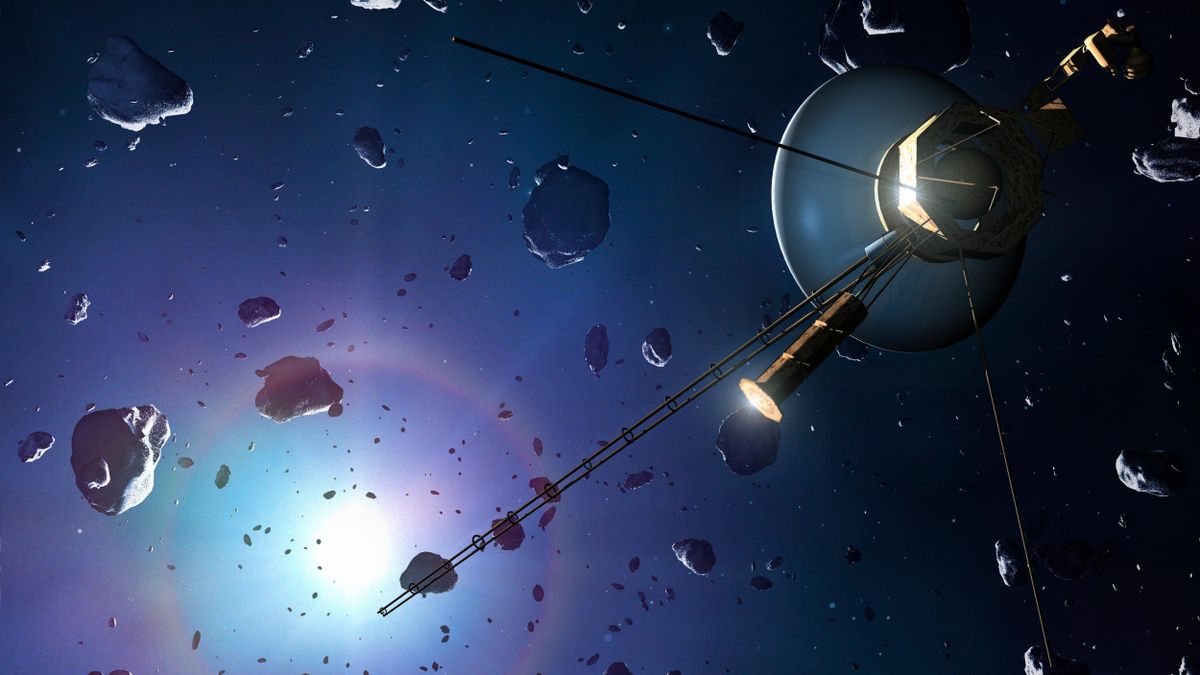
The edge of the Solar System was not calm. It was not a clean border. It was a turbulent frontier filled with plasma waves, magnetic shifts, cosmic radiation, and pressure changes that seemed to pulse like an invisible ocean. Instead of entering empty space, Voyager entered a region that was active, dense, and unexpectedly structured.
Then came the discovery that changed everything.
Voyager began detecting rhythmic plasma signals—patterns that were not random static, but natural vibrations moving through the interstellar medium. These were not alien messages, but they were still extraordinary. For the first time, humanity was “hearing” the space between the stars.
Voyager does not carry a microphone. Space cannot transmit sound the way air does on Earth. What it detects are plasma waves—oscillations in charged particles drifting through interstellar space. Scientists can convert those waves into audio, allowing us to hear the faint hum of the galaxy itself.
That hum revealed something astonishing: interstellar space is not silent.
It vibrates.
It carries waves from solar storms that left the Sun years earlier. It contains denser plasma than scientists expected. It shows signs of compression near the boundary where the Sun’s influence collides with the wider galaxy. The Solar System, it turns out, does not end like a clean line on a map. It fades into a restless, shifting frontier.
Voyager 1’s remaining instruments are now measuring that frontier in real time. Its cameras are long dead, its power is fading, and every signal takes more than 20 hours to reach Earth. Yet the spacecraft continues to give scientists data from a place we cannot visit, a place where the Sun becomes only a distant star and the galaxy begins to reveal its true environment.
The discovery may not be “impossible” in the supernatural sense, but it is impossible in the way great science often feels impossible at first. It shows us that our old picture of the Solar System’s edge was incomplete. The boundary is stranger, louder, and more alive with motion than anyone predicted.
Voyager 1 has not found aliens.
It has found something quieter and perhaps even more profound: proof that the space beyond our Sun is not empty darkness, but a living physical environment filled with waves, pressure, particles, and the faint background music of interstellar space.
One day, Voyager 1 will stop speaking. Its power will fade, its instruments will fall silent, and Earth will listen without receiving an answer.
But until that day, this ancient machine keeps moving through the dark, carrying humanity’s curiosity beyond the edge of the Solar System—and listening to sounds no human had ever heard before.