Something entered our solar system from the darkness between the stars, and from the moment astronomers calculated its path, they knew it did not belong here. It was not a typical comet born in the frozen outskirts of our own Sun’s domain. It was not an asteroid knocked loose by Jupiter or Neptune. It was an interstellar visitor, moving too fast to be captured, too strange to be ignored, and too rare for science to waste even a second.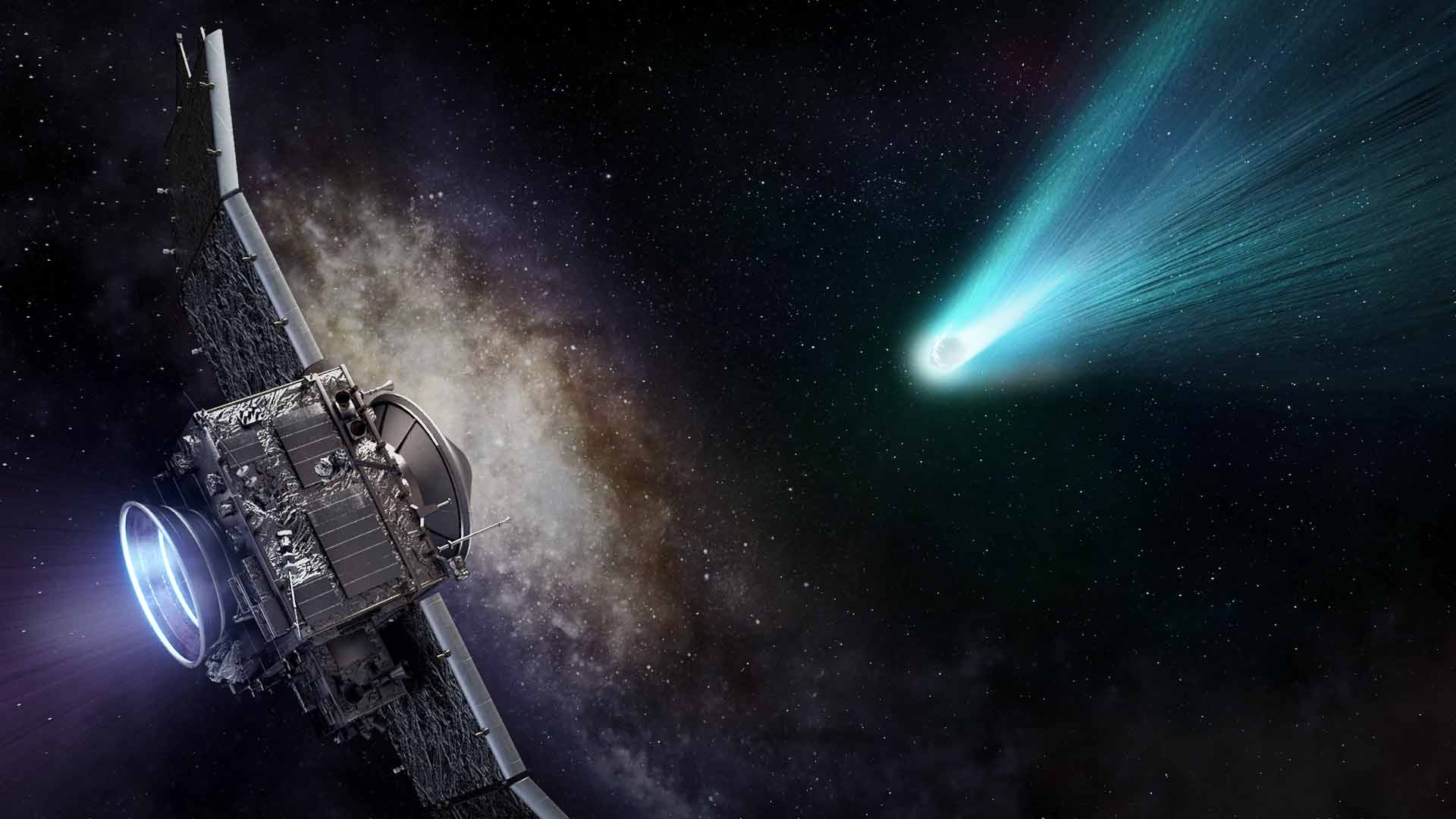
Its name is 3I/ATLAS, the third confirmed interstellar object ever detected by humanity.
When astronomers first spotted it, the object appeared comet-like, surrounded by a faint coma of gas and dust. But its orbit told a much bigger story. 3I/ATLAS was traveling on a hyperbolic path, meaning it was not bound to the Sun. It had entered our solar system from elsewhere and would leave again forever. Its speed, trajectory, and chemical behavior immediately separated it from ordinary solar system objects.
Then came the detail that sent scientists into overdrive: its path would bring it unusually close to Mars.
In everyday terms, the distance still sounded enormous—millions of kilometers. But in astronomical terms, it was close enough to matter. Close enough for spacecraft around Mars to observe it. Close enough for scientists to treat the encounter as a once-in-history opportunity. For the first time, humanity could study an interstellar object not only from Earth, but from machines already orbiting another planet.
That alone made 3I/ATLAS extraordinary.
But the real shock came when the world’s most powerful telescopes turned toward it. James Webb, Hubble, ALMA, Subaru, Gemini, and other observatories began tracking the object before it vanished back into deep space. Webb’s infrared instruments searched its coma for chemical fingerprints, breaking its light apart to reveal what the object was made of.
The results were stunning.
Webb detected volatile compounds such as methane, suggesting that 3I/ATLAS formed in an extremely cold environment, possibly far colder than the region where most comets in our own solar system were born. ALMA added another clue by studying water vapor released from the comet. The ratio of heavy hydrogen to ordinary hydrogen appeared unusually high, pointing toward an origin in a distant planetary system with chemical conditions unlike our own.
In other words, 3I/ATLAS was not just passing through space.
It was carrying the frozen memory of another star.
As the Sun warmed the object, its outer layers began to break down. Gas and dust streamed outward, creating a vast coma around a much smaller nucleus. Scientists realized they were watching an alien object peel itself open, layer by layer, revealing material that may have been preserved for billions of years during its journey through interstellar darkness.
The idea that James Webb “confirmed a collision course with Mars” makes the story sound apocalyptic, but the deeper truth is more scientifically powerful. 3I/ATLAS was not simply a threat. It was a messenger. Its close approach to Mars gave researchers a rare chance to study an interstellar object from multiple angles, using instruments spread across the solar system.
That is what makes this discovery so important.
Objects like 3I/ATLAS are pieces of other planetary systems. They are cosmic fossils, ejected from distant stars and sent drifting through the galaxy until, by impossible chance, they cross our path. Every measurement tells us something about how planets, comets, and star systems form beyond our own neighborhood.
For billions of years, 3I/ATLAS wandered through the cold between stars.
Then, for one brief moment, it entered our sky.
And before it disappeared forever, James Webb and humanity’s greatest observatories caught its light, read its chemistry, and proved that our solar system is not isolated. It is part of a much larger cosmic traffic system, where fragments of distant worlds occasionally pass close enough for us to notice.
3I/ATLAS may not mark the end of Mars.
But it may mark the beginning of a new era—one where interstellar visitors are no longer myths, but measurable evidence that other worlds are constantly sending pieces of themselves into the dark.


