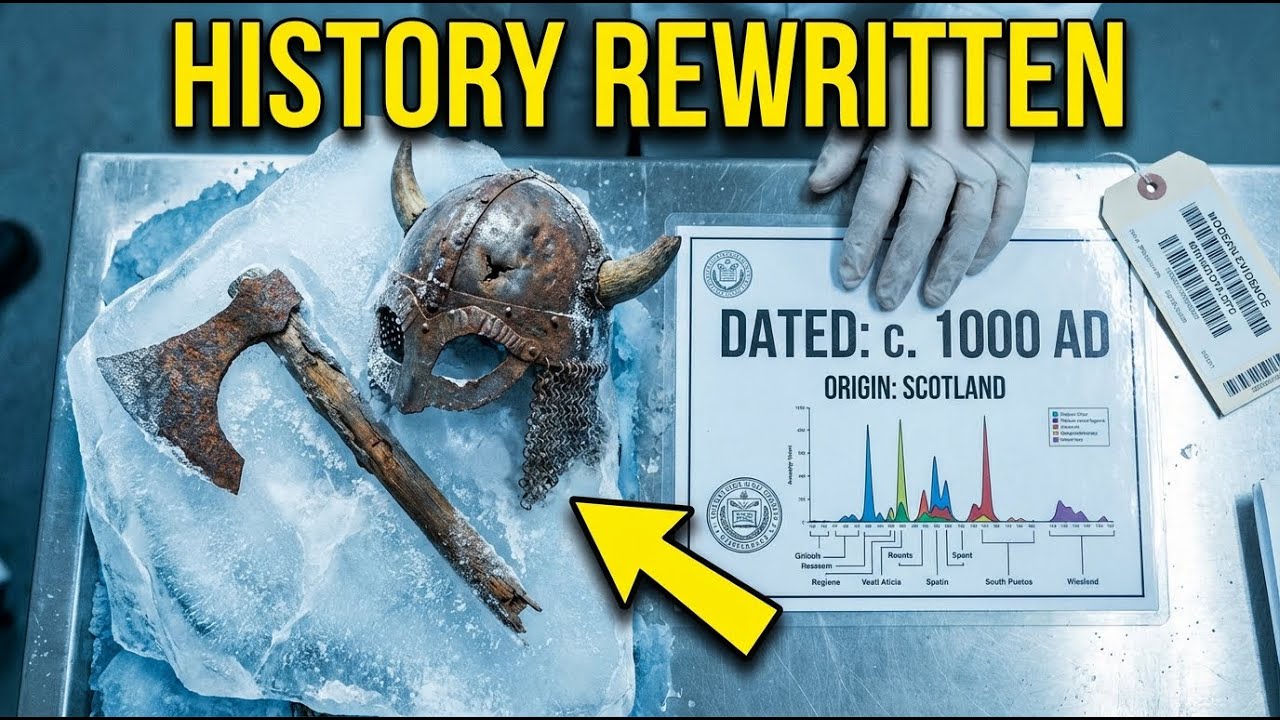
Ancient DNA has shattered the centuries-old Viking narrative, revealing a hidden Atlantic route predating the famed year 1000 landings in Newfoundland. New genetic evidence points to Scottish Viking settlements as the true pioneers of transatlantic exploration, forcing historians to reconsider the origins and scope of Viking voyages across the Atlantic Ocean.
For decades, the accepted story placed Leif Ericson’s expedition around 1000 CE as the starting point of Viking contact with North America. This neat tale emphasized a brief presence, centered on the isolated site of L’Anse aux Meadows. Now, cutting-edge ancient DNA research is overturning this timeline, suggesting far earlier and more complex voyages launched from forgotten northern settlements.
The Vikings were not mere raiders but skilled navigators shaped by necessity. Their survival depended on a relentless search for timber, vital for repairing their massive longships. As forestry dwindled in Greenland and Norway, these communities expanded their maritime reach, pushing westward in search of crucial resources, sparking a wave of Atlantic crossings previously obscured by history.
Maritime archaeologist Professor Bjorn Ericson highlights the critical role of logistics in Viking voyages. Longships, sometimes weighing over 30 tons, demanded vast amounts of timber—up to 30 cubic meters per vessel. The high stakes of resource scarcity governed their routes, with each journey planned around the expectation of finding iron, food, and wood, the lifeblood of any expedition.
Historical sagas mention Markland, a wooded coast west of Greenland, but often underestimate the scale and frequency of these voyages. Archaeological evidence such as the dated wood at L’Anse aux Meadows shows activity between 991 and 1021 CE, but this site may only be a fragment of a much larger Viking transatlantic network fueled by timber scarcity and survival imperatives.
The crucial clue emerges in the Orkney Islands, a strategic outpost lying between Scotland and the open Atlantic. Archaeological finds prove that Norse settlers arrived here by 800 CE, merging with indigenous pictish communities to create hybrid societies. Norse tools, Celtic jewelry, and mixed burial practices reveal a vibrant cultural fusion that flourished for generations.
By the mid-9th century, evidence of agriculture such as cereal pollen indicates these settlers began growing barley and oats, signaling a permanent, thriving Nordic-Scot community rather than transient raiders. This shift from conquest to settlement laid the groundwork for extensive trade networks reaching far beyond the North Sea, including seafood exports that connected Orkney to continental Europe.
Orkney and Shetland became vital hubs for shipbuilding, repair, and resupply. These islands epitomized Viking adaptation and resilience, supporting voyages that spanned the Atlantic. The blending of Norse and local customs forged a unique identity, blending languages, traditions, and technologies, establishing a powerful springboard for exploration westward—far earlier than previously believed.
Modern genetic analysis offers a groundbreaking window into this forgotten past. Dr. Elizabeth Mloud’s painstaking extraction of ancient DNA from petrus bones—densely packed with preserved genetic material—allows researchers to decode Viking ancestry with unprecedented precision. Each fragment of DNA carries stories of migration, interaction, and survival buried for centuries beneath Atlantic winds.
These molecular investigations, led by geneticist Dr. Aisha Hassan, compare Norse DNA from Orkney and northern Scotland to samples found in Newfoundland. Surprisingly, while Orkney graves reveal Norse-Scottish markers, the Newfoundland genetics align more closely with Scandinavian lineages from Norway and Iceland, hinting at multiple, diverse transatlantic voyages rather than a single origin point.
Further evidence emerges from charred barley grains dated around 950 CE found in a Newfoundland lake core, predating the accepted Viking arrival. Despite DNA degradation due to soil acidity, these agricultural remains hint at human activity before the year 1000, intensifying questions about the timeline and breadth of Viking exploration and settlement in North America.
Archaeologists also uncovered a ship repair area along Newfoundland’s coast, featuring timber offcuts, iron slag, and a forge exceeding 1,200°C, dated between 940 and 970 CE. Although erosion has obscured some details, this industrial site underscores a significant, sustained Norse presence aligned with the genetic and botanical clues emerging from the region.
Each discovery—DNA fragments, ancient barley, and industrial artifacts—layers new complexity onto Viking Atlantic history. None alone confirm a complete narrative, but together, they reveal a hidden network of voyages, communities, and survival strategies long absent from textbooks, demanding a radical revision of what historians once firmly believed.
As Dr. Hassan reflects, the silent witness of ancient DNA and material culture holds answers to who crossed the Atlantic and when. With every recovered fragment, the borders of history expand, promising to unveil untold chapters in Viking transatlantic adventures that predate the legendary sagas by centuries.
These revelations challenge the established view that transatlantic exploration originated solely from Greenland or Norway. Instead, the Orkney Islands and northern Scotland emerge as critical launch points, integrally connected to early, sophisticated maritime networks that fostered repeated, resource-driven voyages across the ocean.
The blending of Norse and native cultures in the North Atlantic transformed isolated Viking outposts into thriving hubs of agricultural, industrial, and maritime innovation. Their descendants carried a legacy coded in their genes, linguistics, and material remains, whispering a continuous story of interaction and adaptation across vast distances and generations.
Historical narratives will never be the same. This ancient DNA breakthrough exposes a Viking Atlantic history richer, more diverse, and far older than textbooks suggest. It urges the scientific community to continue probing beneath layers of soil and stone, unraveling mysteries that redefine human exploration and cultural interplay on a global scale.
Future research will no doubt uncover further links, as advancing technologies refine our ability to read the past’s molecular language. With each discovery, the shadowy outlines of Viking Atlantic crossings come into sharper focus, promising a thrilling rewrite of early exploration that acknowledges forgotten actors and routes forgotten for centuries.
This moment marks a turning point—a scientific revolution that blends archaeology, genetics, and history to illuminate the complex realities behind legendary voyages. Ancient DNA has finally lifted the veil on the Vikings’ biggest secret, unveiling a hidden Atlantic route that reshapes our understanding of the world’s earliest transoceanic adventures.