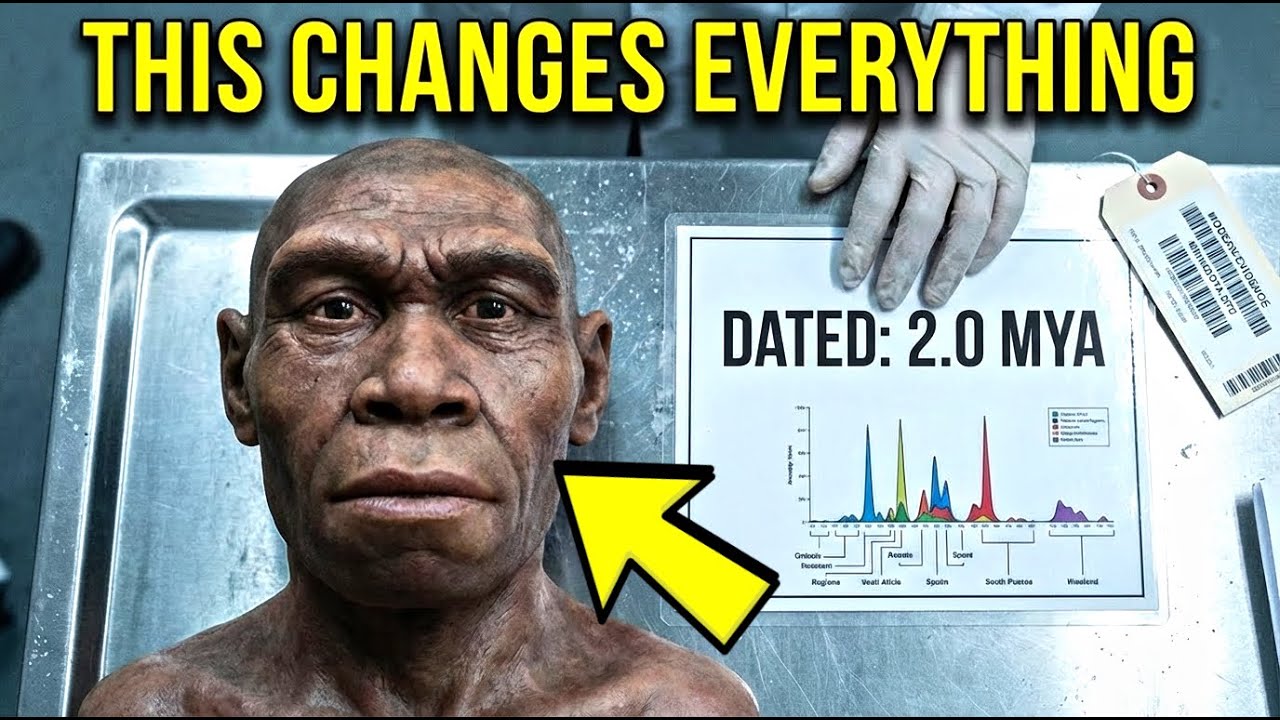
New groundbreaking facial reconstruction of Homo erectus fossils reveals a face strikingly more modern than ever imagined, challenging the long-held timeline of human evolution and suggesting our species’ origins stretch far deeper in time. This discovery demands urgent reevaluation of human ancestry and evolutionary models worldwide.
For decades, Homo erectus was thought to fit neatly into human history, appearing around two million years ago as a clear evolutionary step from primitive ancestors to modern humans. This model depended heavily on partial fossils, traditional reconstruction methods, and established dating techniques that painted a linear progression of facial features and brain development.
Textbooks depicted Homo erectus with a heavy brow, pronounced jaw, and an ape-like visage—a reflection of fragmentary fossil evidence and the slow evolutionary change assumed to characterize human origins. The discovery of the DN5 specimen disrupts this narrative with a face that is less primitive, more complex, and far more human than any previous reconstruction.
Using cutting-edge microCT scanning technology, paleoanthropologist Karen Bab and her team have digitally reassembled fragmented skull pieces with unprecedented precision, revealing subtle facial features previously hidden beneath distortion and damage. This meticulous work allows for virtual manipulation and error correction impossible in traditional fossil reconstruction.
The DN5 digital model stunned researchers by showcasing a flatter nasal bridge, forward-swept cheekbones, and a narrower nose, a striking departure from the classic Homo erectus image. This mosaic of primitive and modern traits suggests a patchwork evolution, not a smooth, linear transition as once believed.
Further significance emerges with the discovery of stone tools and flakes in the same sedimentary layer as DN5. These artifacts hint at advanced behavior and technological skill existing alongside a facial anatomy considered archaic, blurring essential links between physiology and cognitive capabilities in early human ancestors.
Comparisons with fossils from Georgia, dating back 1.8 million years, reveal an unexpected overlap in facial and cranial traits, implying that Homo erectus populations with these complex features spread out of Africa far earlier than textbooks assert—perhaps as early as 1.9 million years ago.
The ramifications of this breakthrough are enormous. It threatens to upend decades of paleoanthropological consensus that portrayed human evolution as a stepwise, gradual process. Instead, we are presented with a tangled web of overlapping traits, rapid migration, and mosaic evolution challenging the neat progression charts of yesteryear.
However, the discovery has also sparked intense debate within the scientific community. Some anthropologists embrace the need for radical revision, arguing that DN5 exemplifies the intricate, non-linear nature of evolution. Others urge caution, reminding peers that one fossil, no matter how extraordinary, cannot singlehandedly rewrite the entire evolutionary history.
This discovery propels urgent calls for new excavation efforts and fossil discoveries across Africa and Eurasia. Researchers now seek additional remains that could confirm or challenge DN5’s revelations, understanding that each newfound face has the power to redraw humanity’s family tree in dramatic fashion.
As technological advances allow scientists to reinterpret existing fossils and uncover new details, the story of human origins grows richer and more complex. The DN5 specimen offers a tantalizing glimpse beneath the surface—a hint that many evolutionary secrets remain hidden, waiting to shatter established timelines and transform our understanding of ancient humanity.
In this unfolding 𝒹𝓇𝒶𝓂𝒶 of discovery, the urgency is clear: the human story is far from complete. Each new revelation like DN5 forces us to reconsider our ancestors’ journey, their adaptations, and the timeline that situates us all within the vast tapestry of life on Earth.
This face uncovered from the depths of time is not merely a fossil; it’s a call to action for science to embrace complexity and uncertainty in the quest to trace our origins. The next find could overturn everything we think we know about who we are—and how we came to be.
Humanity’s evolutionary history was never simple. With DN5, it finally shows its true, intricate face—one that chronicles a past woven with unexpected encounters, rapid change, and the enduring mystery of what it really means to be human. The race is on to map this new frontier.
This landmark discovery stands as a testament to the power of modern technology to rewrite ancient history and expand our grasp of life’s earliest footsteps. It demands immediate attention from scientists and scholars dedicated to uncovering the truths buried within our deepest antiquity.
The layers of sediment hold stories not just of survival, but of innovation and adaptation, as early Homo erectus fashioned tools and faces that defy previous assumptions, complicating the narrative of human evolution and prompting a profound reassessment of our deepest past.
With each slice from the microCT scanner, scientists peel back over a million years of evolutionary history, revealing that the familiar faces painted by decades of study were incomplete illusions—masks that hid a more nuanced and astonishing reality beneath.
As the debate intensifies, the global scientific community watches closely. Will further discoveries validate DN5’s radical implications? Or will new evidence temper the desire for sweeping paradigm shifts? Either way, a new chapter in human origins has begun, written in the fragments of an ancient, hidden face.
This revelation underscores the critical importance of innovative technologies combined with relentless scientific inquiry. As more fossils undergo digital resurrection, the story of Homo erectus and, by extension, humanity itself becomes more vivid, complex, and unforgettable.
Today, the face of an ancient ancestor demands we rethink the very foundations of human evolution. The future of paleoanthropology rests on confrontations with these bold new findings, and the urgent quest for answers that could redefine our place in the natural world forever.