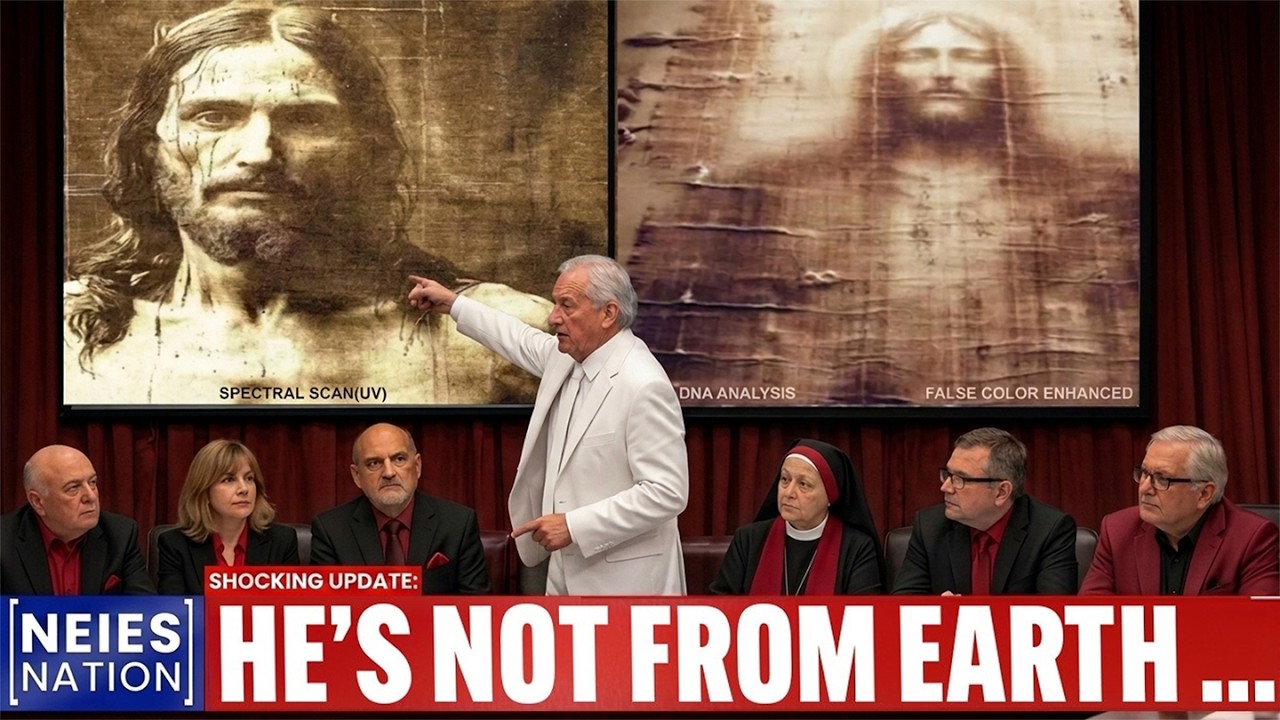
After 46 years of relentless scientific scrutiny, Barrie Schwartz, a Jewish photographer once skeptical of the Shroud of Turin’s authenticity, encountered a single molecule—bilirubin—that shattered his doubts, igniting renewed global debate over this enigmatic relic believed to bear Jesus Christ’s imprint. New research challenges long-held assumptions and leaves the shroud’s mysteries unresolved.
In 1978, Barrie Schwartz entered Turin’s cathedral with a mission born from skepticism: to expose the famed Shroud of Turin as a medieval forgery. Raised in a strict Orthodox Jewish home detached from Christian beliefs, Schwartz came armed with scientific rigor and a neutral eye, determined to uncover truth through photography.
The Shroud, a 14-foot linen cloth said to have wrapped Jesus after crucifixion, has fascinated believers and skeptics alike. When Schwartz joined a team of 33 scientists, he anticipated discovering brush strokes or pigments betraying a hoax. Instead, the cloth confounded logic: the image was not painted, but neither was its authenticity immediately accepted.
A puzzling anomaly haunted Schwartz for years—the blood stains maintained a vivid red color, defying forensic expectations that aged blood should darken to brown or black. This fiery red blood clung stubbornly to the cloth’s fibers, sowing seeds of doubt even among top forensic experts within the research team.
Seventeen years after his initial investigation, a phone call from a dying Israeli blood chemist revealed the presence of bilirubin in the blood—an indicator of extreme physical trauma and severe muscle breakdown. This finding forced Schwartz to confront the evidence head-on, acknowledging the blood’s authenticity without embracing faith.
The shroud’s story began long before Schwartz. In 1898, amateur photographer Secondo Pia captured its first photograph, uncovering a startling phenomenon: the image appeared as a photographic negative, remarkably clear and anatomically accurate, defying medieval artistic capabilities and suggesting a mystery beyond known techniques.
Pia’s discovery revealed a face with closed eyes, bruising, and a calm agony that seemed impossible to fabricate centuries before photography existed. The image’s negative nature only deepened intrigue: reversing the negative produced a startlingly realistic positive portrait, an impossibility for medieval art lacking modern technology.
In 1976, US Air Force physicists John Jackson and Eric Jumper pushed the enigma further by analyzing the image with a VP-8 image analyzer. Unlike typical flat images distorted in 3D processing, the shroud produced a coherent, proportionate three-dimensional body, encoding spatial data impossible to achieve by hand.
Peter Schumacher, the VP-8’s engineer, had never seen such an accurate 3D rendering from a flat image. The cloth appeared to carry physical depth data in its image intensity—a phenomenon defying all known artistic or scientific explanation, leaving researchers grappling with unexplained technologies centuries ahead of their time.
Blood analysis intensified the mystery. The Shroud of Turin Research Project’s 33 scientists employed advanced techniques: X-ray fluorescence, spectroscopy, and microchemical testing, uncovering real human blood markers—hemoglobin, albumin, hemiporphyrin derivatives—and serum halos, never known or replicable by medieval artists.
Crucially, the blood stains preceded the image formation; no body image appeared beneath the blood. This reversed the obvious artistic sequence—blood first, image second—disproving painting or printing theories, since all known art forms layered blood atop images, making forgery theories increasingly untenable under scientific scrutiny.
Further atomic-level analysis in 2017 by the University of Padua revealed unexpected creatine nanoparticles linked to rhabdomyolysis, a condition caused by extreme muscle trauma. This aligned with Roman scourging evidence visible on the shroud, which bears more than 100 whip marks, consistent with ancient flagrum instruments.
However, the 2017 study was retracted in 2018 due to procedural concerns—not evidence falsification—leaving some findings contested but intriguing. Meanwhile, anatomical details, like nail wounds through wrists rather than palms and folded thumbs revealing median nerve damage, further tested medieval artists’ knowledge limits centuries ahead.
Historical crucifixion depictions wrongly show nails through palms; the shroud indicates precise wrist placement, confirming 20th-century forensic experiments by surgeon Pierre Barbet. The thumbs’ absence visible on the shroud matches his studies, exposing an accurate anatomical detail medieval forgers could not have known.
The blood’s rare type AB further puzzles experts, known from the Shroud of Turin and a second relic, the Sudarium of Oviedo in Spain. Matching blood types and wound patterns across two independently preserved cloths undermine claims of forgery and suggest a shared origin, challenging conventional timelines and historical assumptions.
The Sudarium’s documented history dates back to 614 CE, witnessed by King Alfonso VI and Rodrigo Díaz de Vivar, lending authenticity through consistent historical records and challenging forgery narratives that rely solely on medieval fabrication theories for the Turin shroud.
Genetic analysis in 2015 complicated the shroud’s story further. A team led by geneticist Gianni Barcaccia examined dust particles embedded in the linen and found mitochondrial DNA from diverse populations—Druze of the Levant, Europeans, Africans, and Asians—reflecting centuries of travel and contact rather than medieval local origin.
This extraordinary confluence of genetic markers hints at the cloth’s journey across continents, possibly tracing ancient trade routes like the Silk Road, passing through Jerusalem, Edessa, Constantinople, and ultimately Turin, weaving a complex biological and historical tapestry impossible to fabricate in medieval Europe.
Supporting this migration theory is pollen research identifying 58 plant species, especially the thorny Gundelia tournefortii native to Jerusalem’s spring season. Concentrated pollen on the shroud’s head area symbolizes an unseen crown of thorns, a botanical signature reinforcing its Middle Eastern origins and deepening the relic’s enigma.
Despite the mounting evidence supporting early origins, the 1988 radiocarbon dating of the shroud shocked the world, dating the cloth between 1260 and 1390 CE. Laboratories at Arizona, Oxford, and Zurich concluded a medieval origin with high confidence, fueling international headlines that declared the mystery solved—claims now rigorously questioned.
Discrepancies in testing methods have clouds around the 1988 results. Only one small, heavily handled corner was sampled, a patch differing chemically—cotton and dye suggested later repairs. This revelation, coupled with funding controversies and limited lab participation, casts doubt over the supposed definitive medieval dating.
Raymond Rogers, a Los Alamos scientist, overturned repair skepticism by showing the carbon-dated sample lacked original linen chemistry, implying the tested fragment was a medieval patch, not the whole relic. Coupled with inconsistent raw data from subsequent experiments, the medieval dating claim faces growing scrutiny.
Alternative dating techniques by Liberato De Caro suggest an older origin, possibly first-century textiles matching those from Masada, echoing historical narratives rather than medieval forgery—even as the image’s mysterious formation resists explanation by any known chemical or artistic method, surviving fires and centuries intact.
For decades, no modern technology or artistic process has replicated the Shroud’s image, which is a microscopic chemical change on fiber surfaces, not paint or dye. It encodes three-dimensional data and reflects an event untouched by contemporary science, sustaining the shroud’s enduring status as an unsolved scientific and religious enigma.
For Barrie Schwartz, the journey from skeptic to evidence-driven advocate culminated in understanding the blood’s bilirubin content—a marker of profound human suffering and biological authenticity. Though he never embraced religious belief, Schwartz’s 46-year investigation transformed the shroud debate, demanding continued investigation.
Today, the Shroud of Turin remains a profound mystery resting in a chapel in Italy—not disproven nor authenticated, but unexplained. Its layers of science, history, and faith continue to captivate and divide scholars, provoking urgent questions about origins, authenticity, and the limits of human understanding.