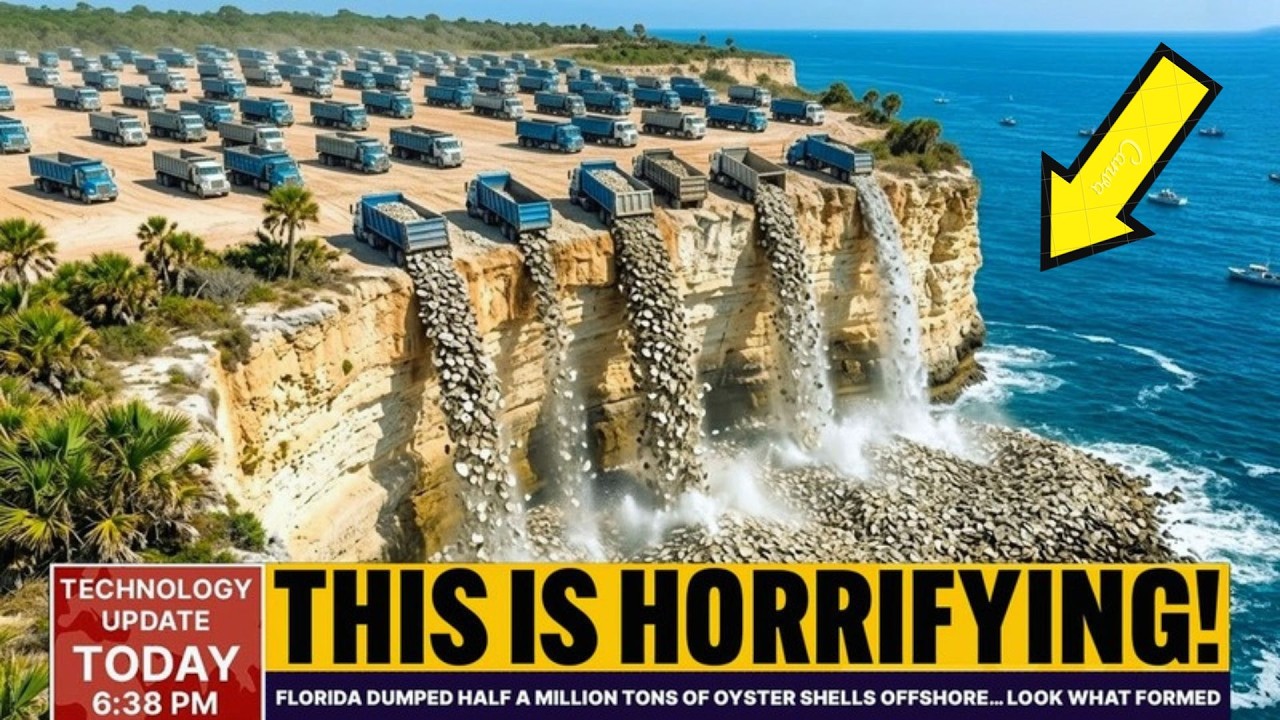
Florida’s bold marine intervention dumped over 500,000 tons of oyster shells offshore, triggering an astonishing ecological revival that stunned scientists worldwide. What was once a barren seafloor off Cedar Key transformed rapidly, defying all expectations and reshaping assumptions about ocean recovery, coastal resilience, and environmental restoration.
For decades, the Gulf seafloor near Cedar Key was a lifeless expanse—flat, featureless sand offering no refuge for marine life. Known as “dead ground” by fishermen and scientists alike, this degraded habitat seemed beyond recovery. Nature’s vital oyster reefs had vanished, destroyed by overharvesting, pollution, and coastal development.
Between 2007 and 2024, Florida’s Fish and Wildlife Conservation Commission launched what many called a reckless experiment: collecting discarded oyster shells from restaurants and seafood industries across the state, then dumping them into the Gulf without engineered precision. The backlash was fierce, with environmentalists and fishermen warning that this “industrial ocean dumping” would devastate fragile ecosystems and disrupt livelihoods.
Yet the biological response confounded all predictions. Within months, not years, life surged on those shell mounds at an unprecedented rate. Bacterial biofilms formed intricate microhabitats, chemically altering the surrounding water to foster rapid colonization by barnacles, algae, juvenile oysters, and countless other species. This cascade of ecological succession was faster and more complex than any scientific model had anticipated.
Oyster larvae, previously adrift in search of hard substrate, finally found refuge on the shell deposits. Juvenile oysters settled in extraordinary numbers, growing to reproductive maturity in just two years. These new generations fed back into the system, building reef structure naturally from their own discarded shells, creating self-sustaining, self-expanding biological architecture without further human input.
The transformation did not stop at oysters. The restored reefs created habitat complexity that attracted fish and invertebrates in staggering diversity and abundance. Juvenile fish prospered, completing life cycles previously impossible in this degraded environment. Commercially and recreationally vital species thrived, triggering a biomass surge over 340% and a species diversity increase of nearly 280% compared to surrounding barren sands.
Economic impact followed swiftly. Skeptical charter fishermen reversed stance, requesting reef expansions near prime fishing grounds. Local tourism and marine-related businesses reported measurable revenue growth linked to the revitalized marine ecosystem. The reefs restored not just nature but whole coastal economies, all without subsidies or ongoing human management.
Beyond ecosystem productivity, the reefs delivered powerful water filtration at scale. Hundreds of thousands of oysters now filter billions of gallons daily, removing toxins, excess nutrients, and harmful bacteria. This natural purification improved water clarity, reduced harmful algal blooms, and boosted oxygen levels, radiating benefits well beyond the reef footprint.
Clearer water allowed seagrass beds—critical nursery habitats for myriad species—to recolonize lost areas. This secondary restoration further stabilized sediments and enhanced water quality, sparking a self-reinforcing cycle of ecological renewal far surpassing initial project goals. Hardwood oyster reefs had morphed into catalytic hubs of coastal ecosystem rebirth.
The program’s resilience was tested brutally by Hurricane Irma in 2017. The Category 4 storm delivered catastrophic surge and waves yet reefs significantly reduced shoreline erosion by 30 to 40 percent in impacted areas. Unlike conventional seawalls, these oyster reefs absorbed and dissipated wave energy through complex structures, preventing millions in property damage and emerging stronger post-storm.
Remarkably, storm impacts stimulated new oyster larval settlement, increasing reef structural complexity and biological density. Each storm left the reef system better fortified, reversing the usual degradation cycle seen in engineered coastal defenses. This dynamic, self-healing barrier reshapes how coastal protection and climate adaptation strategies could integrate living infrastructure worldwide.
After 15 years, the original shell piles have expanded naturally, doubling in size and complexity. Reef architecture now features diverse microhabitats supporting crabs, octopuses, sea turtles, and dolphins, rivals natural limestone reef biodiversity, and approaches ecological equivalence with ancient systems once thought lost forever.
The Cedar Key success ignited global interest, inspiring oyster restoration initiatives across the U.S. Gulf states and as far as New York Harbor, Canada, Australia, and Europe. Scientists and coastal managers embrace the concept of “circular environmental design,” turning waste shells into vital ecological infrastructure to restore degraded shorelines efficiently and affordably.
This unprecedented longitudinal data set documents ecosystem rebirth from discarded restaurant waste to thriving, architecturally complex reef systems. The Florida shell deposition program not only restored oyster reefs but rebooted entire interconnected marine habitats, water quality, coastal protection, and local economies in a self-reinforcing biological miracle.
Today, every oyster generation builds upon the last, juvenile fish complete life cycles, and waters flowing over reefs leave cleaner than before. Shorelines once battered by erosion now stand stabilized by these living fortresses. The Cedar Key reef transformation embodies what nature achieves if humans simply provide the foundational conditions.
Scientists concede the defining truth: the intervention gave the Gulf what it lacked—structure and chemistry. What followed was the Gulf of Mexico doing what it has always been capable of—recovering, rebuilding, thriving—when finally given a fighting chance. Half a million tons of discarded shells sparked an oceanic resurrection unprecedented in modern restoration science.
The Florida oyster shell project’s legacy is a powerful lesson: restoration need not be complicated engineering. Sometimes, nature’s solutions require only opening the door, handing it the keys, and stepping back. The ocean builds everything else—if given something to start with. This story is a beacon for shattered ecosystems worldwide demanding urgent action forged in scientific ingenuity and ecological faith.