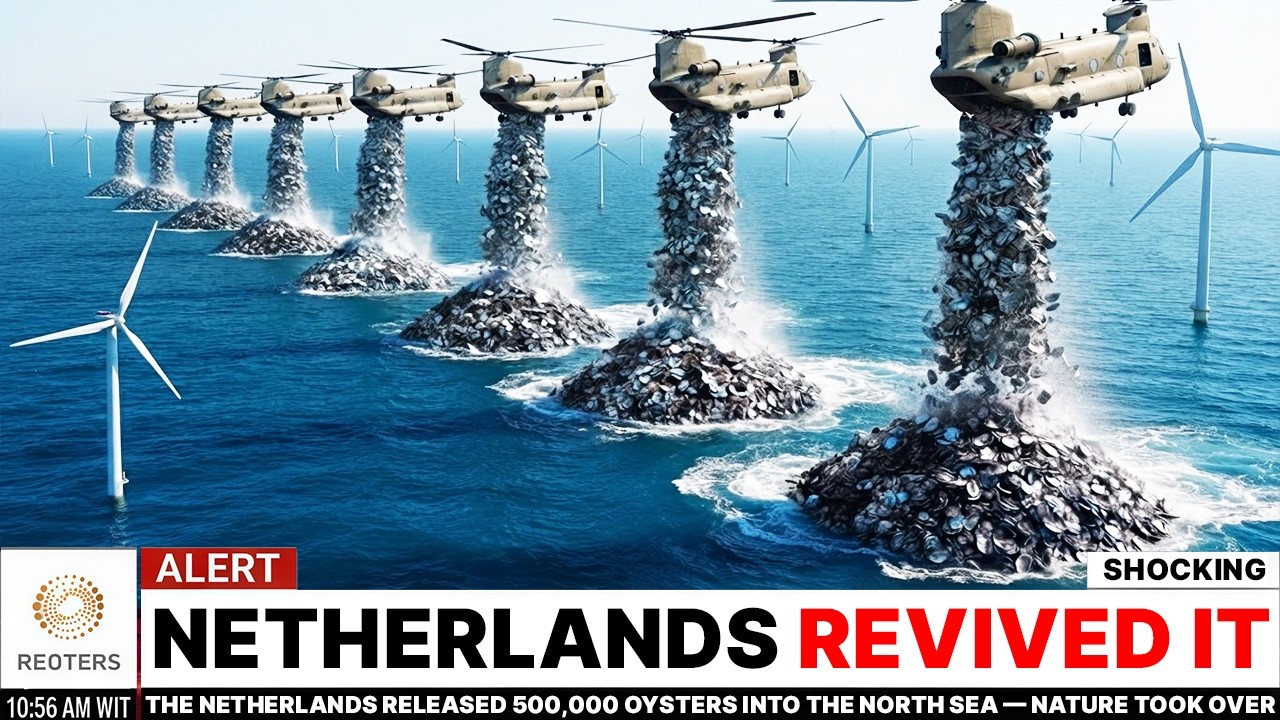
In a groundbreaking ecological resurrection, the Netherlands dropped 500,000 living flat oysters into the North Sea in September 2025, igniting a bold restoration effort. This unprecedented release, free of cages or intervention, marks a critical step to revive century-old dead seabed ecosystems through nature’s raw power.
The North Sea’s oyster reefs, once sprawling over a fifth of its floor, vanished by the 1950s due to relentless dredging and overfishing. These reefs weren’t mere clusters of shellfish but vital natural engineers filtering water, anchoring marine life, and defending coasts from erosion.
The flat oyster, Austria adulis, shaped an underwater city bustling with life—crabs, worms, anemones, and fish thrived in its complex reef structures. Each oyster filtered up to 180 liters of seawater daily, cleaning algae and sediment, cycling nutrients, and brightening the murky depths with sunlight.
Yet, centuries of human industry obliterated these reefs. Dredges tore foundations away, eradicating shells that oyster larvae need for settlement. With no homes for their young, flat oysters became functionally extinct across the Dutch North Sea, slipping quietly into ecological oblivion.
Revival came unexpectedly through offshore wind farms, whose imposing steel pillars and protective no-fishing zones created artificial reefs and safe havens from destructive fishing gear. What began as industrial energy projects unknowingly offered sanctuary for these lost oysters.
Starting in 2018, scientists transplanted adult oysters from Norwegian fjords—the last wild habitats in Northern Europe—into these offshore wind farms. Despite harsher open sea conditions, the oysters survived brutal winters and nourished themselves well enough to reproduce.
Evidence of larval flat oysters drifting in the water in 2019 confirmed a historic breakthrough: oysters had begun breeding 85 km offshore, repopulating a sea that hadn’t supported their kind in over seventy years. The experiment wasn’t just survival; it was reproduction.
Surrounding these new reefs, marine life rushed in—over forty species colonized the recreated habitats. Scallops clung to shells like passengers, worms built colonies between crevices, and anemones burst in vivid color. The reefs were becoming living communities, proving oysters are ecosystem architects.
However, the comeback faced microscopic enemies. Bonamia ostreae, a parasitic protozoan native to the North Sea, threatens oyster populations by causing widespread die-offs. Preventing its spread demanded rigorous biosecurity, including individual hand-washing and disinfection of imported oysters.
This painstaking process dramatically inflates restoration costs, making scaling the project a financial and logistical challenge. Clean, disease-free oysters are rare, and hatcheries producing larvae to seed reefs face bottlenecks in supply that hamper rapid expansion.
To overcome larval settlement obstacles, Dutch researchers pioneered “remote setting,” cultivating millions of oyster larvae on rocks inside shipping containers docked in Rotterdam. The larvae naturally cement onto stones, transforming them into miniature oyster reefs before being deployed offshore.
The September 2025 deployment scaled this innovative method dramatically, releasing half a million oysters attached to rock substrate at once. This approach ensures oysters arrive ready to feed and grow, bypassing fragile early life stages 𝓮𝔁𝓹𝓸𝓼𝓮𝓭 on barren sea floors.
By spreading efforts across five varied sites—each with different depths, oyster origins, and deployment techniques—the consortium gathered data to optimize reef restoration strategies. Success factors included oyster density, water temperature, and native versus imported stock performance.
Scientists determined that approximately 20,000 oysters clustered together are needed to trigger a self-sustaining reef cycle, wherein adults produce larvae that settle nearby, perpetuating growth without human intervention. Below this threshold, reefs falter and remain fragile.
Beyond biological hurdles, the scale of restoration required is vast. The half-million oysters placed represent barely a fraction of the North Sea’s historic reef coverage, highlighting the immense challenge ahead. Still, this pilot sparks hope that restoration can progress incrementally.
Crucially, these reefs hold potential as natural flood defenses. Oyster structures reduce wave energy, mitigating coastal erosion and lessening flood risks for communities—a vital ecosystem service amid escalating climate threats.
This unexpected synergy between industrial wind farms and oyster recovery overturns long-held assumptions. The very infrastructure once contributing indirectly to ecological decline now shields and nurtures nature’s revival from the seafloor up.
The project’s architects stress that oysters are foundational, not optional. Rebuilding reefs supports entire marine food webs by manufacturing habitats. Their resurgence signals a broader restoration narrative where industrial footprints and conservation goals might align.
As the North Sea transforms from oyster deserts back into thriving reef landscapes, this effort embodies the delicate balance between human impact and ecological resilience. Nature’s capacity to reclaim and rebuild offers a cautionary yet hopeful tale.
This restoration journey crystallizes a powerful lesson: ecosystems lost over centuries can rebound within a decade if science drives targeted, scalable interventions backed by strict biosecurity and innovative deployment.
The Netherlands’ pioneering initiative invites global attention and replication. If such vast marine recoveries can begin at the scale of a wind turbine foundation, other degraded ecosystems may also respond to bold, science-led restoration paired with protective policies.
Long silent, the oysters now whisper a return to abundance. Their hidden comeback beneath gray waves signals that with will, technology, and care, lost nature can awaken—rewriting not only seabed histories but ecological futures.


