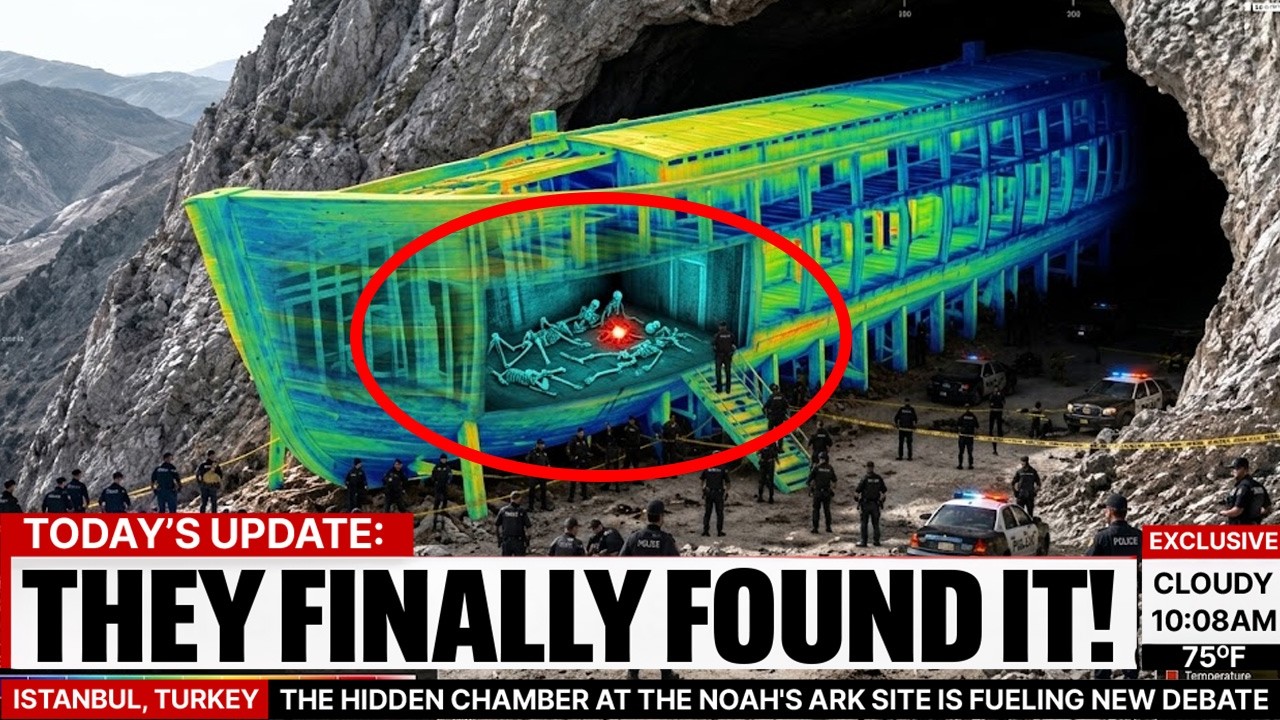
A team of American researchers has uncovered compelling ground-penetrating radar evidence suggesting hidden chambers beneath a boat-shaped formation near Mount Ararat, Turkey, long linked to the biblical Noah’s Ark. This discovery reignites a decades-old debate, revealing unexplored tunnels and anomalies that challenge scientific and archaeological consensus worldwide.
For decades, the Durupinar Formation, an unusual, ship-shaped rocky outline south of Mount Ararat, has divided opinion. Once dismissed as a natural geological quirk, recent subsurface scans have revealed structures beneath the surface — anomalies some claim cannot be explained by natural forces alone. This has thrown the global investigation into overdrive.
Known for its uncanny resemblance to the biblical Ark’s dimensions, this 538-foot-long formation has attracted believers eager to find proof and skeptics determined to set the record straight. The shape itself has been a beacon for explorers and researchers, fueling speculation and hope that the ancient vessel might still lie buried beneath centuries of rock and soil.
Ground-penetrating radar scans conducted by the research team showed striking internal features — straight lines, compartment-like divisions, and tunnel-like voids inconsistent with typical mountain geology. These discoveries hint at the possibility of hidden chambers within the formation, challenging previous geological dismissals and suggesting human or man-made origin.
Intriguingly, soil analyses at the site have reportedly uncovered variations in mineral composition and organic material inside the formation compared to surrounding terrain. Vegetation patterns growing above this area also differ, supporting the notion that something atypical rests below the surface, affecting the soil and ecological ecosystem above.
Experts explain how buried structures influence water drainage and nutrient distribution, directly impacting plant growth patterns. The unusual greenery covering parts of the formation acts like nature’s own radar, marking potential structural remains invisible to the naked eye but detectable through detailed scientific investigation and aerial surveillance.
Despite these promising signs, the research fiercely splits opinion. Supporters argue the convergence of shape, scan data, soil anomalies, and vegetation patterns form a compelling composite case for a lost ancient relic. Skeptics, conversely, caution that natural geologic processes and environmental variables may produce similar signatures, urging restraint and rigorous peer review.
The controversy echoes historic cases like the Piltdown Man, where once-accepted evidence collapsed under advanced scientific scrutiny decades later. This precedent has entrenched caution among many experts, emphasizing the need to separate raw data from interpretation and remain vigilant against confirmation biases born from the human search for meaning.
At the heart of the dispute lies a locked mystery box handed down through generations — the undeciphered question of whether Noah’s Ark left a physical imprint on the earth. New technology promises clarity, but years of investigations have so far failed to deliver a universally accepted breakthrough or decisive excavation evidence.
The current findings may alter this trajectory by providing structured, technical data previously unavailable. Reports claim that the scans do not merely indicate anomalous rock formations but distinctly organized internal spaces suggestive of construction rather than chance. Such data shifts the conversation from myth and speculation toward empirical inquiry.
Nevertheless, critics highlight that anomalies and soil differences alone do not constitute proof. Extraordinary claims require extraordinary evidence, and the leap from patterns in the dirt to definitive Ark remnants remains vast. Until independent validation and transparent data sharing occur, the global scientific community remains divided and watchful.
Adding to the debate, the presence of tunnel-like voids beneath the formation intensifies questions. Are these natural caves carved through millennia or remnants of a gigantic ancient vessel? Researchers believe further advanced scanning and possibly drilling may unearth physical artifacts or definitive evidence, turning speculation into facts.
What makes this eruption of attention remarkable is the fusion of faith, history, and science—fields rarely converging so powerfully on one exact location. The Durupinar site sits at the crossroads of human belief and empirical pursuit, stirring intense emotions and polarized dialogues worldwide, from religious adherents to scientific skeptics.
Previous investigations faltered as funding dwindled and excitement faded, but renewed interest and modern equipment have thrust Durupinar back into the spotlight. The persistent mystery embodies humanity’s relentless pursuit for answers embedded deep beneath the earth and layered in ancient scripture and legend.
This ongoing saga illuminates fundamental questions on evidence interpretation, bias, and the limits of scientific certainty. It warns how communities can project hopes onto ambiguous data while pushing investigators to maintain scrupulous standards amid global pressure and widespread curiosity.
Regardless of what lies beneath the slopes, the Durupinar Formation symbolizes more than a geological puzzle—it represents an enduring human story still unfolding, demanding patience, rigor, and transparency as science inches closer to unveiling the truth beneath its rocky silhouette.
For now, the mountain guards its secret, challenging the world to separate myth from measurement. Researchers call for continued study, hopeful that future technologies and methodologies might unlock the key to the locked box passed down through generations—perhaps finally resolving one of history’s greatest mysteries.
The debate will continue, the arguments sharpened and repeated, but so too does the fascination with this enigmatic formation, drawing new explorers, scientists, and believers to its foothills, each hoping their work will be the one that turns “maybe” into concrete discovery.
As this story develops, the world watches with bated breath—will the Durupinar site confirm an ancient biblical tale or reaffirm the complexities of nature? Only time and meticulous inquiry will answer, but the hunt for the truth beneath this mountain is far from over.