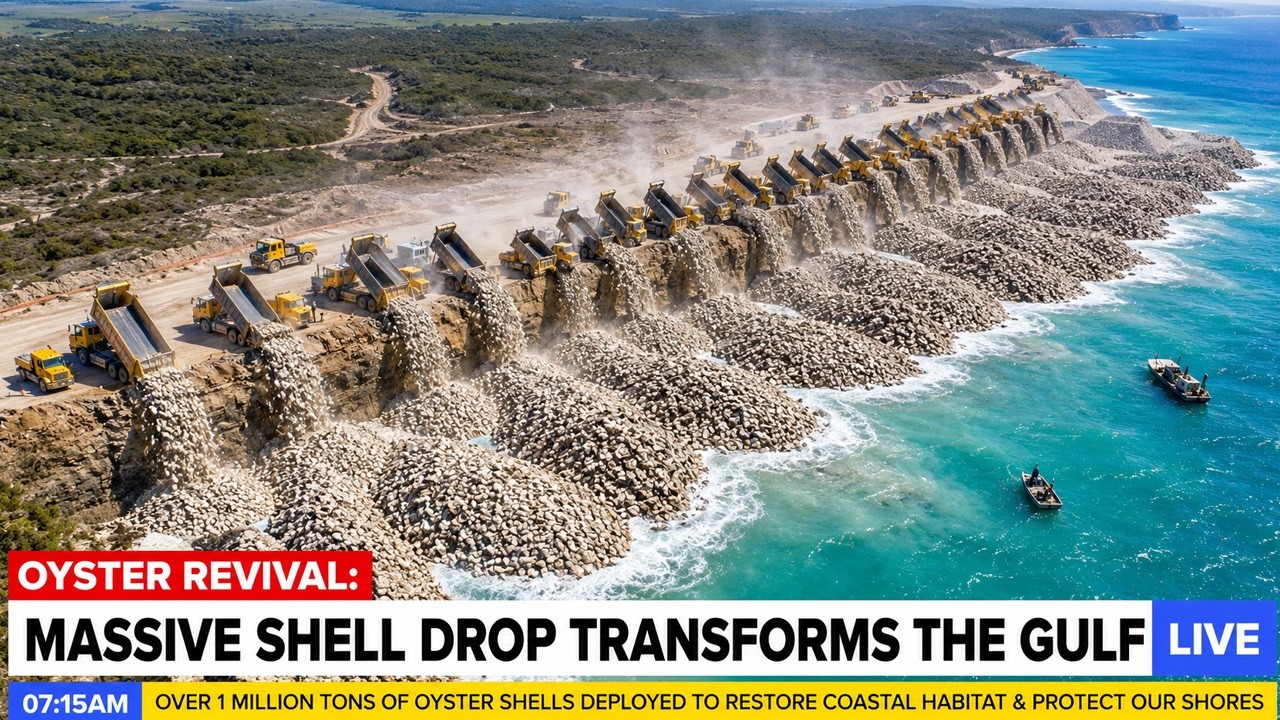
Florida’s bold experiment dumping over half a million tons of oyster shells into the Gulf of Mexico has shattered scientific expectations, sparking an unprecedented ecological revival. What began as a doubted restoration effort has transformed barren seafloors into thriving, self-sustaining oyster reefs teeming with life, reshaping marine ecosystems and coastal resilience.
Between 2007 and 2024, Florida embarked on one of its most controversial environmental projects, collecting discarded oyster shells from seafood industries and depositing them near Cedar Key in the Gulf. Initially condemned as ocean dumping masquerading as conservation, the project faced fierce backlash from fishermen, environmentalists, and coastal communities alike.
Local watermen, inheritors of multi-generational fishing traditions, protested vehemently, fearing the destruction of fragile coastlines and fishing grounds. Public hearings brimmed with opposition, and editorial pages warned against turning productive fisheries into dumping sites. Yet, fishing leaders and scientists understood the urgency: oyster reefs were collapsing, and the Gulf’s ecosystem was on the brink.
Despite the fierce opposition, the Florida Fish and Wildlife Conservation Commission pressed forward, convinced that shells destined for landfills could instead seed ecological restoration. This was a calculated risk; the volume of discarded shells exceeded landfill capacity, presenting a unique opportunity to repurpose this waste material into essential habitat.
The early process was unremarkable. Barges shuffled regular loads of broken shells offshore, tipping them silently into the Gulf’s murky depths, scattering inert calcium carbonate across soft sandy bottoms. For months, no outward signs of life emerged—a silence that spurred skepticism and dread among critics and supporters alike.
Eighteen months into monitoring, data shocked scientists: biological colonization rates on the deposited shells outpaced all existing scientific predictions by nearly a year. The anticipated timeline for reef development was shattered as microscopic life exploded across the shell surfaces with unprecedented speed and complexity.
Researchers discovered that these shells weren’t passive debris but active biological engineers. Within days, bacterial biofilms blanketed the surfaces, creating living carpets that fostered microhabitats. The shells began altering local seawater chemistry, generating alkaline microzones essential for calcifying organisms like barnacles and juvenile oysters to anchor and thrive.
This microscopic foundation sparked a domino effect. Diatoms and microalgae followed, forming the base of a new food web. Tiny crustaceans and larval mollusks grazed upon the algae, attracting juvenile fish. This unseen, vibrant hub of life triggered a revival that extended far beyond the initial shell deposits, transforming dead sediment into a bustling seafloor metropolis.
Within six months, while the shells appeared superficially dull and inert, sediment cores and water quality tests revealed a burgeoning ecosystem. These early biological communities formed the critical scaffolding for reef builders, especially oysters, reversing decades of ecosystem collapse on Florida’s Gulf coast.
The fundamental problem facing Gulf oysters was substrate loss. Over-harvesting and pollution had erased centuries-old shell beds, leaving juvenile oysters adrift without a place to settle. The dumped shells provided crucial landing zones precisely where oyster larvae swirled, reconnecting the life cycle that had stalled for decades.
By the end of year one, juvenile oyster settlement rates defied conservative projections. Dr. Bill Pine of the University of Florida Marine Lab recounted triple-checking his counts as spat numbers soared, signaling a reproductive resurgence. Two years in, these juveniles matured into spawning adults, fueling ongoing reef expansion fueled by natural cycles, not human intervention.
Remarkably, by year three, oyster density reached 847 per cubic meter in restored areas, against near zero in untouched sandy bottoms. The reefs extended beyond their original footprints, producing shells of new generations, building vertical complexity and horizontal sprawl in a self-perpetuating architectural feat unattainable with artificial materials.
Fierce opposition faded as charter captain Mike Lenz, a staunch critic, witnessed firsthand a dense aggregation of redfish schooling over shell reefs. The sight silenced his skepticism—he later publicly admitted his error, marking a turning point in public opinion and igniting broader fishing community support for reef expansion.
Fish biodiversity and biomass surged by over 300% around the reefs, driven mainly by juvenile fish born locally rather than simply displaced. Species once rare in these waters, including sheepshead, flounder, and snook, returned in robust numbers, creating a vibrant marine nursery previously absent from this part of the Gulf.
The unseen impact deepened. Each adult oyster filters between 30 to 50 gallons of seawater daily. Collectively, these reefs processed billions of gallons, cleansing the Gulf organically and continuously. This natural filtration reduced harmful algae blooms, improved oxygen levels, and helped control nutrient pollution, rivaling man-made water treatment plants without electricity or labor costs.
Ecological benefits radiated outward as water clarity improved, enabling seagrass to recolonize seabeds once too turbid to sustain life. Seagrass beds, essential nurseries for fish and vital for species like manatees and sea turtles, flourished, triggering cascading ecological restoration that extended well beyond the reefs themselves.
In September 2017, Hurricane Irma tested the reefs’ resilience. While adjacent shorelines suffered severe erosion and vegetation loss, areas backed by oyster reefs experienced 30-40% less shoreline retreat. The reefs’ complex, three-dimensional structure dissipated wave energy, mitigating storm damage and protecting coastal properties estimated at roughly $3 million in avoided losses.
This resilience represented a breakthrough: unlike seawalls and riprap that degrade over time, oyster reefs repair and grow stronger post-storm. Each generation adds successive layers of shells, building elevation and complexity, enhancing shoreline defense naturally – a living infrastructure that improves with age and adversity.
The 15-year project, which cost around $5 million, nearly paid for itself through a single storm event’s damage avoidance. Unlike static concrete or metal barriers, these reefs appreciate biologically, expanding both in size and ecological function with each generation, promising decades or centuries of ongoing coastal protection.
By the early 2020s, the reefs had doubled their size naturally, without further human input. Diverse habitats emerged: vertical profiles, predator corridors, nursery pockets, and sediment-trapping ledges. Multispecies communities thrived together—crabs, octopuses, sea stars, and juvenile fish—forming an interconnected microcosm of life resembling a small underwater city.
The reefs also contributed to climate mitigation, storing organic carbon in their shells and sediments, sequestering greenhouse gases that exacerbate ocean acidification and global warming. Biodiversity levels approached those of pristine limestone reefs, signaling an ecological restoration of extraordinary scale and significance.
Endangered sea turtles returned, dolphins hunted in coordinated groups along reef edges, and reef expansion stimulated fisheries and local economies. Inspired by Florida’s success, nearby states like Alabama, Mississippi, and Louisiana launched similar shell recycling and reef restoration initiatives. International interest grew as coastal engineers studied the results globally.
Florida’s million-dollar gamble with half a million tons of discarded oyster shells transformed a depleted seafloor into a vibrant ecosystem, overturning skeptics and rewriting ecological restoration textbooks. What was once dismissed as futile ocean dumping has rewritten understanding of how dead marine systems can rapidly and self-sufficiently revive.
Today, the reefs continue to grow, fish counts climb, and the cycle endures. Each generation of oysters sets the stage for the next, creating resilient coastal shields and vibrant underwater habitats. This unprecedented success raises urgent questions: can degraded coasts worldwide replicate this model, or is the Gulf reaching the limits of reef restoration?
As scientists, fishermen, and communities watch ongoing developments with bated breath, Florida’s oyster reef renaissance signals a breathtaking ecological comeback. It’s a testament to the power of nature, fueled by human ingenuity and persistence—proof that even the most devastated marine ecosystems can be revived to thriving life once again.


