Gregory Peck spent six decades in the spotlight, adored by millions and linked romantically to some of Hollywood’s most legendary actresses. But in the final months of his life, the Oscar-winning icon made a startling confession to those closest to him. The one woman he truly loved was not the glamorous co-star whose affair made headlines.
She was the quiet presence who stood beside him for nearly five decades, through triumph and tragedy, until his very last breath.
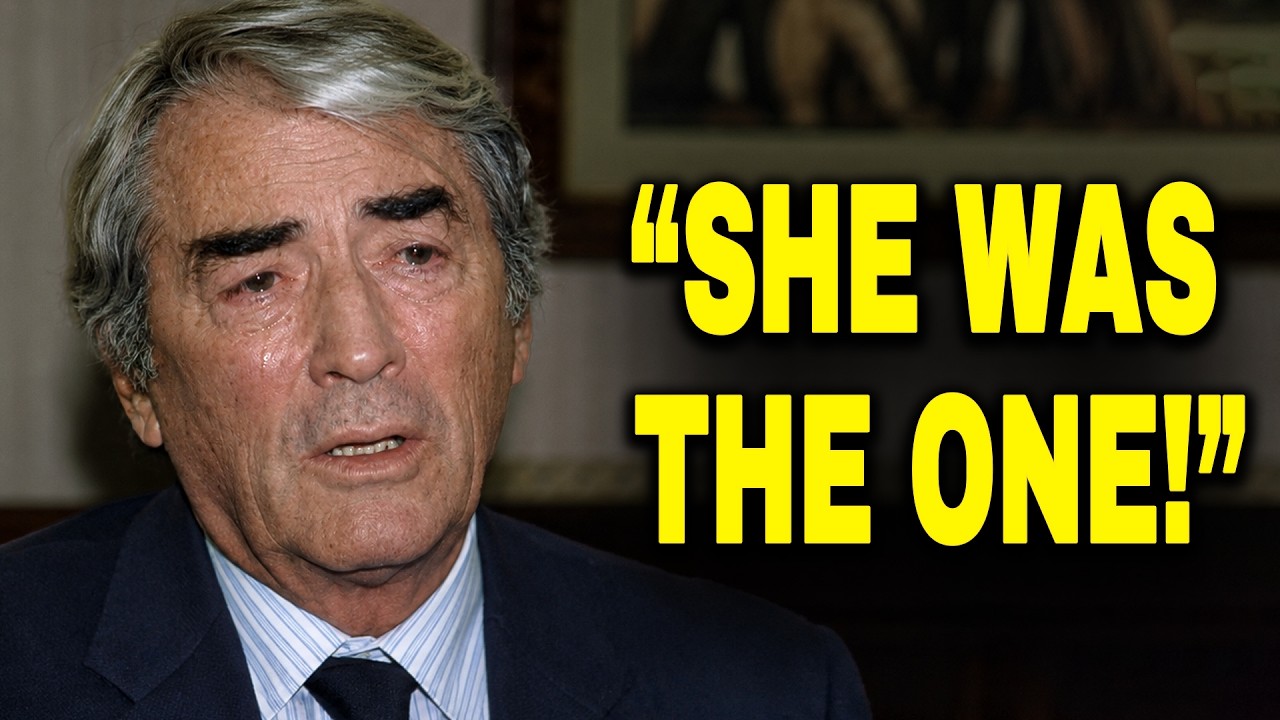 That woman was Veronique Passani, the French journalist who became his second wife. Peck, who died in June 2003 at age 87, revealed before his death that Passani was the love of his life, the woman who gave him the peace and stability he had spent decades searching for. It was a revelation that reframes everything the public thought they knew about the legendary actor’s heart.
The confession carries remarkable weight given Peck’s complicated romantic history. For years, speculation centered on Ingrid Bergman, his Spellbound co-star, with whom he shared a passionate affair in 1945. Peck, still married to his first wife Greta Kukkonen at the time, kept that relationship private for decades.
He only acknowledged it after Bergman’s death, admitting he had genuinely loved her.
But the revelation before his death made one thing unmistakably clear. Those romantic entanglements, however real they may have been, could not compare to what he felt for Passani. Those who knew him say Peck spoke of his second wife with a reverence he reserved for no one else, describing her bright eyes, her intelligence, her humor, and the warmth she carried wherever she went.
The story of how they met reads like something from one of his films. In 1952, Peck traveled to Paris for an interview with France-Soir, one of France’s leading newspapers. The journalist assigned to the story was a young reporter named Veronique Passani.
From their very first conversation, there was an undeniable connection between them.
Peck, then in his mid-30s and trapped in a failing marriage, was immediately struck by her intelligence, warmth, and confidence. Passani, in turn, admired how humble and approachable the famous actor was. Their interview ended and they went their separate ways, but neither ever forgot that first encounter.
When Peck’s separation from Kukkonen became more serious, he found himself thinking about the remarkable young journalist he had met in Paris. He contacted her, and what began as a simple lunch turned into an afternoon together at a racetrack. One meeting quickly became another, and before long, a genuine romance had taken root.
The path to marriage was not immediate. Peck and Kukkonen’s divorce proceedings dragged on, and his relationship with Passani grew quietly in the shadows. Finally, on December 30, 1955, after 14 years of marriage, the divorce became official.
The very next day, New Year’s Eve, Peck married Passani in a quiet ceremony at the California home of friends.
 She was just 23. He was 39. The 16-year age difference raised eyebrows in Hollywood, but those who knew the couple understood immediately that something was fundamentally different about this relationship.
Unlike his first marriage, this one brought Peck the peace and stability he had been searching for his entire life.
The irony of Peck’s journey is that he entered the world unwanted. Born April 5, 1916, in San Diego, his parents’ marriage collapsed when he was just five years old. In an arrangement that would scar him deeply, neither parent wanted to raise their son.
His grandmother stepped in, providing the only real stability he knew as a young boy.
His grandmother took him to the movies every week, unknowingly planting the seeds of his future career. When she was diagnosed with stomach cancer, young Gregory lay awake night after night listening to her cries through the wall. He read her the newspaper each morning, watching helplessly as she slowly declined.
She died while he was away at military school.
That early abandonment shaped everything that followed. Peck spent much of his life searching for something he could not easily name, a sense of belonging, of being truly wanted. He found professional success on stage and screen, becoming one of Hollywood’s most respected actors with films like The Keys of the Kingdom, Gentleman’s Agreement, Roman Holiday, and To Kill a Mockingbird.
His first marriage to Kukkonen, a Finnish-born businesswoman, produced three sons but little happiness. As his career accelerated, the pressures of Hollywood drove the couple apart. At just 34 years old, Peck suffered such intense stress that he believed he was having a heart attack.
He relied heavily on medication and alcohol, eventually isolating himself in the Mojave Desert for a month of reflection.
 He reached a difficult conclusion during that solitary month: he would never truly be happy in the marriage. But he stayed for appearances and for his children. That decision prolonged his unhappiness for years, until a chance meeting in Paris changed the course of his life forever.
His career, meanwhile, continued to soar. In 1944, he made his film debut in Days of Glory and was criticized harshly by The New York Times. But World War II had created a shortage of male stars, and producers saw enormous potential in the tall, commanding newcomer.
Peck negotiated non-exclusive contracts with four different studios, a bold move that gave him unprecedented creative freedom.
The Keys of the Kingdom brought his first Academy Award nomination. Spellbound, his Hitchcock film, became a major success despite the tense atmosphere on set. Hitchcock had wanted Cary Grant and never warmed to Peck, but the film solidified his status as a leading man and a genuine Hollywood heartthrob.
It was during Spellbound that Peck and Ingrid Bergman began their affair. The relationship remained private for many years. A cast member later told journalist Lawrence Leamer that the two once arrived late to set looking noticeably disheveled, fueling rumors that persisted for decades.
When Peck finally spoke about Bergman after her death, he acknowledged that their connection had been real. He explained only that they had been two young people working closely together during an intense period of their lives, and that he had genuinely loved her. But he always remained deeply reserved on the subject, offering no further details.
What he said about Passani was entirely different. He spoke openly and often about what she meant to him. He described truly finding himself after meeting her, suggesting that the first half of his life had been spent searching for something he could not name, and that he finally found it in her.
Friends observed their relationship with admiration. The couple was described as affectionate and deeply supportive, a stark contrast to his first marriage. Whenever filming allowed, Peck treasured the quiet moments he shared with Passani, finding in her the stability that had eluded him since childhood.
Their marriage lasted nearly half a century, enduring the ups and downs of Hollywood and raising their family together. They had two children, Tony and Cecilia. Passani also helped raise Peck’s sons from his first marriage, creating a blended family that remained close throughout the years.
 In his later years, Peck slowed down professionally but never lost the public’s reverence. He remained one of the most respected figures in the film industry, known not just for his talent but for his integrity. He had risked his career to speak out against the House Committee on Un-American Activities, and he had insisted Audrey Hepburn receive equal billing in Roman Holiday when the studio wanted his name alone above the title.
Those choices revealed the character that Passani saw in him. And in his final months, he revealed what she meant to him. Before his death on June 12, 2003, Peck made it clear that Veronique Passani was the one woman he truly loved.
He passed away peacefully at his home, holding her hand until his final moments. The image serves as a fitting end to a love story that had begun with a simple interview in Paris more than 50 years earlier.
The revelation carries profound implications for how we understand Gregory Peck. For decades, the public speculated about his relationships with Hollywood’s most glamorous women. The headlines focused on Bergman, on Ava Gardner, on Lauren Bacall.
But the quiet truth was always there, in the woman who stood beside him through everything.
Passani never sought the spotlight. She never gave tell-all interviews. She never wanted fame for herself.
She simply loved him, and he loved her in return. That was the revelation he wanted the world to know before he died.
In the end, the boy nobody wanted became a man who was deeply, completely, and enduringly loved. The search that began in childhood, that stretched through two marriages and countless films, finally ended when he met a young French journalist in Paris.
And before he died, he made sure everyone knew it. Veronique Passani was the one. She had been all along.