5 September 2026
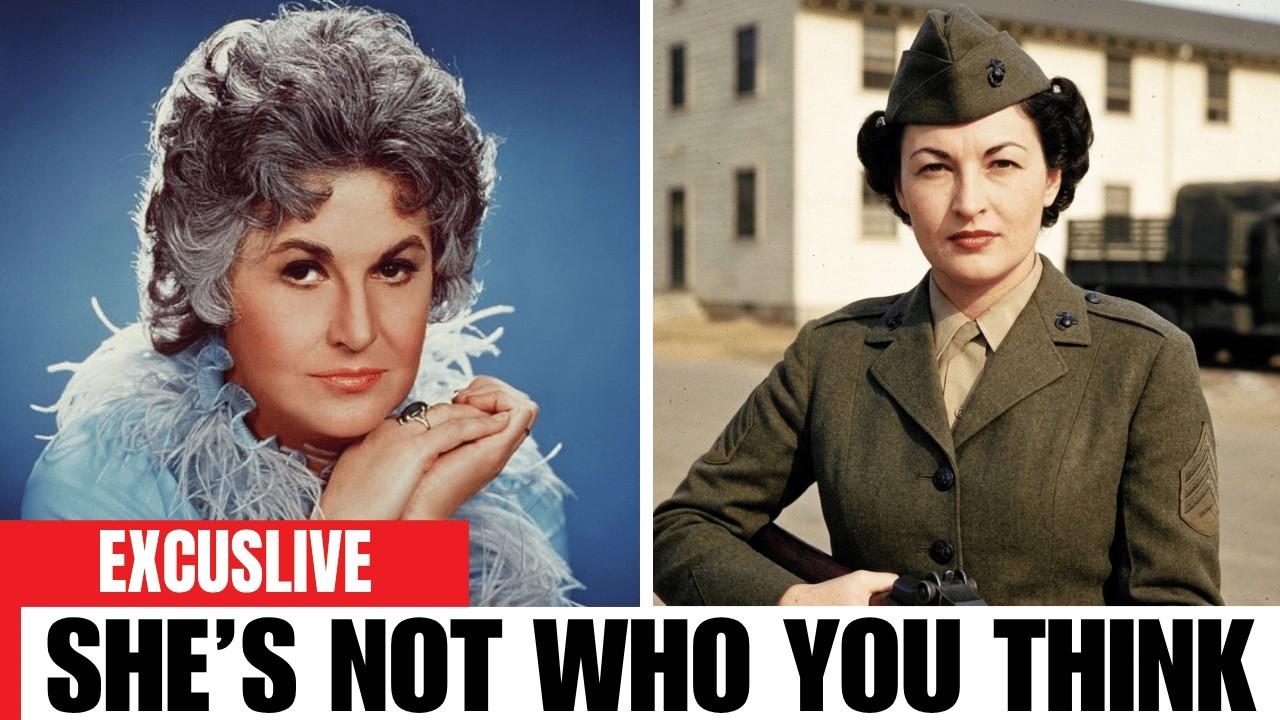
The world knew Beatrice “Bea” Arthur as the towering, sharp-tongued icon of American television. For half a century, her booming voice and razor-sharp gaze defined sitcom royalty through the legendary characters of Maude Findlay and Dorothy Zbornak. But a buried chapter of her life, sealed in federal archives until a year after her death, has revealed a startling truth that redefines her legacy. Before she ever slayed a studio audience, she was driving heavy trucks and managing logistics for the United States Marine Corps during World War II, under the name Bernice Frankel. This fall, declassified personnel records from the National Personnel Records Center in St. Louis have surfaced, shedding light on a 30-month tour of duty that the actress actively and systematically hid from the public, her colleagues, and even her closest friends. Her story, kept under lock and key from her rise to fame in the 1950s until the moment of her passing in 2009, shows that the innate authority and iron discipline so recognizable in her characters were forged not in a New York acting studio, but in the unforgiving crucible of a military motor pool. The revelation pivots on the summer of 1943. In a mere five days after the United States Marine Corps established its Women’s Reserve, a 20-year-old New Yorker named Bernice Frankel walked into a recruiting station to answer the urgent call to “free a man to fight.” The Marines, overwhelmed by a surge of female applications, processed her using standard Navy forms. She secured her family’s signature, two months before her 21st birthday, to gain parental consent and began what would become a distinguished 30-month career in active duty. Initial military evaluations of the young Bernice Frankel read like prophetic character sketches of a television persona yet to be born. Military interviewers wrote a portrait of an officer who was “argumentative,” “overaggressive,” “frank,” and “open.” One handwritten note inside her official file delivered an even sharper edge: “Officious, but probably a good worker if she has her own way.” These descriptions of an iron-willed private set the stage for the very personality that would later make her a star in a male-dominated entertainment landscape, but they were first developed and honed under the discipline of a military commander. Bernie’s initial assignments had her relegated to typing in Washington DC, in a cube that would have made anyone with her temperament restless. Proving that even as a junior Private her initiative was unstoppable, she applied for a transfer to the Motor Transport School at Camp Lejeune, North Carolina. The transfer was granted, and she successfully trained to operate heavy vehicles and military mechanics. The Marines stationed her at the Cherry Point air station, where she operated heavy trucks, coordinated transport, and managed drivers while deployed across the base. Her leadership qualities propelled her up the ranks, and she achieved the rank of Staff Sergeant before her honorable discharge in September 1945. It was during her service in the Marine Corps that she met and married another Marine, Robert Aurthur. When the war ended and she drifted back into her civilian identity, she began using a variation of his name that would eventually become the name that would appear on casting calls: Bea Arthur. Yet while her name changed, she made a strictly professional vow to herself: that her military history would be a blank space in her public life, and she reportedly adopted a strict silence that lasted until her final moments. Even as she left Cherry Point, she signed her discharge under her full married name, neatly separating that version of her identity from the young actress she wanted to be. The choice was a calculated necessity navigating a post-war America that was struggling to process the role of women in war. In the late 1940s and 1950s, America returned men to the workforce and women to their homes. Female veterans were caught in a cultural backlash, often met with social suspicion rather than celebratory parades. They had taken the place that was now perceived to be male, and their service was seen, at the time, as unseemly. Enter Bill came as a single woman pursuing an acting career, a woman who owed a “military-veteran “ label was not a mark of pride she wanted, but an easy target for a studio executive to pigeonhole her. If they typed her as a “former truck driver” or a “base commander,” her character could be taken less seriously. So, Bea Arthur filed away all her dirty combat gear, and she never, seemingly, put it on again. She erased the story entirely and framed her entire public identity through her dramatic training, her musical skill, and her singular stage presence. No one in her professional world knew about the jeeps, the typecasting, or the honor of serving alongside men because she knew that in the entertainment industry of the mid-20th century, her military service was not a boost, but a liability. It was only in of 2010 that the National Personnel Records Center, according to their 75-year sealed policy on military files, unsealed her discharge papers and the photographic personal assessments that led reporters to connect the final dots of her life. It turns out that the same talent that brought her a Tony Award for Best Featured Actress in a Musical in 1966 for Mame and later earned her countless Emmys, was on full display in her younger life riding horses for the military. She was not just playing a razor-sharp character. She was a sitting member of the armed forces, operating under oath and duty in a masculine environment. The discipline she learned under military contract became the discipline of her theatrical life. Before her Broadway breakthrough, she signed up for the Dramatic Workshop of the New School, under the direction of Erwin Piscator, an intense training ground that also held future icons like Marlon Brando and Tony Curtis. At almost 5 ft 10 in tall, she was never going to be a vapid, pretty young woman of the era. But on the stages of mid-century New York, this height, her bell tower of a voice were her character’s greatest weapon. She learned to project without a microphone to control an audience with a mere glance, a direct mirror into the physical command she had gained behind the wheel of a six-by-six truck. In 1972, producer Norman Lear saw this military-grade verisimilitude personified when he cast the 50-year-old stage actress as Maude Findley, a guest spot on All In The Family. Within minutes on screen, she dismantled Archie Bunker’s ego, of the entire premise of a fragile female. She was unwavering, overpowering, and unbending. The public instantly reacted to this powerful woman, and CBS gave her the whole spin-off series titled Maude. Finding herself as the lead television producer, she had to operate in the cultural battleground of Maude’s Decision about the abortion. The show faced boycott and advertiser pullouts, but in front of over 60 million viewers, Arthur brave and grounded the production. She soon took that title in 1981, with a career-ending role in Miami, with The Golden Girls playing Dorothy Zbornak, the epitome of the formidable, regal woman. Her character was written as a “Bea Arthur type” but by then, she became the cipher itself. The show, which ran from 1985 to 1992, transformed the way older women were perceived in North America.…