In the hottest, driest places on Earth, the people who have survived extreme heat for thousands of years are not the ones wearing the least clothing. They are the ones wearing the most. In the Arabian and North African deserts, the Bedouin and Tuareg wrap themselves head to foot in heavy, loose layers. Faces are shielded except for a narrow slit for the eyes.
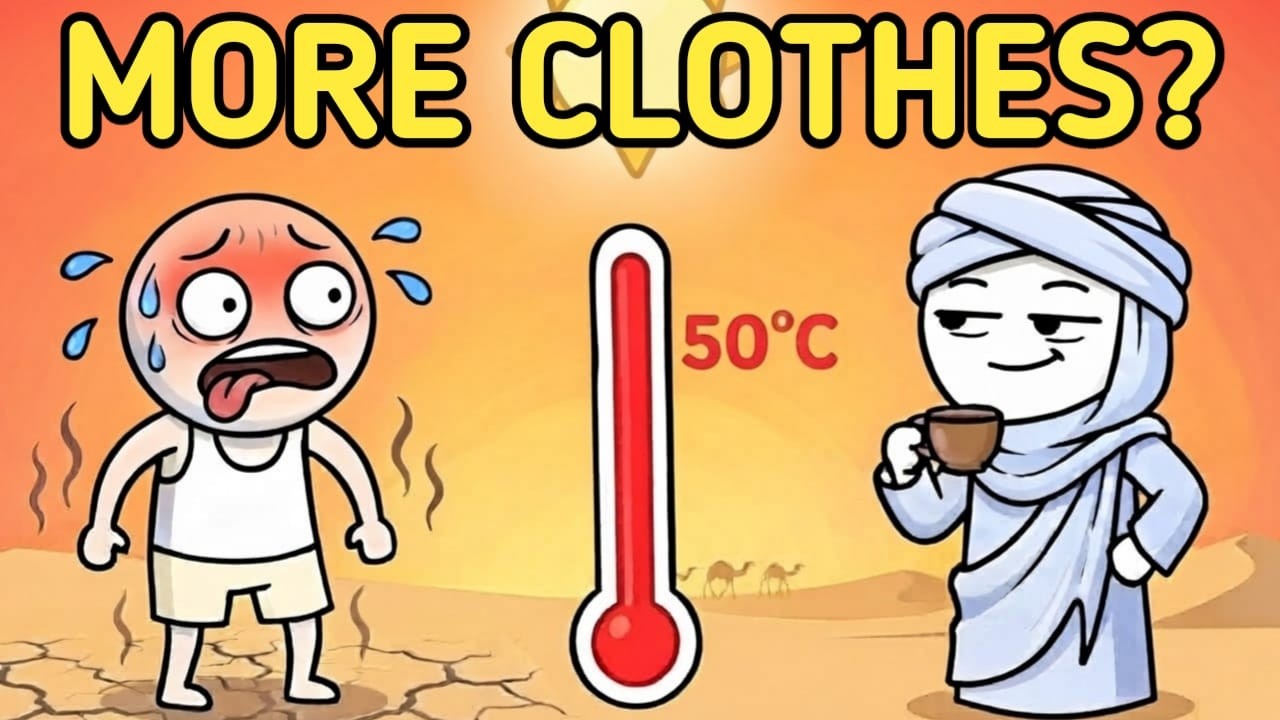
Rajasthani communities in the Thar Desert follow the same approach. Cultures separated by thousands of miles independently arrived at the same solution to the same brutal problem. The logic seems to contradict basic intuition. On a hot day, the instinct is to strip down and expose skin.
But in true desert extremes, that instinct can be lethal. The danger is not abstract. Heatstroke can shut down organs in under an hour. Dehydration can kill faster than starvation.
For most of human history, there was no rescue helicopter, no air-conditioned truck, and no hospital nearby. There was only what a person carried on their body. Getting clothing wrong in that environment was not a fashion mistake. It was a death sentence.
The modern Western approach to hot weather is based on a different experience. In a city on a 100-degree day, people wear tank tops and shorts, relying on the logic that less fabric means less heat. That reasoning works when air conditioning is a doorway away and the worst outcome is a sweaty walk to the car. In the deep desert, with no shade, no building to duck into, and temperatures that barely drop after dark, the rules change completely.
Traditional desert clothing performs three distinct functions, each solving a problem the others cannot. The first is blocking radiation. Direct sunlight in open desert hits the skin with the intensity of a heat lamp held inches away for hours. Bare skin absorbs that radiation.
A loose robe intercepts it first, acting as a wearable parasol that catches the sun’s energy before it reaches the body. The second is convection. In 1980, physiologists studying Bedouin clothing found something unexpected. A volunteer tested in the Negev desert at midday in a black robe, a white robe, and shorts gained no more heat in the black robe than the white one.
Both robes kept him markedly cooler than wearing almost nothing. The robes were loose enough that a chimney effect formed underneath. Hot air near the skin rose and escaped through the top and sleeves, pulling in slightly cooler air from below. The body was ventilating itself using its own convection, with the fabric acting as a duct.
The third is evaporation, which matters most. Sweat only cools the body if it evaporates off the skin. In dry desert air, sweat evaporates almost instantly. That sounds efficient, but it means water is lost faster than it can be replaced.
A layer of breathable fabric traps a thin layer of humid air against the skin, slowing evaporation just enough for the moisture to do its cooling work instead of vanishing uselessly into the air. Bare skin in the desert does not sweat more efficiently. It just wastes water faster. The single biggest design choice in traditional desert clothing is not the color or even the coverage.
It is the looseness. A tight garment traps heat against the skin. A loose one creates a buffer, a personal microclimate a few degrees cooler and a few percent more humid than the furnace outside it. Even the color carries its own engineering.
The Tuareg are sometimes called the blue men of the Sahara because their robes and veils are dyed with indigo so concentrated it rubs off onto the skin, staining it faintly blue over years of wear. That was not decoration. Indigo was believed to have antiseptic properties, which mattered in an environment with no running water and no pharmacy. The deep color came from whatever dye was most available and durable, not from a quest for heat absorption.
The physics of the loose weave underneath did the temperature work. Material mattered as much as cut. Traditional Tuareg and Bedouin garments are typically woven from cotton in an open, breathable weave, tight enough to block radiation but loose enough to let air pass through. Wool sounds like the last fabric anyone would want in a desert, yet Bedouin herders have relied on it for generations.
Not for the daytime heat, but for desert nights, which can drop by 40 degrees or more within hours of sunset. Wool holds body heat when the temperature plummets. Head coverings serve a similar dual purpose. The keffiyeh, the tagelmust, and the turban-wrapped veils shield the most exposed, most blood vessel-rich part of the body from direct radiation.
The loose wrap around the nose and mouth does something else. It slows and humidifies the air before it is breathed in, protecting the lungs from air so dry it can crack the inside of the throat in minutes. This is not a costume or a habit that outlived its usefulness. It is a wearable survival system refined through the harshest possible feedback loop.
The people who got the design wrong did not survive to pass on their methods. The result is applied thermodynamics achieved through trial and error centuries before anyone had the vocabulary of convection currents or evaporative cooling to explain why it worked. But clothing alone was never the whole strategy. It solved the physics problem, not the biology problem underneath it.
No fabric can change how much water the human body actually needs to survive extreme heat. Clothing can only slow water loss, never eliminate it. Desert cultures paired their clothing with an entire architecture of behavior. Activity was shifted to early morning and evening to avoid the sun at its most direct.
Homes were built from thick mud brick or stone because that mass absorbs heat slowly during the day and releases it slowly at night, turning the building itself into another layer of defense. Water sources, wells, and travel routes were mapped and passed down with the same seriousness as any survival skill. Even travel was timed around the coolest hours, with long midday rests built into the rhythm of the day as a rule rather than a luxury. It was load management, not laziness.
The clothing was the visible layer of a much deeper system. One built from physics nobody had named yet. Tested against a landscape that offered no second chances. Refined by cultures who had nowhere to retreat to but the same brutal environment they had already learned to survive.
In the most extreme heat on Earth, survival was never about how little a person wore. It was about how intelligently they wore it. Block the radiation. Vent the heat.
Trap the moisture. Slow the water loss. Cover the skull. Humidify the breath.
Loosen the weave. Every piece of it points at the same underlying answer, arrived at independently by cultures who never met, separated by entire deserts and centuries, because there was only ever one physics to solve and the harshest teacher imaginable making sure the wrong answers did not survive to be repeated.