Ancient humans did not lack privacy. They simply built it out of an entirely different material than we do today. In a world without doors, locks, or soundproof walls, the need for personal space did not vanish—it migrated into behavior, ritual, and unspoken social rules. For most of human history, privacy was not architectural.
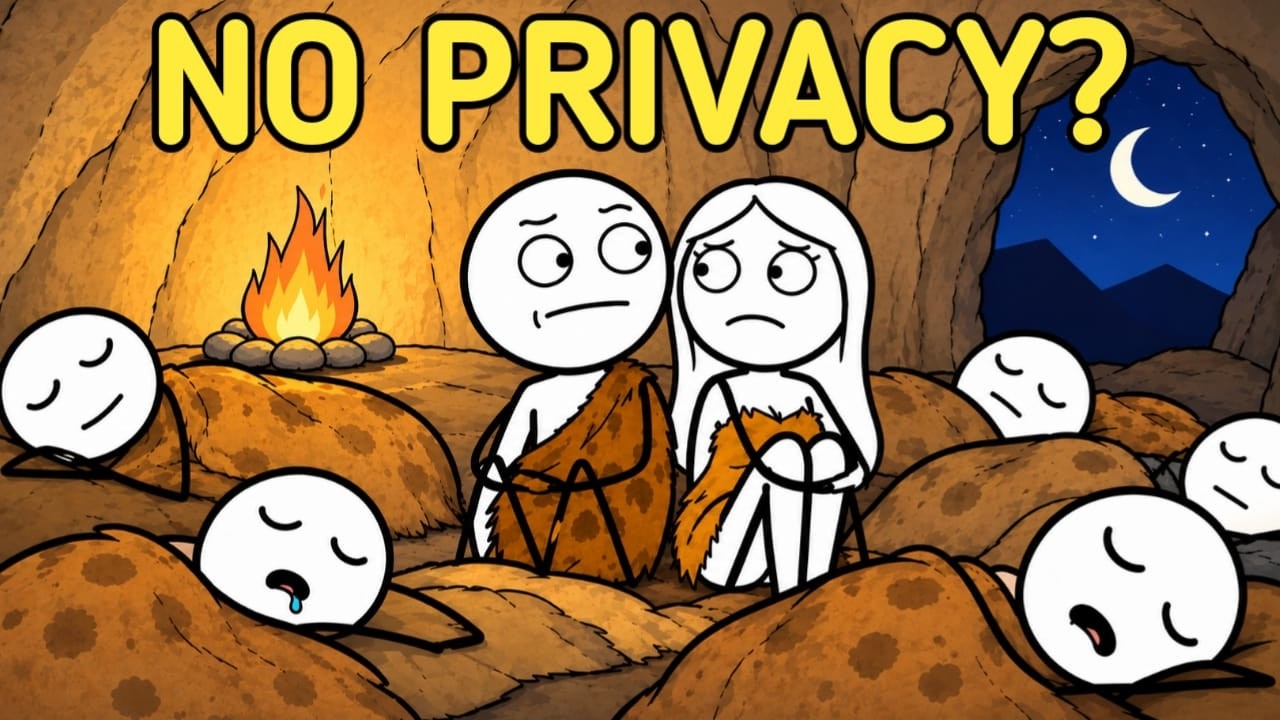
It was choreographic. In shared shelters, longhouses, and cave mouths packed with extended families, every sound traveled and every movement was visible in firelight. There were three distinct problems to solve: acoustic privacy, visual privacy, and informational privacy. In bands of roughly 20 to 150 people—the natural size anthropologists estimate for early human social groups—everyone knew everyone’s business.
Anonymity did not exist. The answer was not a wall. It was shame. Shame and taboo functioned as invisible architecture, allowing a society to agree that certain acts would not be watched, commented on, or acknowledged—even when everyone technically saw them happen.
Privacy, in this system, was not the absence of an audience. It was an audience that agreed to look away. This pattern appears across cultures, from the Arctic to the Kalahari. Anthropologists have documented designated places, times, and postures for acts people wanted shielded.
Turning one’s back, angling toward the wall of a shelter, or walking to a specific spot outside camp were all ways of creating privacy through movement rather than space. As permanent settlements emerged, this choreography began leaving physical fingerprints. At Çatalhöyük, a 9,000-year-old settlement in what is now Turkey, homes were built wall-to-wall with no streets between them. People entered through roof holes, climbing down ladders into rooms shared by extended family.
Yet even there, archaeologists have found platforms and partitions inside single rooms—subtle divisions separating sleeping areas, storage, and burial spaces beneath the floor from the main living area. Even without interior doors, someone was drawing lines. For a long time, however, the goal of ancient design was not to give the individual privacy from the group. It was to give the group privacy from outsiders.
The family, household, or clan was the private unit. Inside it, almost nothing was private at all. A person in an ancient household had no more category for privacy from their own family than they would feel a need for privacy from their own hand. The modern instinct of “my room, my space, my business” is a relatively recent invention layered on top of a much older, more communal foundation.
As settlements grew from dozens into cities of thousands, group-level privacy stopped being enough. Architecture had to start doing work that shame alone could not. In Pompeii, sealed under ash in 79 AD and preserved almost perfectly, wealthier homes were built around private inner courtyards screened from the street by blank outer walls. The noisiest, most public rooms sat at the front; bedrooms and private baths were pushed deep into the interior.
The house itself became a filter, sorting visitors by how far in they were allowed to go. Privacy had become something you could afford, measured in how many walls stood between you and the street. In medieval Europe, ordinary households still slept multiple people to a room and often to a bed, including servants and guests. What developed instead was almost symbolic: heavy curtains around the bed itself.
Not a room of one’s own, but a curtain of one’s own—a few inches of fabric doing the emotional work that an entire wall does today. Privacy scaled with wealth and population density long before it scaled with technology. The bigger and more anonymous a society became, the more it needed physical walls to do what shame used to do for free in a band of 40 people who all knew each other. The more strangers you are surrounded by, the more architecture substitutes for the trust that made shame-based privacy work in the first place.
That pattern traces forward through history. The rise of the private bedroom across the 18th and 19th centuries saw families increasingly sleeping separately by age and gender. The invention of the lock created a portable, individual version of a wall. The modern bedroom door is the descendant of a Roman courtyard wall and a medieval bed curtain compressed into a single hinge.
The dark, crowded shelter where every breath was audible was not a failure of privacy. It was privacy running on a different operating system: not walls but agreements, not locks but shared unspoken rules about what to see and refuse to acknowledge. The acoustic problem was solved with turned backs and unspoken rules. The visual problem was solved with posture, ritual, and eventually walls.
The informational problem was never really solved at all—it was made survivable because everyone agreed to forget what they already knew. We traded a fragile agreement between people for a hard lock on a door. In doing so, we gained security but may have lost what that agreement required in the first place: a group of people who trusted each other enough not to look.