Ancient humans faced a challenge that seems almost unimaginable today: surviving winters so brutal that a single mistake could erase an entire family. Long before warm houses, thick jackets, or even farming existed, small groups of people endured temperatures far below freezing with nothing but stone tools, animal hides, and one another. Their survival did not depend on strength or luck as much as on a series of extraordinary decisions that transformed fragile groups into the ancestors of everyone alive today. The first challenge was not finding food, but protecting heat.
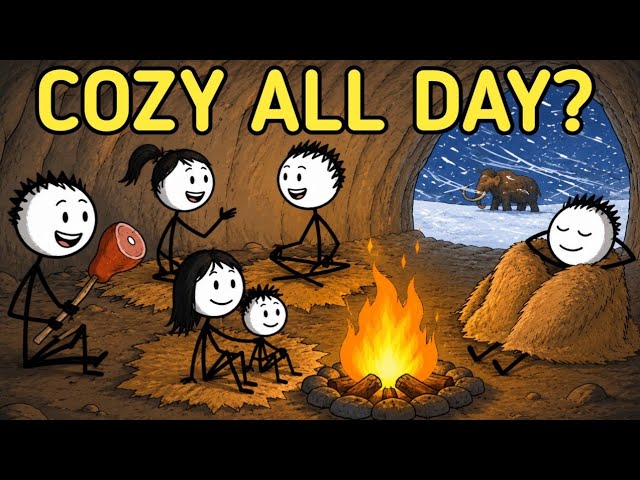
In freezing conditions, the human body burns precious energy every second, and every unnecessary movement drains calories that cannot easily be replaced. Instead of wandering alone, entire groups stayed close together. As darkness fell, everyone gathered around a carefully protected fire. Children slept beside adults, and elders rested where the warmth was strongest.
Animal hides covered exposed skin, while layers of grass and fur trapped warm air close to the body. Even sleeping became a survival strategy, because one mistake during the night could mean never opening your eyes again. Keeping the fire alive was a constant battle. Long before sunrise, someone quietly woke up to feed dry branches into the glowing embers before the flames disappeared completely.
The wood collected during the previous day now decided whether the entire group survived another freezing night. Without fire, frozen meat became impossible to soften, water turned into solid ice, darkness became deadly, and predators moved closer. Hunger was the next terrifying reality. Winter transformed familiar forests into silent landscapes.
Berries were gone, edible plants had disappeared beneath snow, and many animals had migrated or were hiding. Every hunting trip became a gamble where failure cost far more than pride. Hunters often followed herds of reindeer across frozen valleys or waited patiently near narrow paths where animals had to pass. Instead of chasing every opportunity, they learned to cooperate, surrounding prey from different directions and striking together.
A successful hunt meant more than one full stomach. The meat became food, the fat became a vital source of energy, hides became clothing and blankets, and bones became tools and needles. Even tendons were turned into strong cord for sewing and building. But the greatest weapon ancient humans possessed was each other.
One person alone rarely survived a brutal winter, but a group could. When someone was injured, others carried supplies. When experienced hunters found fresh tracks, they shared the knowledge. Older members remembered where to find sheltered caves, reliable water sources, and seasonal migration routes because they had survived winters before.
Knowledge passed from one generation to the next shaped the future. Children watched and learned which animal skins trapped heat best, which trees burned longer, and which valleys became death traps after heavy snowfall. These lessons could not be written down, so they had to be remembered. Forgotten knowledge often disappeared forever, and winter never forgave those who forgot.
The deadliest part of winter sometimes came from the sky itself. A deep rumble would roll across a valley, the ground would tremble, and a wall of snow would break free from the mountainside. An avalanche could send thousands of tons of ice and rock racing downhill, snapping trees like dry twigs and burying entire landscapes. After the roar faded, the path home might be gone, animal tracks could vanish, and landmarks disappeared beneath fresh snow.
Finding the way back then depended on memory alone. In one common scenario, hunters would spot a raven circling overhead. Experienced hunters understood this often meant a dead animal or another predator feeding nearby. Following the bird could lead to a frozen woolly mammoth, but massive paw prints sometimes revealed that cave lions had claimed it first.
The group then faced an impossible choice: challenge one of the Ice Age’s most dangerous predators for desperately needed food, or walk away and hope another opportunity appeared before starvation did. Most ancient humans survived because they understood that patience often beats strength. They waited, sometimes for hours, until the predators left, then carefully collected whatever remained. Even scraps of meat could feed children, and shattered bones still held rich marrow.
Back at the shelter, another battle quietly unfolded. While hunters were gone, other group members spent the entire day repairing clothing made from animal hides. Using bone needles and sinew thread, they stitched tears before freezing winds could reach exposed skin. A tiny hole in a fur coat might seem unimportant, but out in the cold it could slowly steal body heat hour after hour until exhaustion took over.
Survival was often decided by dozens of small preparations no one noticed: gathering dry moss to start the next fire, storing meat where the freezing air naturally preserved it, and having children collect small branches instead of playing. Days became weeks, snow continued falling, and food grew scarcer. Then sickness often arrived, perhaps beginning with a cough or a fever after a freezing hunting trip. No medicine existed.
The only treatment was warmth, rest, clean water, and the care of others. One healthy person might sacrifice valuable sleep to keep the fire burning through the night, while another shared their own portion of food with someone too weak to hunt. These choices came with consequences, because helping another person meant risking your own survival. Yet abandoning the weak could weaken the entire group tomorrow.
The strongest communities were often the ones that trusted each other enough to survive together. That trust became humanity’s hidden advantage. Predators had claws, but ancient humans had cooperation. Stories filled the darkness while snow buried the world outside.
Older members spoke of winters even harsher than the current one, of rivers that froze completely, of hunts that lasted for days, and of families forced to leave familiar lands. Those stories were survival manuals carried in memory, not mere entertainment. But winter always demanded one final test. When spring approached, melting snow brought dangers of its own.
Frozen rivers began breaking apart, floodwaters surged through valleys, weak ice collapsed without warning, and hungry predators, driven by months of starvation, became more desperate. Surviving winter did not mean the danger was over, and the hardest decision of the year was still ahead: stay in the place where the group had survived, or risk everything by following the retreating ice into an unknown world. As the herds moved north following fresh grass, the people had to decide. Staying behind meant watching the food disappear with the animals, but following the herds meant leaving the only shelter that had protected them through the deadliest season.
There was no map and no guarantee, only a choice. Many groups chose to move, and this is how ancient humans slowly spread across enormous parts of the world. Not because they wanted adventure, but because survival demanded movement. Every successful winter gave them another opportunity to explore new valleys, rivers, forests, and grasslands.
Every failed journey disappeared without leaving a story behind. The journey began before sunrise. Children walked between adults, hunters scouted ahead, and others watched the surrounding hills for danger. The group moved slowly because everyone understood that the slowest person determined everyone’s pace.
Leaving someone behind was not merely cruel; it weakened the entire community. For countless generations, cooperation had become humanity’s greatest survival tool, more important than sharper weapons or larger muscles. Nature was never predictable. Dark clouds could gather without warning, heavy rain could replace snow, and a frozen river could begin roaring as enormous chunks of ice broke apart.
A crossing that seemed safe one day could become a deadly trap the next. Groups often had to wait and risk losing the migrating herds, or cross immediately and gamble with their lives. In many cases, they found a narrower section where fallen trees created a natural bridge. One by one, every member crossed carefully while others stood ready to help anyone who slipped.
That simple pattern appeared again and again throughout humanity’s story. When food became scarce, they shared. When predators attacked, they defended each other. When children were born, the entire group helped protect them.
When elders grew too weak to travel, their knowledge often guided every important decision. The strength of ancient humans was never measured by one individual; it was measured by the community. Generation after generation, those communities adapted. They learned which caves stayed warm through winter, which animals provided the thickest hides, which valleys flooded during spring, and which trees burned slowly through freezing nights.
Knowledge became an invisible inheritance. Every lesson passed from parent to child increased the chances that someone would survive another year. This ability to learn may have been humanity’s greatest advantage. Many Ice Age predators were faster, some were stronger, and others had claws, fangs, or incredible size.
But none could pass thousands of seasons of experience from one generation to the next the way humans could. Each winter made survivors wiser, each mistake became tomorrow’s lesson, and each successful decision quietly shaped the future of the species. Over thousands of years, the climate slowly changed. The giant ice sheets that once covered vast parts of the northern hemisphere gradually retreated.
Forests expanded into places that had been frozen wastelands, and rivers carved new paths through the landscape. Some massive Ice Age animals disappeared forever. Human beings changed with the world around them. Some groups remained hunters, while others slowly discovered new ways of finding food.
Eventually, agriculture emerged, villages appeared, cities rose, and civilizations flourished. But none of those achievements would have been possible without one simple victory repeated countless times long before history was ever written: surviving winter, not once, but again and again. Every warm home entered today, every thick blanket pulled over on a cold night, and every hot meal on the table exists because somewhere in the distant past, ordinary people refused to surrender to extraordinary winters. They protected the fire, shared the food, trusted one another, learned from failure, and endured seasons that could erase entire families in a matter of days.
Their names are lost, their voices have disappeared, and their footprints melted away thousands of years ago. Yet every person alive today carries the legacy of those survivors.


