Ancient cities are not simply lost to time; they are buried beneath our feet. In modern Rome, London, or Istanbul, the streets people walk on every day often sit 10 to 30 feet above older streets, and beneath those, even more. This is not because the earth expanded or because entire civilizations were deliberately paved over. The ground itself rose over thousands of years due to a combination of human habitation, natural disasters, and biological processes.
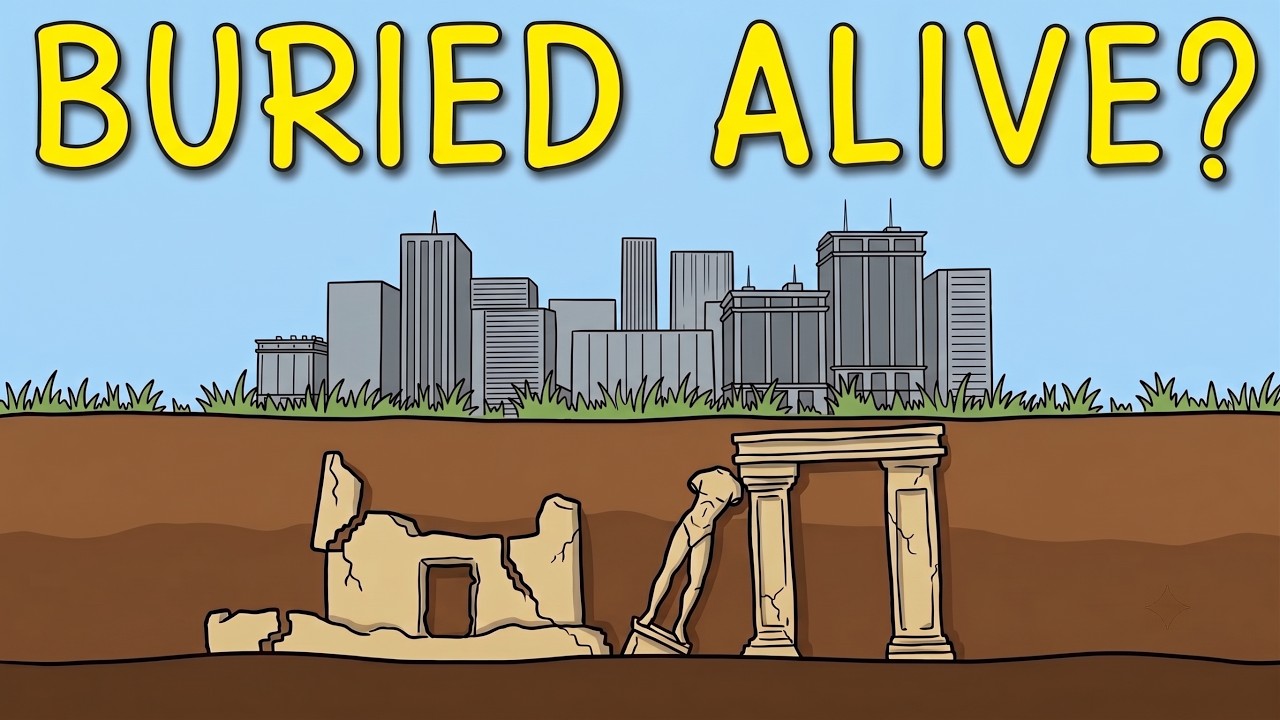
One of the most mundane reasons ancient cities ended up underground is garbage. Before modern sanitation, there was no waste management system. People simply threw their trash into the streets, alleys, and any empty space. In ancient Rome, this practice was so widespread that the street level rose consistently century after century.
With hundreds of thousands of residents discarding broken pottery, food waste, and construction debris, a massive volume of material accumulated. Each generation had to build doors higher and adjust walkways, and what was once the ground floor eventually became the basement. Life was literally lived on a platform made of previous generations’ refuse. Nature also played a significant role in this slow burial.
The Tiber River frequently flooded Rome, leaving behind layers of silt, mud, and sediment. Over hundreds of floods, low-lying areas like the Roman Forum were buried under meters of dense mud. This is why visitors to Rome today must descend into the earth to see the ancient city. The modern consequence of this is visible in the construction of the Metro C subway line, which has faced decades of delays due to crews constantly hitting ancient Roman barracks, farms, and frescoed walls.
The problem became so severe that the city converted subway stations into museums, where commuters can see artifacts like fossilized peach pits from 2,000 years ago. Beyond waste and flooding, the burial of the past was often a deliberate architectural strategy. When an ancient building collapsed, its residents had a choice: clear the massive rubble by hand or level it out and build directly on top of it. Most civilizations chose the latter for practical reasons.
Building on a ruin was faster and more efficient than excavating a site. Over time, cities grew upward on the crushed remains of their own past rather than sprawling outward. At Çatalhöyük in modern-day Turkey, one of the earliest urban settlements dating back roughly 9,000 years, this cycle repeated for over two millennia. Archaeologists have found up to 18 distinct layers of occupation stacked on top of each other.
The residents even buried their dead beneath their home floors, meaning each new house was built directly above the decaying bodies of their ancestors. These artificial mounds, known as tells, dot the landscape of the Middle East. The ancient city of Ur in Iraq is built inside a massive tell, with each layer representing a different era, from early mud huts to Sumerian temples and Babylonian palaces. Perhaps the most famous example is Troy in Hisarlik, Turkey, which consists of nine distinct cities built atop each other over thousands of years.
In the 19th century, amateur archaeologist Heinrich Schliemann, obsessed with finding the Troy of Homer’s Iliad, used dynamite to blast through the upper layers. He destroyed the actual layer most likely corresponding to the Trojan War in his rush to reach the bottom in search of treasure. Nature itself is also capable of erasing human history. Wind and dust slowly fill abandoned buildings through every crack and crevice.
In desert regions, entire cities have been swallowed by shifting sand dunes in a matter of centuries. In temperate climates, plant life takes over. Roots pry into mortar, leaves decay into compost, and over centuries, a stone city can transform into a forested hill. Paradoxically, this organic cover preserves the structures below by shielding them from further erosion.
Charles Darwin dedicated his last years to studying a smaller force at work: earthworms. In 1881, he published a book entirely about them, demonstrating that worms constantly eat dirt from below and deposit it on the surface. This process, known as bioturbation, slowly sinks heavy objects into the ground. Darwin proved this with a large stone he placed in his garden and measured for 29 years, showing that worms could bury human history simply by existing.
Sometimes, history is buried in a single catastrophic event. In 79 AD, Mount Vesuvius erupted and buried Pompeii under 4 to 6 meters of volcanic ash and rock. The city was frozen in time. Loaves of bread remained in ovens, graffiti stayed legible, and the voids left by decayed bodies were later filled with plaster to reveal the exact forms of victims in their final moments.
Pompeii vanished from memory for 1,700 years until it was accidentally discovered in 1748. Sudden, violent burial preserved it with a clarity that slow decay could never achieve. Humans have also buried history on purpose. Göbekli Tepe in modern-day Turkey, dating back roughly 11,500 years, is the oldest monumental structure ever found.
It is older than Stonehenge by 6,000 years and was built by hunter-gatherers who erected massive T-shaped stone pillars weighing dozens of tons. When archaeologists excavated it, they discovered the enclosures had been intentionally and painstakingly buried by the people who built them, likely as a ritual decommissioning. This act of burial is the only reason the pillars survived for millennia. Even today, 90% of the site remains underground.
Some cities were lost to water rather than earth. Off the coast of southern Greece lies Pavlopetri, a 5,000-year-old Bronze Age city submerged just three or four meters below the Mediterranean Sea. Its streets, courtyards, and tombs remain perfectly intact. It did not sink in a dramatic cataclysm but through a slow combination of rising sea levels and shifting tectonic plates over hundreds of years.
It was abandoned until a geologist spotted it in 1904. In other cases, humans chose to go underground themselves. In 1963, a man renovating his house in the Cappadocia region of Turkey discovered Derinkuyu, an 18-story underground city plunging 85 meters deep. This subterranean metropolis could house 20,000 people along with their livestock and supplies.
It had chapels, schools, wine cellars, and a complex ventilation system. Built as a defensive bunker starting around the 8th or 7th century BC, residents would retreat below ground and seal the tunnels with massive circular stone doors when invaders approached. The reason archaeologists only find ancient cities underground comes down to survivorship bias. Buildings left exposed did not survive.
They were eroded by rain and wind, scavenged for stones, rotted, and melted down. The surface of the earth is highly destructive to human architecture. Burial, however, protects structures from the elements, stabilizes temperature, and hides them from looters. Our view of the past is therefore fundamentally skewed, representing only what was lucky enough to be buried quickly.
The ground beneath our feet is a dense archive of thousands of years of accumulation: garbage, flood mud, volcanic ash, and old foundations. Ten thousand years from now, someone might dig down and find the concrete foundations of our buildings, a fossilized coffee cup, or a smartphone they cannot identify. The surface of the earth is not fixed.
It is an active process that rises, buries, and overwrites what came before, and each generation becomes part of the page about to be turned.