The most advanced cargo ship on the ocean today—400 meters long, carrying over 200,000 tons of goods, tracked by satellites and powered by engines the size of apartment buildings—owes its existence to an event that occurred hundreds of thousands of years ago: the moment a human with no tools grabbed a floating log in a river and held on. That moment was the origin of every boat, ship, submarine, and aircraft carrier ever built. To understand how humanity reached the open ocean, it is necessary to understand what water meant to early humans. For most of our history, water was not a resource; it was a wall.
Humans are not built for water. Unlike four-legged mammals, which can swim instinctively, the human upright posture places the center of mass high above the hips, making natural buoyancy difficult. Early humans crossing a wide river risked drowning or exhaustion. Rivers were barriers that separated hunting grounds, trapped families during floods, and stopped the movement of both people and ideas.
Archaeological evidence shows that major river systems consistently acted as boundaries for early hominin migration, dividing populations and halting gene flow. The breakthrough did not begin with engineering but with observation. Early humans watched the natural world with precision because survival depended on it. They noticed that after storms, rivers carried debris downstream, and some of it floated.
Dead trees drifted; birds landed on floating logs without sinking. The pattern repeated itself so often that it became unspoken knowledge: heavy things sink, wood floats. The principle was formalized by Archimedes around 2,300 years ago—an object floats if it weighs less than the water it displaces—but early humans understood it practically long before anyone named it. What was missing was the leap from observation to action.
The circumstances of that first leap are lost, but the reasoning is clear: somewhere, someone watched a log float and decided to hold on. The physical result was that the log held the person up. The cognitive result was more profound—the water was no longer an absolute wall. However, holding a natural log was dangerous and impractical.
A cylindrical trunk rolled when climbed upon, dumping the person into the water, and it could not be steered. As a proof of concept, it was everything; as a tool, it was nearly useless. The next step was modifying the wood. Using stone tools, early humans discovered they could hollow out a log.
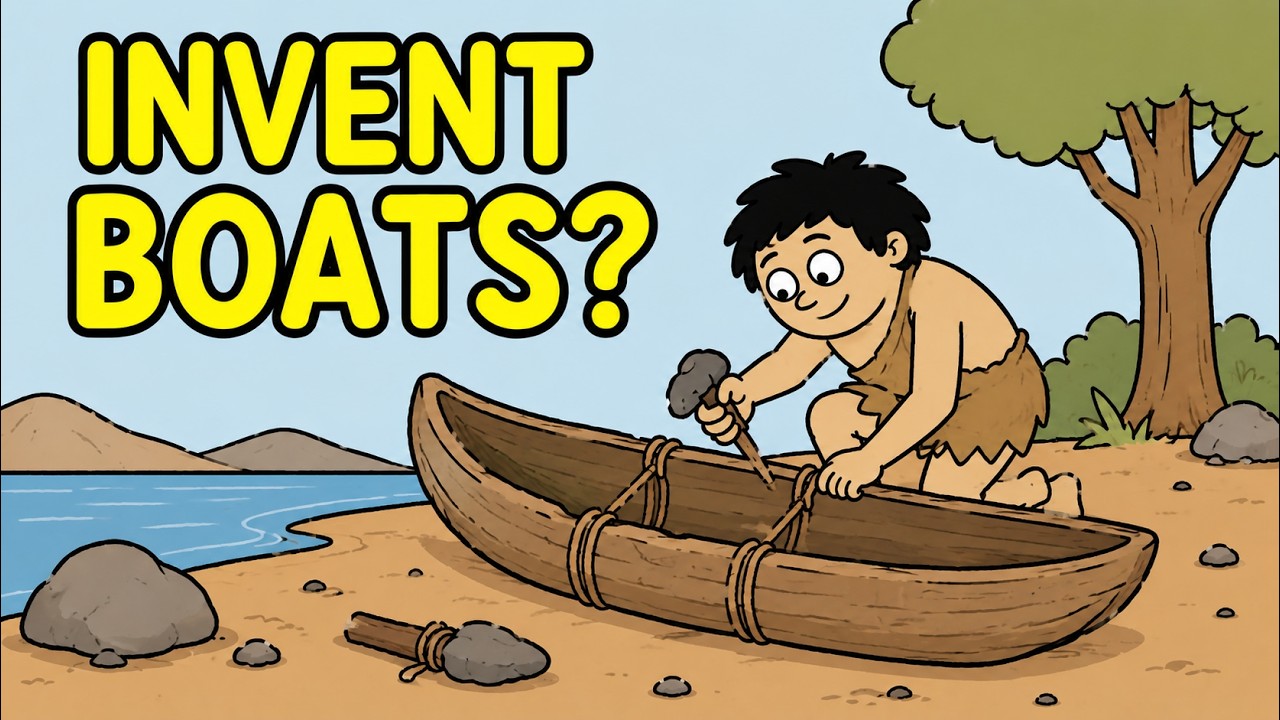
Sitting inside the hollow lowered the center of gravity, making the vessel far more stable than sitting on top. The earliest attempts were crude and often failed—canoes tipped or split—but each failure taught something about wall thickness and balance. This was engineering, even without a name for it. Then fire changed everything.
Humans had controlled fire for at least 400,000 years. Someone discovered that burning the interior of a log softened the wood fibers, allowing them to be scraped away easily. By alternating burning and scraping, and protecting the outer hull with wet clay, builders could produce a canoe in days instead of weeks. Fire also delivered more consistent results than stone tools, which followed the grain of the wood and often split it unpredictably.
The oldest confirmed wooden boat in the world is the Pesse canoe, found in the Netherlands in 1955. The carved pine log, blackened inside, measured about 3 meters long and just over 40 centimeters wide, and radiocarbon dating placed it between 10,000 and 9,500 years old. In 2001, archaeologist Jaap Boekman built a full-scale replica using the same methods and paddled it on open water; it floated and was stable enough to use. But the Pesse canoe is far from the oldest evidence of humans building watercraft.
It is simply the oldest surviving object. Wood decays, and most early boats have rotted away. What remains is evidence of where those boats went. Stone tools found on the island of Flores in Indonesia have been dated to at least a million years ago, and Flores was never connected by land to any mainland.
The island could not be reached without crossing deep ocean water. The creatures who left those tools were not modern humans—they were likely Homo erectus, crossing open water long before our species evolved. Similar evidence exists on Sulawesi, dating back over a million years, and on Luzon in the Philippines, at roughly 700,000 years. Whether those crossings were planned voyages or accidental events involving floating debris during storms remains debated, but the fact is clear: hominins breached major ocean barriers more than a million years ago.
Modern humans made their own planned crossings around 50,000 to 60,000 years ago, when people sailed from Southeast Asia to Sahul, the landmass that became Australia and New Guinea. That voyage required navigating at least 70 to 90 kilometers of open ocean, out of sight of land. The people who made it were as cognitively sophisticated as any human alive today. They lacked accumulated knowledge, not intelligence.
Their descendants became the Aboriginal Australians, and the boats they used worked. Building a canoe was never a solo project. It required finding the right tree, felling it, moving it without wheels, hollowing it, and mastering the skills to paddle it. This knowledge was shared and taught across generations, and it improved steadily.
Someone discovered which wood resisted splitting, how to make the interior smoother to reduce drag, and how narrowing the ends helped the canoe cut through water. Technology developed not in flashes of genius but through the slow accumulation of small improvements. The single-log dugout had limits. A tree trunk could only be so wide, and a narrow boat tips easily.
Builders solved this with rafts—multiple logs lashed together with plant-fiber rope for stability and load capacity. Rope itself was a sophisticated technology; a fragment of three-ply twisted plant fiber rope found in France dates to approximately 50,000 years ago, well before the oldest confirmed boats. Rope allowed builders to join separate pieces into unified structures, unlocking new designs: outriggers for stability, planks lashed to raise hull walls, and multi-hull vessels that appeared independently in different parts of the world. Environment drove innovation.
In the Arctic, where trees were scarce, people built kayaks from animal hides over frames of bone and driftwood—a completely waterproof craft so well designed it could roll over in rough water and be righted by a skilled paddler. In the Pacific, builders developed the outrigger canoe, which paired a narrow fast hull with a secondary float to prevent rolling. With a crab-claw sail, these canoes could even make progress against the wind. These were not primitive vessels; they were optimized solutions to specific problems.
The navigators who sailed these canoes across the Pacific were not guessing. They read the night sky with precision, memorizing which stars rose at which points on the horizon. They understood the sun’s arc and could estimate their latitude. They could read ocean swells that bent around islands they could not yet see, and they watched for frigate birds, which ranged only a limited distance from land.
Drifting vegetation, water color, and the smell of soil all provided information. This knowledge was built over generations; every navigator who made an error did not return, and the knowledge that survived was the knowledge that worked. The Caroline Islands navigators of Micronesia developed a system in which the navigator conceived the boat as stationary while the sea and islands moved around it, allowing them to track the position of known islands even beyond the horizon. This sophisticated form of dead reckoning required memorizing dozens of island positions relative to star bearings and holding them in mind during multi-day voyages.
It was not primitive; it was a different tool for solving the same problem that modern GPS solves. By around 3,000 years ago, Austronesian navigators began expanding into the open Pacific. Over the next 2,000 years, they settled every habitable island in the ocean, including Hawaii, over 3,200 kilometers from the nearest significant land, and Easter Island, over 2,000 kilometers from the nearest Polynesian island. New Zealand, the last major landmass on Earth settled by humans, was reached around 700 years ago.
These were not accidental discoveries; oral traditions and genetic evidence confirm deliberate return voyages between islands. The people who colonized the Pacific sailed out, found land, sailed back, and sailed out again with families and supplies. The invention of the sail came next. Paddles had limits—a crew tired, and muscle power could only push a boat so far so fast.
Someone noticed that wind pushes things, from hides hung to dry to leaves skittering across a pond. The first sails were likely accidental discoveries, and the leap from accident to deliberate rigging seems to have happened independently in several places. The oldest physical evidence of a sail comes from an Egyptian painted ceramic vessel dating to around 5,500 years ago, but boat remains with mast sockets from the Persian Gulf from the same period suggest sails existed even earlier. A sail changed what boats could do.
Wind catches continuously without fatigue, and a sailing ship could travel farther and carry larger loads than any paddled vessel. Boats stopped being tools for crossing rivers and became tools for crossing seas. This changed societies. A community with a boat could trade its goods over distances that landlocked communities could not imagine.
Raw materials could be moved to where they were needed. The great Bronze Age civilizations of the Mediterranean—the Phoenicians, Minoans, and Mycenaean Greeks—were built on maritime commerce. The Phoenicians established trade colonies across the entire Mediterranean, from Cyprus to the coast of Spain, carrying goods that created a single economic zone connected by sea lanes. The same pattern emerged independently in the Indian Ocean, where Arab and Indian merchants moved spices, cotton, and precious stones across thousands of kilometers, and in the Pacific, where Polynesian traders moved obsidian hundreds of kilometers across open ocean.
Before boats, every community lived on what it could find locally. After boats, communities could specialize, trade, and develop the economic activities they were best suited for. The consequence was not just economic—ideas traveled on boats too. Agricultural techniques, religious practices, languages, diseases, plants, and animals all moved wherever boats went.
The Austronesian expansion carried a common vocabulary, boat-building methods, and crops like breadfruit and taro from Hawaii to New Zealand to Madagascar. More than 40% of the world’s population today lives within 100 kilometers of a coastline. That fact is not a coincidence; it is the demographic footprint of 10,000 years in which coastal locations were more prosperous and more connected than landlocked ones. The great cities of civilization—Ur, Alexandria, Carthage, Rome, Constantinople, Guangzhou, Venice, Lisbon, London—were port cities.
The age of exploration that began in the 15th century was built on every piece of boat-building and navigation knowledge accumulated over the preceding millennia. The ships that carried Columbus and Vasco da Gama descended from the practical discoveries of people who had never heard of Europe. The cargo ship cutting through the ocean today displaces water according to the same principle that kept the first floating log from sinking. Archimedes named that principle; an early human discovered it practically at a river somewhere in a world that no longer exists.
Modern engineers learned the physics formally in classrooms; a prehistoric boat builder learned it by watching what happened when a hollowed log sat in water. The descriptions are different in their precision, but the reality they describe is the same. The instinct that made a prehistoric human reach for a floating log—the willingness to test an idea against the physical world, to observe what worked and what did not, and to try again—is the same instinct that produces modern engineering. The scale, tools, and mathematical formalism are different; the underlying cognitive act is not.
That instinct is the most consistent thing about human beings across our entire existence. Presented with a wall, we eventually figure out how to get past it. Water was the biggest wall early humans faced. They got past it with a log, then a hollowed log, then a raft, then a sail, then a navigation system built from stars and waves and birds, and then, over millennia, everything else.
The cargo ship is not the end of that story; it is the most recent chapter, made possible by the long, slow, brilliant work of 10,000 generations of ordinary people who built boats and crossed water.

