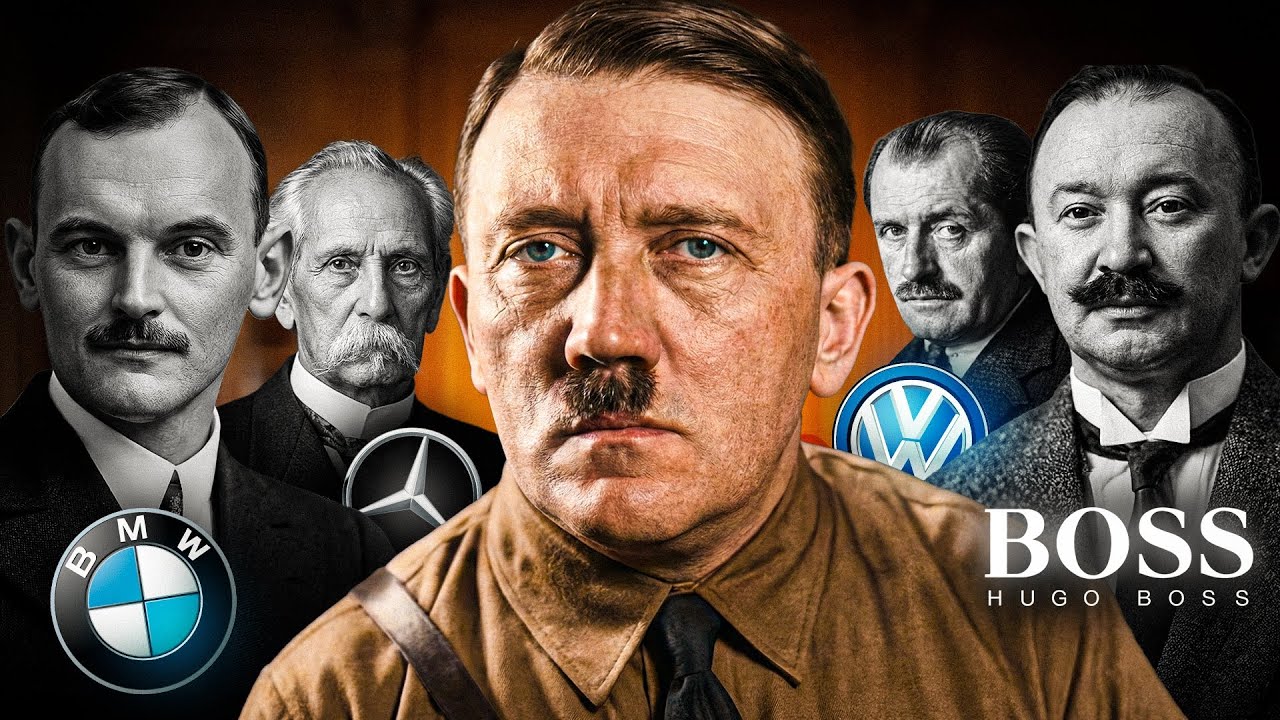
Major global corporations that powered the Nazi war machine during the 1930s and 1940s not only survived the devastation of World War II but continue to dominate industries today. From Volkswagen to Hugo Boss, these firms’ dark legacies are woven into their postwar reinventions, revealing a chilling continuity of influence and controversy.
Among the most notorious was IG Farben, a colossal chemical conglomerate deeply entwined with Nazi Germany’s military ambitions. Formed by merging Germany’s biggest chemical companies in 1925, IG Farben aggressively invested in synthetic fuels and rubber to bypass resource shortages. Its factories, crucial to the war effort, were strategically positioned to support Germany’s Four-Year Plan of 1936.
However, IG Farben’s involvement extended horrifyingly into the Holocaust itself. Its Monowitz plant near Auschwitz used thousands of forced laborers under brutal conditions. The conglomerate also had stakes in Degesch, which manufactured Zyklon B gas—the deadly agent of mass murder in Nazi extermination camps. The scale of IG Farben’s complicity ignited fierce legal scrutiny after the war.
After Germany’s defeat, Allied forces deemed IG Farben too compromised to continue and prosecuted its executives in the 1947–48 Nuremberg trials. Charges included plunder and exploitation of forced labor. Though sentences varied, the company was dismantled by 1952, splitting into BASF, Bayer, and Hoechst—firms that emerged as pharmaceutical and chemical titans while carrying the indelible shadow of their origins.
Other firms shared this dark history but managed to reinvent themselves as postwar Germany recovered. Volkswagen, conceived in 1937 as the “People’s Car” under Nazi guidance, converted swiftly to produce military vehicles and components. The company heavily relied on forced labor from occupied territories, a fact later acknowledged amidst ongoing reckonings.
When British forces seized Volkswagen’s damaged Fallersleben factory in 1945, they surprisingly chose revival over dissolution. With Major Ivan Hirst’s leadership, production resumed, focusing initially on supplying Allied occupation forces. By the 1950s, Volkswagen’s iconic Beetle transformed it into a global automotive powerhouse, masking a wartime past fraught with exploitation.
BMW and Daimler-Benz also expanded rapidly during the Nazi era, becoming key suppliers of aircraft engines, military trucks, and elite cars. Both companies employed coerced labor from occupied nations to meet surging wartime production demands. Allied bombings devastated their factories, but they successfully rebuilt, later becoming symbols of German engineering excellence.
BMW’s survival was precarious until the Quandt family intervened in 1959. The Quandts, themselves enriched by wartime industry and forced labor associations, financially rescued BMW from absorption, ushering the company into an era of growth. Daimler-Benz recovered quicker, continuing to expand internationally while confronting its wartime legacy through compensation programs.
Unlike automakers, textile manufacturer Hugo Boss adopted a different route but with equally troubling associations. Founder Hugo Ferdinand Boss joined the Nazi Party in 1931, securing lucrative contracts to produce SS, SA, and Hitler Youth uniforms. The company’s wartime workforce included approximately 180 forced laborers, primarily women from Poland and prisoners of war from France.
Postwar denazification penalized Boss severely, ending his control of the company shortly before his death in 1948. Under new management, the firm transitioned from producing uniforms to workwear and eventually high-end menswear. Nonetheless, revelations about the company’s Nazi ties in the late 1990s ignited legal challenges and led to formal apologies and reparations efforts.
Today, these corporations maintain dominant positions in their respective industries while grappling publicly with their origins. IG Farben’s dissolution contrasts sharply with the survival and flourishing of Volkswagen, BMW, Daimler-Benz, and Hugo Boss, whose histories reveal the complex interplay between commerce, ideology, and accountability during and after one of history’s darkest chapters.
This reckoning underscores a broader historical narrative: that global industrial giants’ transformations post-1945 often masked uncomfortable truths about their roles in sustaining the Nazi regime. Their stories compel an ongoing reflection on how deeply intertwined business and political power shaped—and continue to influence—the modern economic landscape.
The legacy of coerced labor persists as a key issue. Volkswagen and BMW have acknowledged forced labor, contributing to compensation foundations. Hugo Boss’s admission and apology came after external legal pressure unveiled its indebtedness to coercive wartime economies. These acknowledgments mark critical steps in confronting corporate complicity in systemic atrocities.
Direct links between these companies’ wartime operations and present-day successes spark intense debates among historians, legal experts, and human rights advocates. The question remains whether economic survival justified close collaboration with a genocidal regime or if these firms bore profound moral responsibilities extending into contemporary business ethics.
Their histories also highlight the difficulty of post-conflict justice in disentangling commercial interests from ideological crimes. Trials like those against IG Farben executives achieved limited deterrence, while many implicated individuals reintegrated into postwar industry. This duality challenges narratives of clear-cut justice after systemic abuses.
Industrial rebuilding in West Germany was heavily influenced by these companies’ capacity to reorient production toward peacetime economies. Volkswagen’s postwar revival under Allied oversight and BMW’s turnaround due to private investment exemplify how economic pragmatism sometimes superseded thorough denazification in the pursuit of national recovery.
The transformation of Hugo Boss from a uniform manufacturer tied to Nazi ideals into a global fashion brand epitomizes the complexities of historical reputation management. It reveals tensions between commercial branding and confronting foundational legacies, particularly when original business models were rooted in authoritarian regimes.
Scrutiny of wartime corporate roles continues to evolve as archives open and new research emerges. For many, these revelations prompt urgent questions about corporate governance, historical memory, and the ethical dimensions of global capitalism shaped amid catastrophic conflict.
As consumers and governments demand greater transparency, companies harboring Nazi-era legacies face heightened pressure to fully disclose histories and participate in restorative initiatives. The trajectory from complicity to accountability remains a fraught yet necessary journey for these enduring industrial powers.
The narratives of Volkswagen, BMW, Daimler-Benz, Hugo Boss, and the shattered titan IG Farben form a powerful tableau illustrating how industrial empires best known for innovation and design were built on wartime exploitation and cooperation. Their stories serve as stark reminders of the enduring impact of history on modern business.
Acknowledging these uncomfortable truths does not diminish the technological achievements or global market success of these firms. Instead, it emphasizes the imperative to integrate ethical reflection into the framework of corporate heritage—ensuring that remembrance and responsibility guide future progress.
The intertwined legacies of commerce and conflict laid bare in this exposé demand urgent, sustained examination. As these companies continue to exert vast influence worldwide, the need to confront their haunted pasts remains not only a matter of historical justice but a crucial component of global corporate accountability today.