For forty years, Margaret “Maggie” Carter believed that loyalty, patience, and love could survive almost anything. She had stood beside her husband, Richard Carter, through the uncertainty of starting a small construction business, years of financial hardship, the birth of their two children, countless sleepless nights, and every success that followed. While Richard became known throughout their Connecticut town as a respected businessman, Maggie quietly managed everything behind the scenes. She raised their family, handled the household finances, cared for aging parents, and sacrificed many of her own dreams so his could flourish. She never imagined that after four decades together, the man she had devoted her entire adult life to would decide she had become disposable.
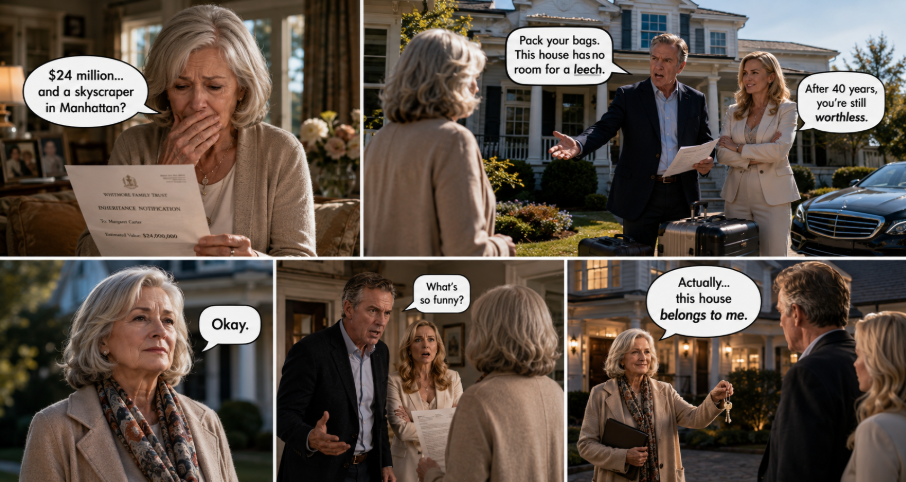
The day everything collapsed began like any other Tuesday. Maggie had spent the morning volunteering at the local community center before driving home, unaware that only hours earlier she had received a voicemail from an attorney in New York asking her to return an urgent call regarding the estate of her late Aunt Eleanor Whitmore. Maggie noticed the missed call while sitting in her car but assumed it could wait until evening. She had no idea that the message would change her life forever.
When she walked toward the front porch, she immediately sensed something was wrong. Richard stood at the entrance with a cold expression she had never seen before. Beside him stood Vanessa Collins, a woman nearly thirty years younger who worked in Richard’s corporate office. Maggie recognized her from several company holiday parties but had never suspected how deeply she had already entered her husband’s life.
Richard didn’t even invite Maggie inside.
“We need to talk,” he said flatly.
Vanessa folded her arms and smirked as if she had been waiting for this moment.
Richard handed Maggie a thick envelope.
“I’ve filed for divorce.”
For a brief second Maggie thought it had to be some kind of misunderstanding. Forty years of marriage could not possibly end with a few sheets of paper on the front porch.
Richard continued before she could respond.
“I’m tired of carrying someone who contributes nothing. I’m done supporting a leech.”
Vanessa laughed quietly before adding, “Pack your things. Richard and I are starting over, and frankly, this house has no room for dead weight.”
The words stung more than Maggie expected. Not because she believed them, but because they came from the two people standing together while dismantling the life she had spent decades building.
She looked from Richard to Vanessa and simply asked, “Is this really how you want to remember forty years together?”
Richard shrugged.
“It ended a long time ago.”
Without raising her voice or creating the dramatic confrontation they clearly expected, Maggie nodded.
“All right.”
Vanessa frowned.
“That’s it? You’re not even going to fight?”
Maggie offered the faintest smile.
“No.”
She walked inside, packed two suitcases containing only her personal belongings, family photographs, several books, and her mother’s wedding ring. Before leaving, she took one last look around the house where she had celebrated birthdays, Christmas mornings, graduations, and anniversaries that now felt strangely distant.
As she drove away, she finally returned the attorney’s phone call.
The voice on the other end belonged to Daniel Whitmore, legal counsel for the Whitmore Family Foundation in Manhattan.
“Mrs. Carter,” he said warmly, “I’ve been trying to reach you. First, allow me to express my deepest condolences regarding your Aunt Eleanor.”
Maggie thanked him quietly.
“There is another matter we need to discuss immediately,” Daniel continued. “Your aunt named you the sole beneficiary of her estate.”
Maggie expected perhaps a few family heirlooms or charitable responsibilities.
Instead, Daniel calmly explained that Eleanor had left her an inheritance valued at approximately twenty-four million dollars, including controlling ownership of a historic Midtown Manhattan office tower, several investment portfolios, and leadership of the Whitmore Community Foundation, an organization that had quietly funded hospitals, scholarships, homeless shelters, and veterans’ assistance programs throughout New York for decades.
Maggie pulled her car onto the shoulder of the highway.
“I’m sorry,” she whispered. “Could you repeat that?”
Daniel repeated every detail.
For several minutes she simply sat in silence.
The irony was almost impossible to comprehend. On the very day her husband declared she had nothing, she had inherited more wealth than either of them had ever imagined.
But something inside Maggie told her not to call Richard.
Not yet.
Over the following week, she traveled to Manhattan to review legal documents and meet the foundation’s board of directors. Eleanor had intentionally kept much of her wealth private, believing public attention distracted from meaningful charitable work. She had admired Maggie’s compassion for years and believed she possessed the integrity needed to continue that mission.
As Maggie settled into temporary accommodations provided by the foundation, another unexpected discovery emerged during the legal review.
Years earlier, when Richard’s business had nearly collapsed during a severe economic downturn, creditors had threatened to seize nearly every family asset. To protect their home from possible business liabilities, Richard’s attorney had recommended temporarily transferring ownership solely into Maggie’s name because she had no involvement in the company.
The crisis eventually passed.
No one ever transferred the deed back.
Richard apparently forgot.
Maggie hadn’t.
She had simply never considered it important.
Until now.
Two weeks later Richard proudly hosted an engagement celebration at what he believed was now exclusively his home. Vanessa eagerly began planning expensive renovations, discussing luxury furniture and designer landscaping with friends as though the property already reflected her future.
Their celebration came to an abrupt halt when a real estate attorney, accompanied by a county official, knocked on the front door.
Richard confidently opened it.
“There must be some mistake.”
“There isn’t,” the attorney replied politely.
He handed Richard certified documents confirming that legal ownership of the property belonged entirely to Margaret Carter.
Richard’s smile disappeared.
“This house can’t be mine to give away because it was never mine to keep.”
The attorney explained that Mrs. Carter had exercised her legal rights as the sole property owner and had given formal notice requiring Richard and any unauthorized occupants to vacate the residence according to state law.
Vanessa’s face turned pale.
Richard immediately called Maggie.
She answered calmly.
“What kind of game is this?”
“It’s not a game, Richard.”
“You planned this.”
“No,” Maggie replied. “You simply never bothered to understand what belonged to whom.”
There was a long silence.
Then Richard asked quietly, “Why didn’t you tell me?”
“You never asked.”
Several days later, Maggie returned briefly to supervise the transition. Richard looked exhausted, while Vanessa stood silently beside packed boxes.
“You knew about the inheritance,” Richard finally said.
“Yes.”
“And you still walked away?”
“I walked away because you had already decided my value before knowing what I owned.”
Vanessa muttered, “People don’t just throw away twenty-four million dollars.”
Maggie smiled gently.
“No. But people who respect themselves walk away from those who believe money determines human worth.”
She wished them both well before leaving for New York.
Life gradually transformed in ways Maggie never expected. Instead of purchasing extravagant mansions or luxury yachts, she immersed herself in Eleanor’s charitable foundation. She expanded scholarship programs for first-generation college students, funded affordable housing initiatives, created grants for women rebuilding their lives after domestic hardship, and established vocational training centers for military veterans transitioning into civilian careers.
She also reconnected with her adult children, Emily and Michael, making it clear that her inheritance was never intended to replace hard work but to create opportunities for others. Together they modernized the foundation while preserving Eleanor’s vision of quiet generosity rather than public recognition.
For the first time in decades, Maggie built a life defined not by someone else’s expectations but by her own purpose.
Meanwhile, Richard’s carefully constructed future slowly unraveled. His business struggled after several risky investments failed. Former clients questioned his judgment following the highly public divorce, while Vanessa became increasingly frustrated as the glamorous lifestyle she expected never materialized. Their relationship, once fueled by excitement and secrecy, gradually collapsed under financial pressure, distrust, and mutual resentment.
Neither could blame Maggie for their downfall.
Their choices had created it long before she ever inherited a single dollar.
Months later, Richard requested one final meeting.
They met at a quiet café overlooking Central Park.
“I’ve replayed everything a thousand times,” he admitted. “I kept thinking the money changed you.”
Maggie stirred her coffee thoughtfully.
“No, Richard.”
She looked directly into his eyes.
“The money didn’t change either of us.”
He waited.
“It simply revealed who we already were.”
Richard lowered his head, understanding there was no argument left to make.
As Maggie walked through Central Park afterward, she realized she no longer carried anger. Hatred would only have kept her emotionally tied to the life she had already left behind. Forgiveness was not something she offered because Richard deserved it. It was something she chose because she deserved peace.
Looking across the Manhattan skyline her aunt had entrusted to her care, Maggie understood the greatest gift Eleanor had left behind was never the skyscraper or the twenty-four million dollars.
It was the freedom to live with dignity, compassion, and self-respect.
Because in the end, wealth never creates character.
It simply reveals it.