“We all voted that she should stay,” my parents wrote after abandoning my 8-year-old at the airport…
The call came at 11:47 a.m. on a Thursday.
I was in the middle of a work meeting when my phone lit up with an unknown number. I almost let it go to voicemail. Something made me step out into the hallway and answer.
“Is this the mother of Sophie Lang?” a calm woman’s voice asked.
“Yes.”
“This is Officer Reyes with airport security at Terminal B. Your daughter is here with us. She’s safe, but she’s alone. Her grandparents boarded a flight without her.”
The hallway suddenly felt too narrow.
“I’m on my way,” I said. My voice sounded strange even to me—flat, controlled. “Please don’t leave her with anyone else.”
I hung up, sent a short message to my boss that I had a family emergency, and drove to the airport with both hands locked on the wheel. I did not cry. I did not call my mother. I did not call my sister. There would be time for that later. Right now there was only Sophie.
I found her sitting in a small security office, feet not quite touching the floor, holding a juice box someone had given her. Her little pink suitcase stood upright beside the chair. When she saw me she slid off the seat and ran straight into my arms hard enough to knock the air out of my chest.
“They left,” she whispered into my coat. “Grandma said the plane was full. She said they all voted.”
I held her tighter. “I’ve got you. You’re okay.”
Officer Reyes handed me a folded piece of paper. “She was carrying this. Said her grandmother gave it to her before they went through the gate.”
I opened it with one hand while the other stayed on Sophie’s back.
My mother’s handwriting.
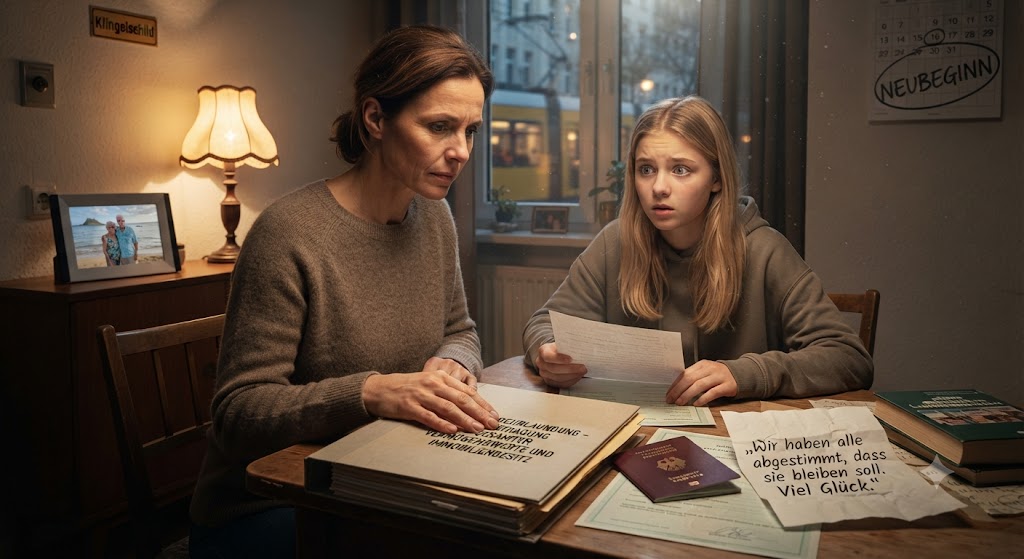
We all voted that she should stay. It will be easier this way. Don’t make a scene.
No apology. No phone number. No offer to turn around. Just those three lines, written as if they were reasonable.
Sophie pulled back enough to look at me. Her eyes were red but dry now. “Did I do something wrong?”
“No,” I said. The word came out low and absolute. “You did nothing wrong. Not one thing.”
I thanked the officer, signed whatever papers they needed, and took my daughter home. In the car she sat very quiet, watching the traffic. At a red light she asked, in a small voice, “Are Grandma and Grandpa mad at me?”
“No,” I told her. “They’re mad at something else. Grown-up things that have nothing to do with you.”
She nodded, but she kept her hands folded tightly in her lap the rest of the way home.
That night, after Sophie finally fell asleep with the hallway light on, I sat at the kitchen table with the note in front of me and my laptop open. I did not shout. I did not send angry texts. I did something quieter and far more permanent.
First I opened the shared family calendar. The trip was listed as “Hawaii – Family Vacation.” First-class seats for six people: my parents, my sister Rachel, her husband, and their two children. Sophie’s name had been on the original booking. I knew because I had paid the deposit three months earlier when my mother claimed they were “a little short this year.”
I pulled up the airline app, found the reservation, and removed every payment method connected to my accounts. Then I called the airline’s customer service line and calmly reported that I would no longer be financially responsible for any changes, upgrades, or additional charges on that booking. The representative was polite. She noted the request.
Next I opened my banking app. There were four automatic transfers I had set up years ago “just until things stabilized.”
One for my parents’ supplemental health insurance. One for the storage unit they insisted on keeping. One for Rachel’s older son’s private tutoring, which I had agreed to help with “for a few months.” One small monthly contribution to the family vacation fund that somehow never included Sophie in the expensive parts.
I canceled all four. Confirmation emails arrived within minutes.
Then I went into the cloud photo album we had all shared for years. I downloaded every picture of Sophie, then removed myself from the album entirely. Same with the group chat labeled “Lang Family Updates.” I left without a farewell message.
By 1:14 a.m. the practical work was done. I closed the laptop, checked on Sophie one more time, and went to bed. I slept better than I had in months.
The first call came the next afternoon.
My mother.
I let it ring twice before answering on speaker while Sophie colored at the table a few feet away.
“Ellie,” she said, already sharp. “What did you do to the airline reservation? They’re saying the payment method was removed.”
“I removed it.”
“You can’t just— We needed that card for the seat upgrades. Rachel’s children are flying first class. It looks terrible if—”
“Sophie was left at the airport,” I said. My voice stayed even. “With a note that said you all voted she should stay.”
A short silence. Then the familiar pivot. “You’re exaggerating. There wasn’t enough room. The tickets were complicated. We thought it would be simpler if she stayed with you. You’re her mother.”
“I’m her mother,” I agreed. “Which is why I’m the one who drove to the airport to pick up the child you abandoned.”
“Abandoned is a dramatic word.”
“It’s the accurate one.”
My mother exhaled hard. “Rachel said you would react like this. Always so sensitive about Sophie.”
I looked at my daughter. She had stopped coloring and was watching me with careful eyes.
“I’m going to go now,” I said. “Don’t call this number again unless it’s an emergency involving someone else’s child.”
I hung up.
Rachel called twenty minutes later. I did not answer. She left a voicemail that managed to sound both injured and superior. I deleted it without listening past the first sentence.
On the third day the tutoring company emailed to say the account was past due. On the fourth day the storage facility sent a notice. On the fifth day my father’s supplemental insurance lapsed and the company sent a polite but firm letter. None of those problems were mine anymore.
Sophie asked only once more about her grandparents. We were making grilled cheese for dinner when she said, very quietly, “Do they still love me?”
I set the spatula down and crouched so we were eye level.
“I don’t know what they feel,” I told her. “But I know what they did. And I know that love doesn’t leave a little girl at an airport with a note. You never have to wonder about that with me. I will never leave you. I will never vote you out.”
She nodded slowly. Then she leaned forward and rested her forehead against mine for a few seconds, the way she used to when she was smaller.
“Okay,” she whispered.
By the seventh day the consequences had rippled further than I expected. Rachel’s husband called from Hawaii—collect, because apparently their payment methods were in temporary chaos. I declined the charges. My mother sent a long text about how I was “destroying the family over a misunderstanding.” I screenshotted it, saved it, and did not reply.
That evening Sophie and I ordered pizza and watched a movie she had been wanting to see. Halfway through she fell asleep with her head on my shoulder. I sat there in the dark living room listening to her breathe and felt something settle in my chest that had been missing for years.
The following week I met with a family lawyer—not for a lawsuit, not for revenge, just for clarity. I wanted every shared account, every automatic payment, every informal agreement documented and closed. The lawyer, a calm woman named Ms. Patel, listened to the whole story without visible reaction until I finished.
Then she said, “You did the right thing by removing financial entanglement first. People like this often escalate when money stops flowing. Document everything. Keep the note. Keep the airport report. And if they try to insert themselves into Sophie’s life again without your consent, we already have a paper trail.”
I nodded. It felt strange to be believed so quickly.
In the months that followed, the silence from my parents became permanent. Claire—my other sister who had stayed carefully neutral for years—sent one careful message: I heard what happened. I’m sorry. I should have said something sooner. I thanked her and left it there. Some bridges can be rebuilt. Others are better left as ruins.
Sophie started sleeping through the night again. She stopped checking the driveway for cars that weren’t coming. At school she began raising her hand more. Her teacher mentioned that she seemed “lighter.”
On her ninth birthday we invited three friends, ordered too much cake, and played in the backyard until the mosquitoes drove us inside. No one mentioned grandparents. No one looked at the door expecting someone who had chosen not to be there.
That night, after the last friend was picked up, Sophie sat on the couch with a piece of leftover cake and said, “I’m glad it was just us.”
“Me too,” I answered.
She was quiet for a moment. Then: “If they ever say they want to see me again, do I have to?”
“No,” I said. “You never have to. That’s a choice you get to make when you’re older, if you want. Not before.”
She considered that, then nodded once, satisfied.
I still have the note. It’s in a folder with the airport incident report and the bank confirmations. I don’t look at it often. I don’t need to. The memory of my daughter’s face when she asked if she had done something wrong is clearer than any piece of paper.
Some families vote with ballots. Mine voted with boarding passes and a folded note left in a child’s hand.
I voted back with every canceled payment, every closed account, and the simple decision to never again let my daughter wonder whether she was wanted.
Seven days was all it took for their carefully balanced life to start tilting. It has not stopped tilting since.
And Sophie? Sophie is fine. Better than fine. She knows exactly where she belongs.