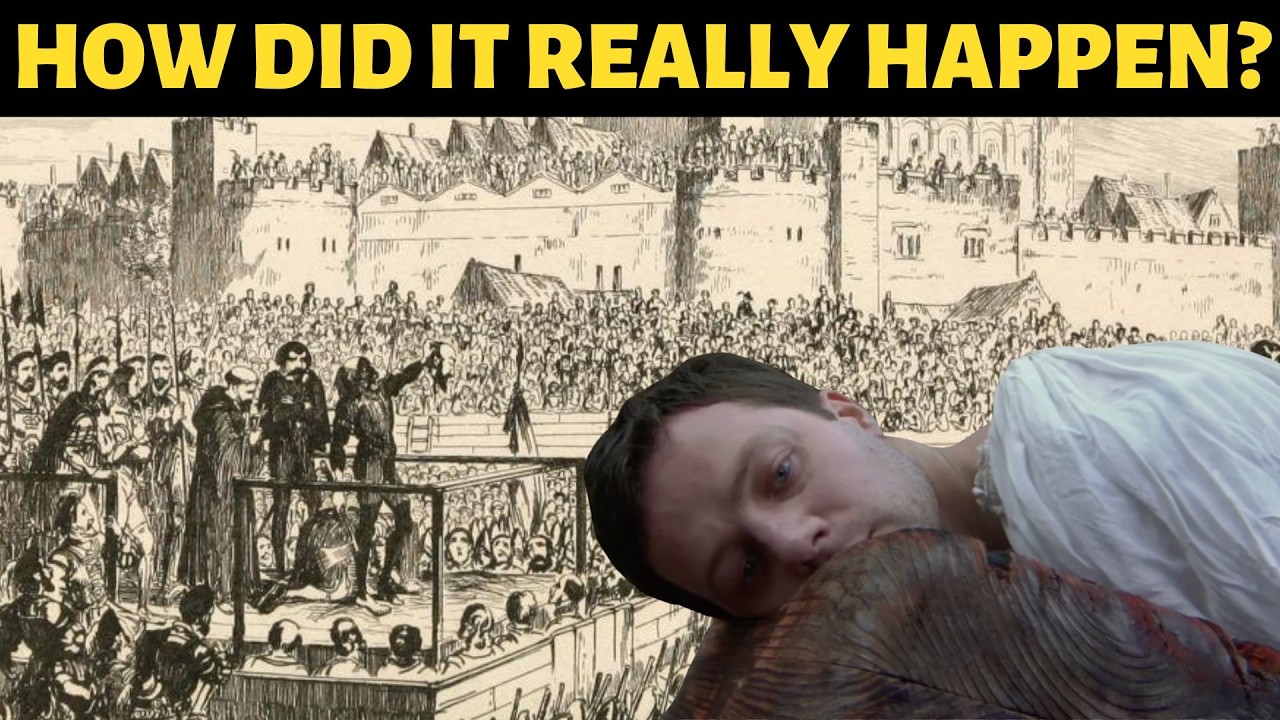
Convicted of incest with his famous sister Queen Anne Boleyn and sentenced to die on the infamous Tower Hill in London, George Boleyn, Viscount Rochford, faced his execution on May 17, 1536, with a speech that would echo through history. The brother of the disgraced queen was the last of five men to be beheaded that day, and new accounts from contemporary sources reveal a man who met his death with remarkable composure, refusing to admit guilt to the specific charges but acknowledging his sins as a sinner. The grisly end of the 32-year-old courtier marked the culmination of a swift and brutal fall from grace that had begun just two weeks earlier when Henry VIII’s patience with the Boleyn family finally snapped.
George Boleyn was born around 1504, the younger brother of Anne Boleyn, who would become Henry VIII’s second wife in 1533. No authentic images of him survive, but his rise mirrored his sister’s ascent. He married Jane Parker in 1525 or 1526, and by 1529 he had been created Viscount Rochford.
As Anne’s star soared, so did his own, but when the queen fell from favor in the spring of 1536, George was dragged down with her. The king had grown tired of Anne and wanted to marry Jane Seymour, and the machinery of destruction was set in motion with terrifying speed.
The crisis erupted on May 1, 1536, when George competed in the May Day tournament completely unaware of the storm about to break.
The very next day he was arrested, along with his sister and two other men. A third man was already in custody, and more would follow. The group was accused of adultery with Queen Anne, meaning George faced the monstrous charge of incest.
All were imprisoned in the Tower of London to await trial. For George, that trial took place on Monday, May 15, in the King’s Hall inside the Tower. Anne had already been tried and found guilty earlier that same day.
Their four co-accused—Mark Smeaton, Sir William Brereton, Sir Henry Norris, and Sir Francis Weston—had been convicted on May 12 in Westminster Hall. George was the last to face Henry VIII’s so-called justice, and 2,000 people packed the hall to watch him fight for his life.
Presiding over the trial was George and Anne’s own maternal uncle, the Duke of Norfolk.
The Imperial Ambassador, Eustace Chapuys, later reported to his master Charles V of Spain that the Earl of Wiltshire, father of George and Anne, had wished to be present at the trial as he had been at the earlier one for the other four men. Wiltshire was not there, however, and only Chapuys recounts this rumor. Chapuys also noted that the charges included not only incest but also ridiculing the king and laughing at his manner of dressing, showing that Anne did not love him and was tired of married life.
The brother was charged with having had sexual relations with his sister. No proof of guilt was produced except that he had once passed many hours in her company and other little follies.
George answered so well that many present at the trial had no doubt he would be acquitted.
Chapuys wrote that witnesses were not called, which was unusual. The ambassador also mentioned a damning accusation: that Anne had told George’s wife, Jane Parker Boleyn, that the king was impotent. This charge was not read in public but was given to George in writing under protest, with instructions that he was only to say yes or no without reading it aloud.
 To the great annoyance of Thomas Cromwell and others, George read it aloud and said he was unwilling to create suspicion in a matter likely to prejudice the issue the king might have from another marriage. He was also charged with spreading a rumor that Princess Elizabeth, Anne’s daughter, was not the king’s child. To that charge he made no answer.
Charles Wriothesley, a herald and chronicler, wrote that George was arraigned for treason for supposedly imagining the king’s death and for incest. He made answer so prudently and wisely to all articles laid against him that it was a marvel to hear, and he never would confess anything but made himself as clear as though he had never offended. Lancelot de Carle, the French ambassador’s secretary, reported that at one point George had an outburst, saying, “On the evidence of only one woman, you’re willing to believe this great evil of me, and on the basis of her allegations, you are deciding my judgment.”
Many historians believe the woman he spoke of was his wife, Jane, suspecting she had given evidence against him. This accusation is a large part of why her reputation is still in ruins centuries later. However, other historians point to the letters exchanged between George and Jane while he was in the Tower, which indicate a good marriage, and suggest he was referring to the Countess of Worcester.
Historian Eric Ives supports the theory that Jane sold George and Anne down the river, citing the lost journal of Anthony Anthony, a clerk in the ordinance office, known only through notes made in the 17th century by a Mr. Thomas Tourneur. Bishop Burnet in the 17th century also claimed that Jane provided damning evidence, and though he is not a contemporary source, Ives argues he may have had access to evidence now lost.
A memorial written by George Constantine, a servant of Sir Henry Norris, to Thomas Cromwell, said that George and his sister were examined at the Tower, and “I heard say that he had escaped had it not been for a letter.” Nearly all the lords of the realm were present, and the Duke of Norfolk, their uncle, was judge. Constantine added that much money would have been laid that day on the odds that Lord Rochford would be acquitted.
Remarkably, all these sources agree that George defended himself extremely well. Despite Anne’s conviction, there was a strong feeling he might be spared, especially because the evidence against him was so slight. But his serious error in reading the embarrassing accusation about the king’s impotence probably sealed his fate.
Wriothesley’s Chronicle records that he was condemned by 26 lords and barons of treason, and the Duke of Norfolk pronounced the judgment: he should go again to prison in the Tower, then be drawn through the city of London to the place of execution called Tyburn, there to be hanged, cut down alive, his members cut off, his bowels taken out and burned before him, then his head cut off, and his body divided into four pieces. But Henry VIII commuted this gruesome sentence to simple beheading, showing a measure of mercy, just as he allowed Anne to be beheaded with a sword rather than burned or axed.
After the trial, George was taken back to his prison.
 The Constable of the Tower, William Kingston, wrote to Cromwell on May 16 that he had told Lord Rochford to be ready to suffer execution the next day, and “he accepts it very well and will do his best to be ready.” George even asked to receive the sacrament, which was not usual there. On May 17, George and the other four condemned men were taken out onto Tower Hill.
Chapuys described that Rochford, before dying, declared himself innocent of all charges but owned that he deserved death for having been contaminated with new heresies and causing others to be infected. He recommended all to forsake heretical doctrines and return to true faith. Chapuys also claimed that Anne was made to witness the execution from the windows of her prison, but this is highly unlikely.
No other source mentions it, and it would have been difficult for her to see from such a distance.
Far better accounts of George’s final minutes come from several other sources. An anonymous Spanish letter dated May 16 but finished after May 19 says that Lord Rochford made a good Catholic address.
He said he had not come to preach but to serve as a mirror and example. He acknowledged crimes against God and the king, and prayed for forgiveness. He bade listeners avoid the vanities of the world and the flatteries of the court.
He said it was worth more to be a good doer than a good reader. Wriothesley’s Chronicle provides a similar speech: “Masters all, I am come hither not to preach and make a sermon, but to die, as the law hath found me, and to the law I submit me.” He urged trust in God, not vanities of the world, and asked them to help set forth the true word of God.
He said he had been diligent to read it but not to live thereafter. The Chronicle of Calais also records his words: “Christian man, I am born under the law and judged under the law and die under the law, and the law hath condemned me.” He admitted he was a wretched sinner and asked forgiveness.
The most detailed description comes from a letter dated June 10, 1536, by a Portuguese man, Joaquim de Cruz. He wrote that Lord Rochford said three times, “Oh ye gentlemen and Christians, I was born under the law and I die under the law, for as much as it is the law which hath condemned me.” He then spoke about not coming to preach but to die, and begged prayers.
He confessed he deserved death even if he had a thousand lives. He said he knew not of any more perverse sinner. He warned gentlemen of the court to take heed not to fall into his error.
He prayed to the Father, Son, and Holy Ghost. He said he was a great reader of the word of God, but if he had followed it, he would not have come to this. “Better profiteth he who readeth not and yet doeth well, than he who readeth much and yet liveth in sin.”
 After making an end of speaking, he knelt down and his head was stricken off.
These accounts are remarkably consistent, far more so than those of Anne’s death. The fragments of vocabulary—vanities of the world, flatteries of the court, law condemning him—appear again and again.
Chapuys is the only source claiming George backtracked on his reformation leanings and returned to Catholicism. Historian Joseph S. Block argues that Rochford’s interest in reformed religion was a guiding light in his life.
About 1534, he gave two manuscript texts by French reformers to Anne, and he commissioned translations committed to putting scripture in lay hands. This does not sound like someone who would switch religion at the last minute. The standard execution speech format included asking for forgiveness, recommending better lives, praising the king, and not protesting the injustice.
George’s refusal to admit or deny the specific charges was an implicit statement of innocence, as viewers would have understood.
After his death, Chapuys said Rochford’s head and body were buried with those of the other men, but he did not specify where. John Stow’s Chronicles of England records that the Lord Rochford’s body with the head was buried in the Chapel of the Tower, meaning St.
Peter ad Vincula, while the other four were buried in the churchyard. Wriothesley agrees. George’s sister Anne was interred next to him two days later after her own execution.
When Victorians dug up the chapel floor in 1876 for restoration, they found Anne’s remains but not George’s. The assumption is that he lies under that floor still, just outside the area searched. His death was grisly, pointless, and a testament to the brutal politics of Henry VIII’s court.
The story of George Boleyn remains a cautionary tale of proximity to power, the fickleness of fortune, and the enduring mystery of what truly happened between him and his sister. Whether he died a reformer or a Catholic, his last words continue to fascinate historians and viewers alike, offering a window into the mind of a man who faced the ax with extraordinary dignity.