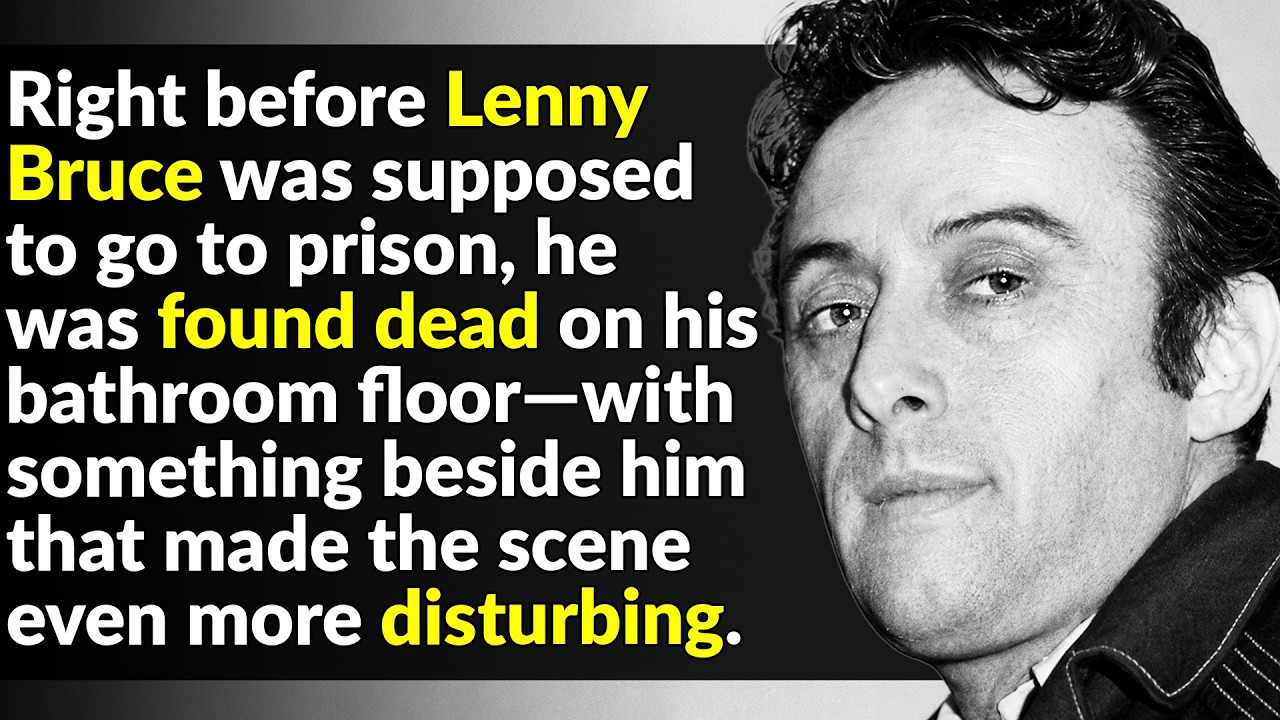
The body of Lenny Bruce, the most controversial and influential comedian of his generation, was discovered on the bathroom floor of his Hollywood Hills home, a needle still dangling from his arm and a final, grotesque punchline written in the silence of his death. The 40-year-old satirist, who had been sentenced just days earlier to four months in a workhouse for obscenity, was found unclothed, surrounded by the narcotics paraphernalia that had become his tragic co-star. The discovery, made by police who had come to serve his warrant, has sent shockwaves through the entertainment world, closing the book on a life that was as reckless as it was revolutionary.
The scene, described by law enforcement sources as a tableau of despair, has left investigators and fans alike grappling with the brutal finality of a man who once joked, “I’ll die young, but it’s like kissing God.” Those words, spoken during a rare moment of introspection about his addiction, have proven devastatingly prophetic. The coroner’s office has yet to release an official cause of death, but the presence of multiple syringes and a small cache of heroin and morphine nearby paints a grim picture of a life consumed by the very demons Bruce so often mocked on stage.
 Bruce’s journey to this tragic end began in a fractured childhood that seemed to foretell his turbulent path. Born Leonard Alfred Schneider in 1925, he was raised by a mother, Sally Marr, who was an aspiring comedian, and an absent father, Myron Schneider, a shoe clerk rarely seen at home. The divorce of his parents when he was just five years old set the stage for a life of instability, bouncing between relatives and receiving what he later described as a “spotty education.”
In one of his stand-up bits, he quipped, “I won’t say ours was a tough school, but we had our own corner. We used to write songs like, ‘What am I going to do if I grow up?’” The humor masked a deep-seated pain that would only intensify with time.
His mother’s influence, however, was undeniable. Sally Marr, who found moderate success as a comedian and later worked as a talent scout, instilled in Bruce a love for the stage. In a 1989 interview, she would boast, “People are always saying that everything in comedy stems from Lenny.
That everything touches him. What can I tell you? He took after me.”
But Bruce’s road to stardom was anything but direct. At 16, he joined the United States Navy in 1942, a decision that would lead to one of the most bizarre and controversial episodes of his early life.
In May 1945, Bruce, then a sailor, performed a drag show for his shipmates that had them rolling with laughter, but his commanding officers were not amused. The performance was followed by a shocking written confession to his superiors, in which Bruce claimed he was “normal in all aspects except for one” and admitted to being “attracted physically to a few of the fellow shipmates,” one of whom he said he kissed. The Navy medical officer testified that Bruce had admitted to “suppressing gay tendencies” and that the desire was becoming stronger.
After a neuropsychiatric consultation, the Navy dishonorably discharged him, citing his orientation as a liability.
 Decades later, in his memoir, Bruce would claim the entire incident was a practical joke, a ruse to get out of the Navy and pursue a career in comedy. “I think no one would accuse me of having behaved like a sissy,” he argued in his appeal for an upgraded discharge, but the damage was done. The episode, whether real or fabricated, foreshadowed a life of pushing boundaries and challenging authority, a pattern that would define his career and ultimately seal his fate.
After the Navy, Bruce settled in New York City, where he struggled to stand out in the crowded comedy clubs of the late 1940s. His first paid gig in 1947 earned him a paltry $12 and a spaghetti dinner, but he refused to give up. Over the next few years, he honed his craft alongside legends like Joe Ancis, Joe Maini, and Lord Buckley, slowly building a following with his ribald ad-libs and scathing political satire.
In 1951, he met and married Honey Harlow, a burlesque dancer from Manila, Arkansas, and the two became a volatile duo, their romance fueled by passion and narcotics.
Bruce was determined to make enough money to retire Harlow from her exotic dancing career, and he pursued a series of ill-conceived get-rich-quick schemes. In one of the most audacious, he posed as a priest, borrowing a clerical collar and clergy shirts to impersonate a clergyman in Florida. Dressed in his borrowed vestments, Bruce claimed to be collecting donations for a leper colony in British Guiana, setting up a real charity called the Brother Matthias Foundation.
In just three weeks, he collected $8,000, but in his autobiography, “How to Talk Dirty and Influence People,” he confessed to keeping most of the money for himself, with only $2,500 actually reaching the colony.
The courts struggled to determine if the scheme was authentic or an elaborate hoax, and Bruce escaped serious repercussions, even as church officials failed to prove he was an impostor. The incident was a testament to his skewed morality and his willingness to bend the rules for a laugh or a buck. In 1953, he and Harlow moved to Los Angeles, where he wrote and starred in the mafia-themed film “Dance Hall Racket,” a critical and commercial flop that only deepened his resolve to make it in stand-up.
 Bruce found his true voice in the seedy burlesque clubs of Los Angeles, where he worked as a master of ceremonies, introducing dancers and testing his material on eager crowds. His biographer noted that it was “precisely at the moment when he sank to the bottom of the barrel and started working the places that were the lowest of the low, that he broke free and became himself.” There, Bruce developed his unique style, blending jazz-influenced spontaneity with a raw, unflinching honesty that would make him a legend.
But his personal life was unraveling. In 1955, Harlow gave birth to their daughter, Kitty, but the marriage was far from stable. The following year, the couple separated briefly before reuniting for a working honeymoon in Honolulu, bringing their baby along.
While in Hawaii, Harlow was arrested on drug possession charges, and Bruce, seeing an opportunity, abandoned her and returned to the mainland with their daughter. Harlow was sentenced to two years in federal prison, and decades later, she revealed that Bruce had turned her in to the authorities in the first place.
Bruce’s betrayal was compounded by an affair with jazz singer Annie Ross, whom he courted with bizarre gestures like writing “I love you” on airplane sick bags. The relationship was a reflection of his twisted approach to love, a pattern that would continue as his career soared. By the late 1950s, Bruce had become a sensation, his recordings selling millions and his influence spreading to the nascent world of television.
He appeared on the Patrice Munsel Show alongside Buddy Hackett, dubbing their sketches “Not Ready for Primetime Players,” a name that would later be borrowed by Saturday Night Live.
But his success came at a cost. In 1957, he was fired from a prestigious gig at the Slate Brothers nightclub for what Variety called “blue material,” a pattern that would repeat itself as authorities cracked down on his obscene humor. Bruce remained unapologetic, arguing, “If God made the body and the body is dirty, then the fault lies with the manufacturer.”
 His defiance only made him more popular, but it also made him a target.
Between 1961 and 1964, Bruce faced multiple obscenity charges, most of which were dismissed by juries packed with fans. But in 1964, a New York jury found him guilty of obscenity, a verdict that stunned the entertainment world. Despite a public petition and glowing testimony from celebrities like Woody Allen, Bob Dylan, and James Baldwin, the judge sentenced him to four months in a workhouse.
Bruce was in no shape to serve the sentence, his health ravaged by years of addiction to heroin, morphine, and other substances.
The end came before he could serve a single day. On the morning of his death, police arrived at his home to serve the warrant, only to find his lifeless body on the bathroom floor. The needle in his arm and the drugs beside him were the final, tragic punchline to a life that had been a relentless battle against authority, convention, and his own demons.
In his eulogy, the Reverend William Glenn Esk said, “He was in a sense an evangelist on a street corner. He was a man uptight against an artificial world who shattered its facades and its hypocrisy. And, if you will pardon the phrase, which seems to become a cliché, he saw life as it is, albeit with an odd sense of humor.”
Bruce’s legacy is one of contradictions: a man who mocked religion yet seemed to believe in God, who joked about killing Christ yet was deeply Jewish, who fought for free speech yet was silenced by his own addictions. His influence on comedy is immeasurable, paving the way for generations of comedians who would push the boundaries of what is acceptable. But his death is a stark reminder of the cost of that rebellion, a final, tragic act in a life that was always destined for a dark curtain call.
As the investigation into his death continues, the world is left to wonder what might have been, and to mourn the loss of a voice that was silenced far too soon.