The carefully maintained composure of a global philanthropist finally cracked, not with a statement, but with a smile. Melinda French Gates, the woman who spent 27 years measuring every public word alongside the world’s most scrutinized billionaire, has confirmed to the world that she is not just moving on—she is deeply, deliberately happy. In her first explicit comments about her romantic life since her 2021 divorce from Bill Gates, French Gates confirmed she is dating, describing herself as “very, very happy” in a new relationship.
The revelation landed like a shockwave through the philanthropic and tech elite, not because of any 𝒔𝒄𝒂𝓃𝒹𝒶𝓁, but because of how radically different her new partner is from everything she left behind.
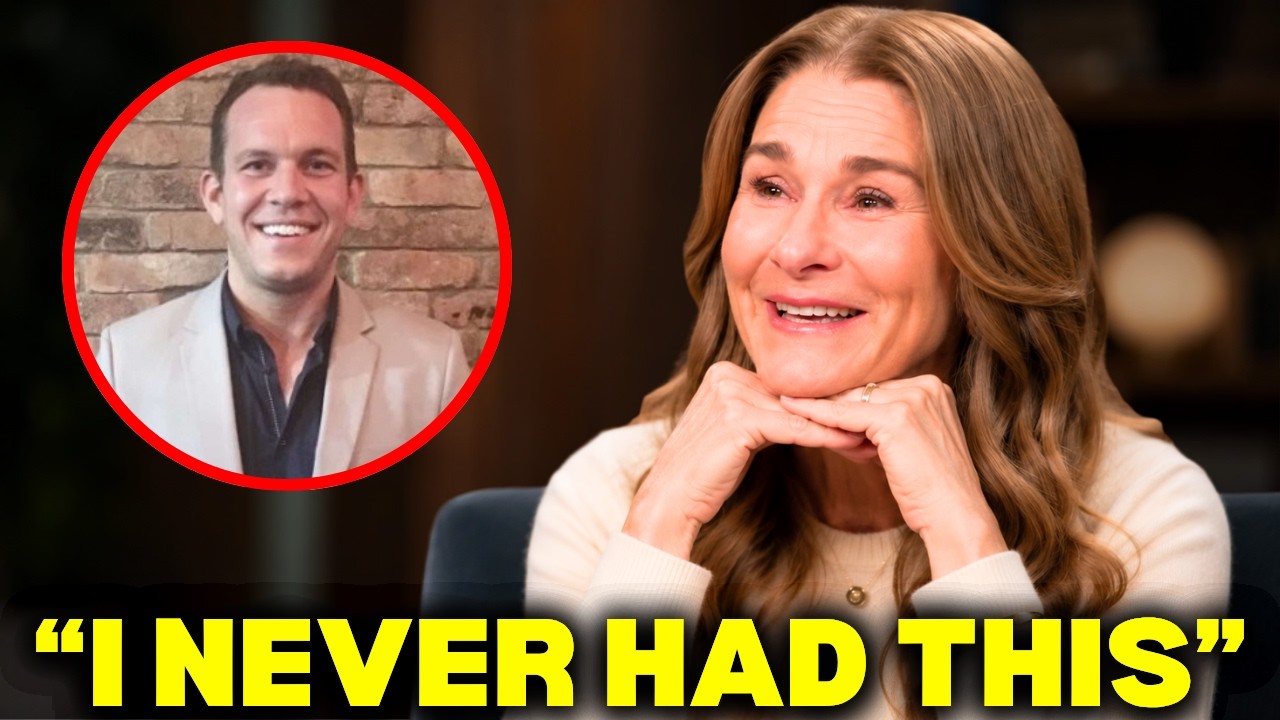 The man in question is Philip Vaughan, a 48-year-old Seattle-based entrepreneur who runs Theo, a craft beer delivery company that connects independent, small-batch breweries with consumers. He is not a billionaire. He has no foundation with his name on the door.
He does not sit on a board with world leaders. Instead, Vaughan built a niche business entirely on the opposite end of the economic spectrum from the Gates empire he once inhabited—because, as it turns out, Vaughan is himself a former Microsoft employee, having worked there for nine years from 1999 to 2008. This fact of his history and the radically different life he chose creates a poetic, almost defiant echo of the corporate halls where Melinda French was rising before Bill Gates ever noticed her.
The first public glimpse of this new reality came unexpectedly in October 2025. At the Clooney Foundation for Justice Gala in New York City, Melinda arrived on the arm of Vaughan, a man nobody in the room could immediately identify. The photographs circulating in the aftermath were not of a celebrity mystery man, but of a woman luminescent with a distinct and visible ease.
The change in her bearing was so stark that it became the story itself. This wasn’t a controlled leak or a strategic narrative; this was a woman, 61 years old, entering a room full of powerful people with a craft beer distribution CEO on her arm, and looking utterly, unencumberedly at home.
When Stephen Colbert asked the direct question of whether she was open to love again, she didn’t hesitate, replying with a laugh and a confirmation that she was “dipping my toe in that water.”
The specific details of her answer went beyond the simple desire for companionship. She said she wanted someone “open to learning,” someone “vibrant and intellectually curious,” and someone who would challenge her thinking. She framed her desire around a need to be seen, not as a public figure, but as herself.
This is a woman who, for 27 years, lived under the enormous weight of a marriage founded in a Microsoft parking lot in 1987. The man who asked her out had to present her with a physical list of “pros and cons” before he proposed to her in 1993, a clinical approach to a life commitment that set a tone for what was to come.
Despite the massive endowment of the $50 billion foundation and the world’s moral admiration, the cracks in the fairytale have been well-documented in recent years. The bombshell reporting revealed that Bill Gates had met with convicted 𝒔𝒆𝒙 offender Jeffrey Epstein at least six times, attending to Melinda’s furious objections that the meetings were dangerous and that Epstein would destroy the foundation’s credibility. Melinda has since used visceral language to describe her feelings on Epstein, calling him “evil personified” and admitting the association gave her “nightmares that stayed with her.”
Then came the more devastating revelation, publicized in 2019, that Bill had dallied with a Microsoft employee in the year 2000, while their youngest child was barely born.
All of this came to a head in spring 2021. What appeared to be a carefully parsed joint statement of divorce on May 3, 2021, was revealed to be the end of a much longer internal collapse. Melinda later described the reality of that period in horrifying terms: “lying on the floor of her room, unable to move,” suffering from panic attacks where she genuinely wasn’t sure she’d come through them intact.
She had wanted to leave years before the announcement, but remained a unified front in private and public, carrying the weight of her knowledge while performing the picture of harmony during that time.
The year 2025 is a distinct turning point. Months after her very public appearance with Vaughan, she has seemingly built the life she wants on her own terms. She left the Gates name behind in 2024, formally resigning from the foundation she helped build.
But she did not simply sever ties; she launched her own vehicle, Pivotal Ventures. She has earmarked $1 billion specifically for gender equality, and has announced another $1 billion for reproductive rights globally—a niche she could do without the previous political constraints of the Gates Foundation. Her book, “The Next Day,” pursues not the breakdown of the marriage, but the unsparing concept of the morning after and how you rebuild.
Her joy now is overwhelmingly shaded by the parallel story of Bill Gates. He has been photographed with Paula Hurd, the widow of a tech titan, com in a world she already knows. He also publicly has confessed that losing Melinda is the central regret of his life.
Melinda’s path, conversely, is outward bound. By ending up in the hands of Philip Vaughan, she has not chosen an improvement, but a correction. He is not simply not Bill Gates, he is cut from an entirely different cloth, one of craft breweries, social connections built on convenience, and the kind of small-scale entrepreneurial passion that follows the logic of a neighborhood, not a boardroom.
She is reportedly playing an to him, building a quiet, stable life in Seattle, far from the stage of the world.
In her People magazine interview, the philanthropy exclusively described herself as “very, very happy.” Not a carefully worded political statement, but a perhaps radical declaration of personal truth. During the gala, she didn’t appear to be holding a narrative at all; she was simply living her life, not felt the need to explain that choice to anyone.
So, as Giddily, the story has come full circle. The woman who helped hold together one of the world’s most powerful partnerships, who was the operational force behind it all, has done the hardest thing: she has admitted that true partnership requires more than success—it requires being truly seen. Her choice of a craft beer entrepreneur over a tech giant offers a quiet, unequivocal answer to the question.
Melinda French Gates is finally, unmistakably, free.