A 40,000-year-old vulture bone discovered in the Hohle Fels cave in Germany features precisely spaced drilled holes. When researchers reconstructed the object and played it, it produced a clear, controllable musical tone across a recognizable scale. The instrument demonstrates that its maker understood the relationship between hole spacing and pitch, indicating that sophisticated musical concepts already existed tens of thousands of years ago. This flute, along with similar instruments found at other European sites from the same period, represents the oldest direct physical evidence of music currently known.
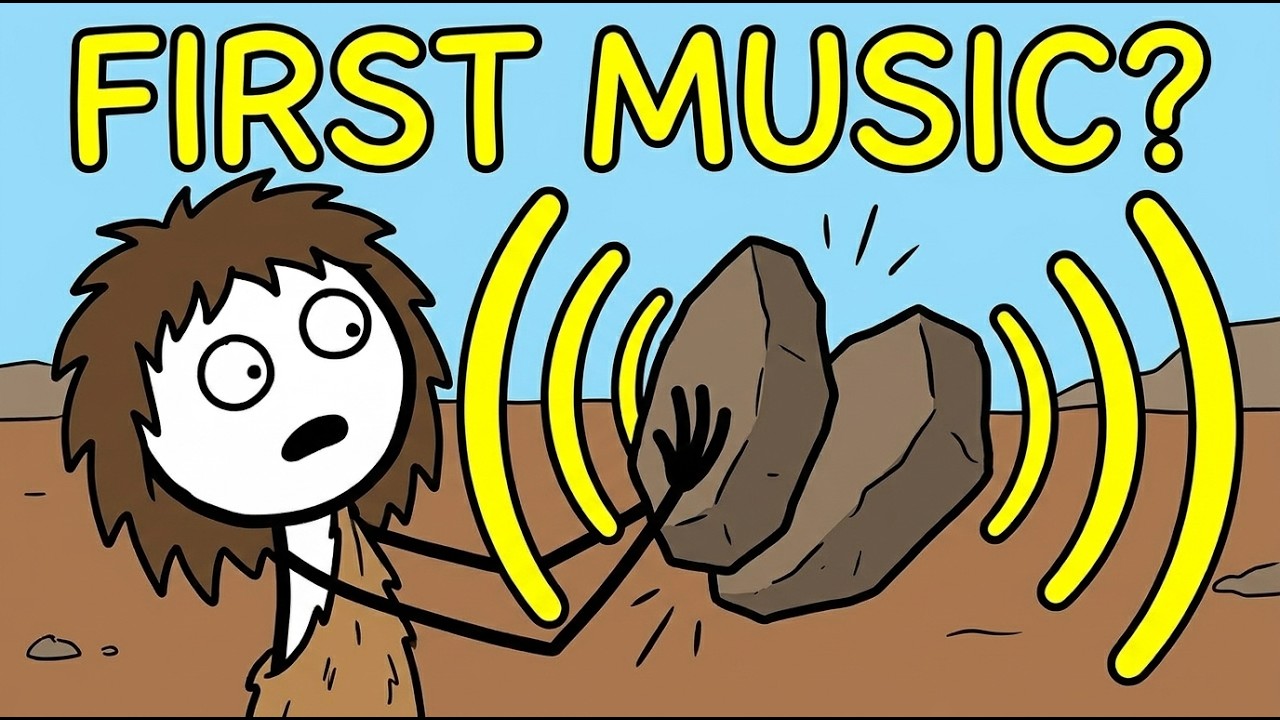
However, researchers emphasize that it is almost certainly not the beginning of music itself. A musical instrument is a tool that serves an existing practice, meaning simpler sound-producing methods likely preceded the creation of dedicated instruments. The human voice is considered the most obvious starting point for early music, as it is present in every human group that has ever existed. It is capable of producing melodic lines, harmonics, and rhythmic patterns without requiring any tools, leaving no archaeological trace.
Body percussion, including clapping, stomping, and chest slapping, also requires no tool-making and is documented across virtually every human culture. Great apes engage in rhythmic behaviors, including the buttress root drumming of chimpanzees, where individuals beat on tree roots to produce resonant sounds. This suggests the capacity for rhythmic, intentional sound production predates the split between human and chimpanzee lineages, placing rudimentary percussive rhythm in our evolutionary history before modern humans existed as a distinct species. Rhythm serves a distinct function from melody by synchronizing bodies.
This observation is at the heart of the entrainment hypothesis, which proposes that rhythmic sound causes listeners to synchronize their physical movements to a beat. This phenomenon has been documented in humans across cultures and in several non-human species. Movement synchrony has documented effects on social bonding, cooperation, and shared identity. Collective physical work becomes considerably more efficient when everyone is synchronized, and rhythmic vocalization during work is documented across many cultures as a practical coordination tool.
Work songs function as active synchronization tools that align the timing of physical effort across multiple individuals, reducing wasted effort and improving outcomes for groups that practiced them. Robin Dunbar’s work on music and social bonding proposes that group musical activity produces endorphin release through the same physiological pathway as physical grooming contact. This allows multiple individuals to receive social bonding benefits simultaneously from a shared musical experience. Researchers have documented elevated pain thresholds, a reliable proxy for endorphin release, in people who have been singing in groups compared to those who listened to music individually.
Research by archaeoacousticians studying prehistoric cave sites has found that the locations of cave paintings in many decorated caves correlate with the locations of greatest acoustic resonance. Caves like Lascaux and various sites in Spain show that areas richest in painted imagery are frequently also areas where human vocalizations produce the most powerful acoustic effects. Early humans exploring caves may have discovered spaces where sounds seemed to emerge from or blend with the rock surface itself. The relationship between music and language remains a subject of genuine scientific debate.
Both involve organizing sounds in time using learned, culturally transmitted systems, show early acquisition in infancy, and are lateralized in similar ways in the brain. Some researchers propose that both evolved from a common precursor called musilanguage, while others argue music evolved specifically for social bonding and language evolved separately for information transmission. Infant-directed speech, sometimes called motherese, represents one of the most interesting connections between music and its possible evolutionary origins. This distinctive, exaggerated, melodically rich speech register is used by adults in all studied cultures when talking to prelinguistic infants.
It differs from normal adult speech in being higher pitched, more melodically varied, and rhythmically more regular, all properties that also characterize music compared to speech. Research by Samuel Mehr and colleagues analyzing recordings from 60 small-scale societies found that listeners with no prior exposure to music from other cultures could reliably identify recordings as music associated with specific social functions such as healing, ceremonies, love songs, and dancing. This suggests certain acoustic features reliably signal social contexts across radically different musical traditions. Geoffrey Miller’s sexual selection hypothesis proposes that musical ability functions as a costly, hard-to-fake signal of genetic quality and cognitive ability.
Professional musicians show elevated reproductive success in some studied populations, though the effect is complicated by confounding variables. Neuroscience reveals that music processing in the human brain is extraordinarily distributed, engaging auditory cortex, motor systems, emotional processing centers, reward systems including dopaminergic pathways, memory systems, and social cognition networks simultaneously. The extensive multi-system engagement is not what would be expected from a recently acquired cultural skill, suggesting music has been functionally significant for a long evolutionary period. The chills or goosebumps that music produces in many people are mediated through the same autonomic nervous system pathways that produce goosebumps in response to cold or threat.
They appear to be triggered specifically by music that violates and then fulfills expectations about where a melodic or harmonic progression is going. A piece of cave bear femur found at the Neanderthal site of Divje Babe in Slovenia, dated to around 50,000 to 60,000 years ago, has holes that some researchers interpret as a musical instrument. Others argue the holes are more plausibly explained by carnivore tooth marks. If the Divje Babe bone is a genuine Neanderthal flute, it would push the origin of musical instruments considerably further back, though this interpretation remains genuinely contested in the scientific literature.
The tempos that most reliably produce involuntary movement synchronization in humans cluster around the range of 60 to 120 beats per minute. This tempo range also corresponds to normal human walking pace, resting heart rate in active adults, and infant rocking pace during soothing. External rhythms in this range feel naturally synchronizable because they resonate with rhythms the body already produces. Every human culture that has been studied has music.
Every human child responds to music with emotional engagement and rhythmic movement before learning cultural associations with music. The evolutionary timeline places music well within the period of prehistory where cognitive architecture was being shaped by living conditions. The most clearly accidental aspect of music’s emergence is likely the discovery of specific acoustic phenomena that humans then elaborated culturally. The resonance of hollow objects, the acoustic properties of particular spaces, the specific intervals at which vocal harmonics naturally cluster, and the way certain rhythmic tempos produce involuntary movement synchronization would not have required anyone to intend to invent music.
These discoveries required people to produce sounds in the course of other activities, notice when those sounds produced interesting effects, and repeat and elaborate behaviors that produced the interesting effects. The cultural accumulation of those elaborations over many generations, combined with social bonding functions and emotional effects, could produce sophisticated musical culture without anyone ever deciding to invent music. The vulture bone flute from Hohle Fels demonstrates how far musical elaboration had progressed by 40,000 years ago.
The actual beginning of the story is likely the first time a human made a sound and noticed that something about it felt worth repeating.


