For roughly 10,000 years, the Sahara Desert was not a desert at all. It was a sprawling green savanna dotted with lakes and rivers, home to hippos, giraffes, and crocodiles, soaking under monsoon rains that fell so consistently that early humans built permanent settlements in the region and painted images of swimming figures and water buffalo on cave walls. That period is known as the African Humid Period, and the archaeological and genetic record it left behind is so detailed that scientists are still extracting ancient DNA from bones found there today. The question researchers have long explored is a practical one: how did people survive endless, relentless rain without concrete, waterproof tarps, or rubber boots?
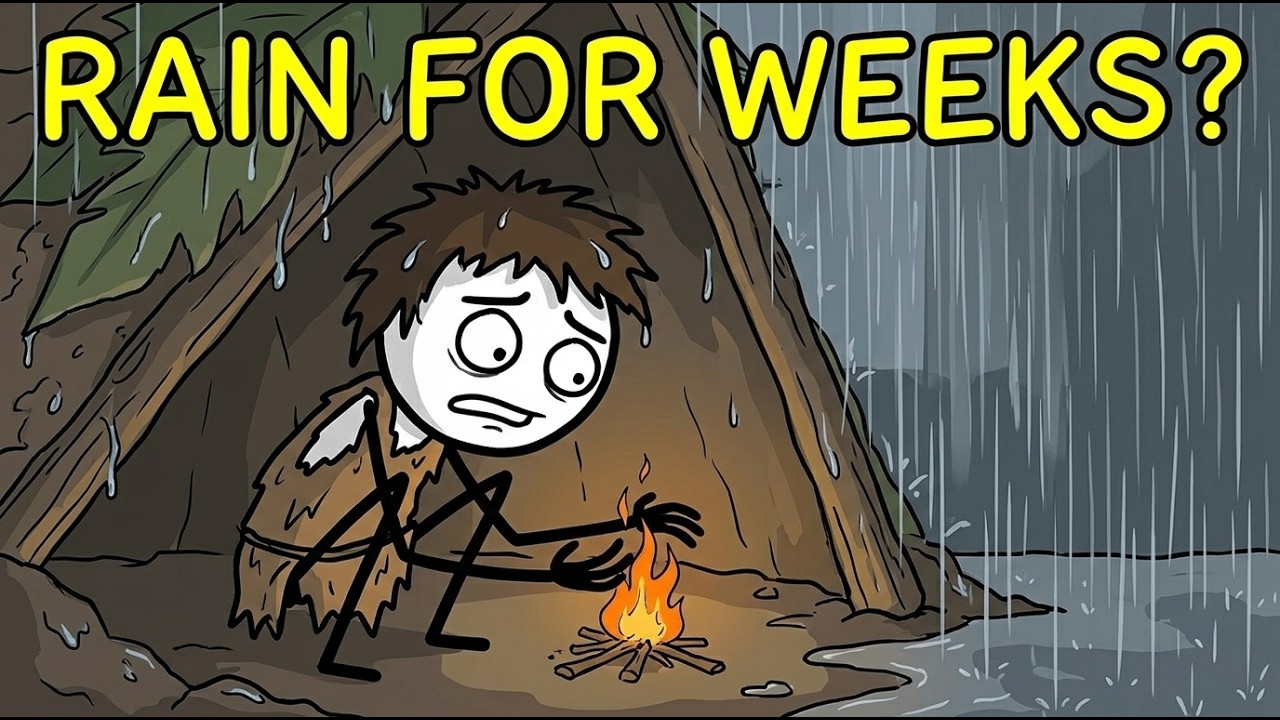
The answer involves geological water reservoirs hidden underground, animal hides engineered for waterproofing, and entire civilizations built entirely around a single river’s flood cycle. For our ancestors, rain was not always the enemy. In many cases, it was the very reason civilization became possible. The most basic threat posed by sustained rainfall was not drowning, but hypothermia.
Wet skin loses heat far faster than dry skin, and a human who is soaked through can deteriorate into dangerous hypothermia within hours, even in temperatures that would otherwise be survivable. The first urgent problem ancient humans needed to solve was keeping their bodies dry enough, often enough, to avoid that lethal threshold. Clothing was considerably more sophisticated than the popular image of cavemen wrapped in random animal pelts. Tailored animal skin clothing, scraped, stretched, and treated through a labor-intensive process, provided both waterproofing and thermal insulation.
The outer side shed water much like a duck’s feathers, while the inner hide trapped warm air against the skin. Some cultures treated hides with animal fats and oils to enhance water resistance, creating an early form of waterproofing with nothing more than rendered fat rubbed into the leather over repeated applications. This knowledge was not discovered once and forgotten. It was passed down through direct teaching and observation over generations, including which animals produced the most water-resistant hides, how those hides needed to be cured, and how garments had to be cut and stitched to keep water from entering through seams.
Shelter demanded similar ingenuity. Caves and natural rock shelters were the obvious first solution, offering naturally engineered roofs carved by water long before humans needed them. In regions without caves, builders constructed steeply angled roofs covered with thick layers of thatch woven from reeds, grasses, or palm fronds. The steep angle was functional engineering: water runs off a steep slope far faster than it can pool and seep through, with each overlapping layer channeling water downward and off the edge.
Some cultures built raised floors on support posts to handle seasonal flooding, a solution that appeared independently across Southeast Asia and prehistoric Europe, from stilt houses to lake dwellings near rivers. Around 14,500 to 5,000 years ago, the region now known as the Sahara experienced the African Humid Period, when the African monsoon pushed dramatically further north than it does today. Lakes formed across the open desert where there is now only rock and sand. Rivers ran where there are now only dunes.
Savanna grassland spread across territory that today supports almost nothing. Ancient rock art in the region, first documented by a German explorer crossing the area in the mid-1800s, depicts swimmers, hippos, elephants, and cattle in a landscape that today could not support any of them. Human populations expanded rapidly, settling into rock shelters such as the one at Takarkori in southwestern Libya, where archaeologists have found nearly 5,000 years of continuous human occupation. Researchers have even extracted ancient DNA from individuals buried there roughly 7,000 years ago, revealing a previously unknown North African genetic lineage that had remained isolated for thousands of years.
The Green Sahara did not last forever. Sediment records from a basin in southern Ethiopia reveal that the ending was gradual but turbulent, punctuated by repeated droughts lasting 20 to 80 years, recurring roughly every 160 years, interspersed with sudden bursts of extreme wetness. Communities had to repeatedly adapt to wild swings between flood and drought, sometimes within a single human lifetime. Around 5,000 years ago, when the rains permanently retreated, populations did not simply vanish.
They migrated following the water, moving toward the Nile Valley, the Sahel, and what would become Lake Chad and the Niger River Valley, carrying with them generations of accumulated knowledge about living alongside unpredictable rainfall. This pattern repeats elsewhere in the ancient world, most notably with the Harappan civilization of the Indus River Valley. Around 4,500 years ago, strong monsoon rains allowed the Harappans to farm the wide floodplains of the Indus River, supporting large cities with organized urban planning and advanced sanitation systems. In regions further south on the Indian Peninsula, lush vegetation supported hunter-gatherer communities who never needed to build permanent settlements, because the abundant natural environment simply provided enough food.
Then the monsoon weakened. The Harappans’ agriculture began to fail, and their cities were progressively abandoned in favor of smaller settlements in the foothills of the Himalayas. The southern peninsula, meanwhile, became more arid, pushing the hunter-gatherer communities there toward permanent farming settlements out of pure necessity. One civilization collapsed because the rain it depended on disappeared; another was born because the natural abundance it depended on dried up at almost the same historical moment.
Groundwater also played an underappreciated role. A study focused on East Africa’s Rift Valley found that human survival through harsh arid stretches may have depended heavily on natural springs. Certain types of rock store rainwater that falls during wetter periods and release it slowly over the following years, even through extended droughts. This meant ancient humans were not solely dependent on whatever rain happened to be falling in any given week or month.
They relied on a slow-release natural reservoir system that smoothed out the unpredictability of rainfall, giving communities that settled near these buffering systems a genuine survival advantage. Floods required their own strategies. The earliest known systematic flood management dates back to roughly 7,600 BC, long before the famous ancient civilizations were founded. Communities living along the Nile, the Tigris, and the Euphrates learned not just to tolerate seasonal flooding but to actively depend on it.
The Nile’s predictable annual flood deposited a fresh layer of nutrient-rich silt across the floodplain, effectively refertilizing farmland on a reliable schedule. Ancient Egyptian agriculture was built entirely around the flood, with planting, harvesting, and religious festivals organized directly around when the waters were expected to rise and fall. But that dependence required sophisticated engineering when floods arrived with more force than expected. Rulers built dams and earthen embankments to protect settlements and granaries while still welcoming the moderate, beneficial flood.
The picture that emerges is not one of passive endurance. It is one of active, sophisticated adaptation across multiple fronts, refined over generations. Clothing engineered to keep bodies dry and warm. Shelters designed with water-shedding roofs, raised floors, and drainage channels.
Entire migration patterns that tracked the retreat and advance of monsoon systems across thousands of years. Underground geological reservoirs that smoothed the worst unpredictability of rainfall. And entire agricultural systems built to depend on flooding completely. The Sahara was once green because the rain seemed to never stop for roughly 10,000 years.
The humans living through that sustained deluge did not just scrape by. They built rock shelters that still stand today. They created art that still moves people thousands of years later. And they left behind a genetic record that scientists are still piecing together.
For longer than most modern civilizations have existed, rain was not simply something ancient humans had to endure. In enough places across enough human history, it was the very thing that made survival, and eventually civilization itself, possible in the first place.