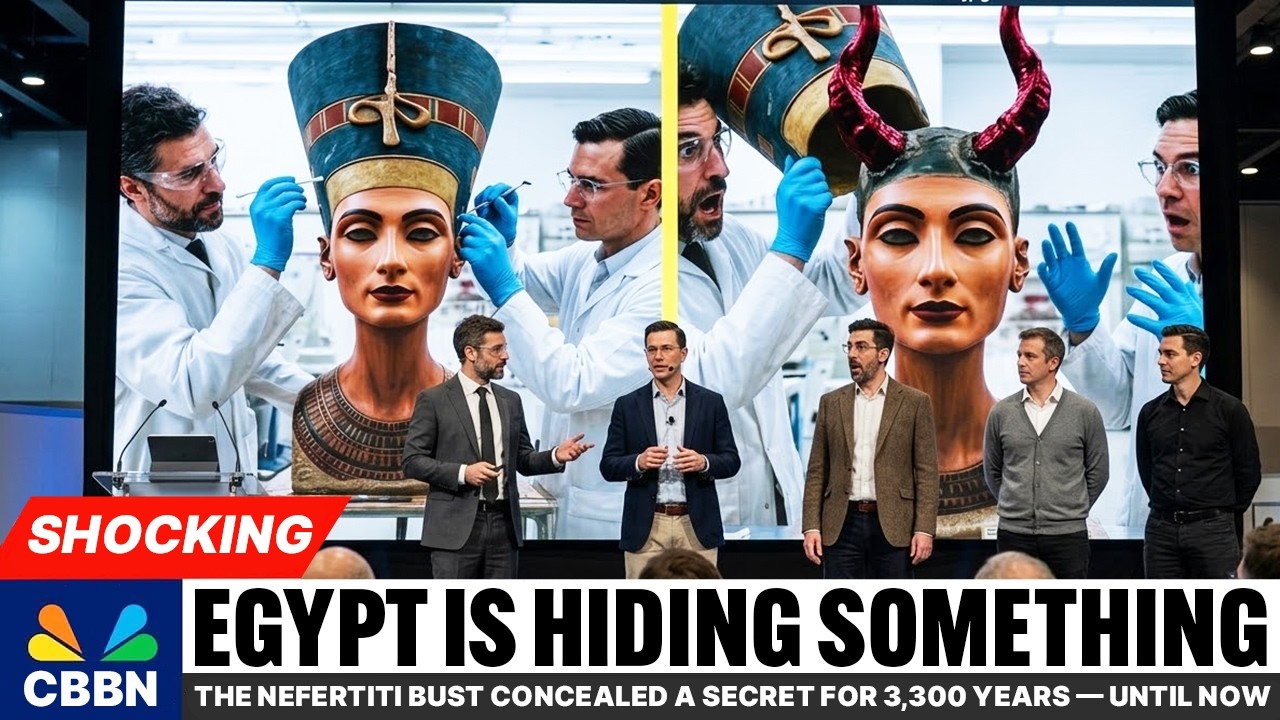
For over 3,300 years, the iconic bust of Queen Nefertiti concealed a hidden secret beneath its flawless surface—a second, fully finished face carved within the limestone core, now revealed through advanced CT scanning. This astonishing discovery fundamentally reshapes our understanding of one of the ancient world’s most famous sculptures.
Discovered in 1912 at the ruins of Amarna by German archaeologist Ludwig Borchardt, the Nefertiti bust has long captivated the world with its elegance and mystery. Yet, for more than a century, no one suspected the stone held a hidden truth—one that would only come to light in the 21st century through cutting-edge technology.
The bust was uncovered in the workshop of Thutmose, the chief royal sculptor, where it sat, unfinished and abandoned amid tools and casts. Unlike other treasures, it was never delivered or displayed in a royal tomb or temple. This detail alone suggests the bust was a model or test piece, left behind in the sudden collapse of Akhenaten’s religious revolution.
In 2007, medical researchers at Berlin’s Charité Hospital employed a state-of-the-art 64-slice spiral CT scanner to peer inside the sculpture. The images revealed not merely a rough core but a second, detailed face embedded beneath the outer finish—a face concealed deliberately and perfectly preserved through millennia.
This inner face differs markedly from the smooth, idealized outer visage. It bears natural creases around the mouth, a subtle bump on the nose, and softer cheekbones. These imperfections align with the Amarna era’s known emphasis on naturalism, contrasting sharply with the flawless, youthful outer face designed to project royal beauty.
Experts are divided on what this hidden layer signifies. One interpretation views it as the sculptor’s initial, realistic carving, with the outer face serving as a perfected public mask. Another suggests deliberate image management—ancient public relations hiding the queen’s true appearance beneath an idealized veneer.
The discovery also deepens the decades-long controversy surrounding the bust’s provenance. Taken from Egypt to Germany in 1913, its ownership remains fiercely disputed. Egypt claims the bust was misclassified during excavation division to ensure its removal, but Germany maintains all procedures were legal and transparent.
Throughout wars, political upheaval, and museum relocations, the bust remained a symbol of cultural pride and contention, largely defined by its visible facade. Now, with the inner face revealed, every debate over its value, identity, and story must consider this unseen reality layered within the stone.
Nefertiti’s image has long been synonymous with beauty and power, yet this revelation exposes a complex narrative of artistic craft, political symbolism, and perhaps even ancient censorship within royal portraiture. What millions perceived as the queen’s true face was, in fact, a carefully curated illusion.
The inner portrait’s naturalism evokes the Amarna period’s radical break from Egypt’s traditional, idealized depictions of royalty, favoring a more human and vulnerable vision. Yet, paradoxically, the outer face reverts to classical perfection, suggesting a tension between private truth and public image etched in stone.
This hidden duality challenges historians’ and art scholars’ assumptions about ancient Egyptian art and royal representation. It illuminates the sculptor Thutmose’s extraordinary skill in crafting not one, but two portraits—one for mortal eyes and another concealing the authentic human beneath.
The advanced scanning technology that 𝓮𝔁𝓹𝓸𝓼𝓮𝓭 this secret was unavailable to earlier researchers. A 1992 CT scan hinted at internal complexity but lacked the resolution to discern the dual faces. It took Dr. Alexander Huppertz and modern imaging breakthroughs to unveil this staggering archaeological revelation.
Despite the bust’s global fame—drawing half a million visitors annually in Berlin’s Neues Museum—the public has been unaware of the second face hidden beneath the painted surface. This breakthrough commands a profound reevaluation of what images of ancient figures truly represent.
Borchardt’s own diary entry from the day of discovery reflects awe and speechlessness, underscoring the bust’s unique power. Yet only now do we grasp the full depth of this masterpiece’s layered identity, reshaping the legacy of Nefertiti and her era’s artistic revolution.
As debates over repatriation continue between Egypt and Germany, this new knowledge adds complexity to cultural claims. The bust is more than an artifact; it embodies intertwined histories, politics, and artistic intentions locked within limestone for millennia.
The revelations call attention to the limitations of historical artifacts that exist primarily as public images shaped by political and cultural forces. They remind us that what is shown may only be a fragment of the complete story, especially with symbols as powerful as Nefertiti’s portrait.
The discovery invites the world to reconsider how we interpret art and history, acknowledging the presence of concealed layers—both literal and metaphorical. Behind every masterpiece may lie a secret waiting patiently to transform our understanding of the past.
For now, the hidden face remains sealed beneath a delicate stucco mask, its mysteries intact but visible through the eyes of modern science. The sculptor’s choice to bury the original suggests intentional preservation, protecting the authentic from time and view.
This extraordinary find enhances the mystique of Nefertiti, the queen whose real visage has eluded us for millennia. It unveils not only artistic practice but poses profound questions about identity, truth, and the narratives constructed around historical figures.
Each visitor who gazes at the bust’s perfected face in Berlin unknowingly encounters a profound act of historical concealment. The outer facade, undeniably stunning, now stands as a crafted image overlying a more human, nuanced truth beneath.
Ultimately, this breakthrough signals a new chapter in Egyptology and art history. The most famous stone face in existence is revealed to be two faces, forever united yet separate—public and private, ideal and real, visible and hidden—shaping the memory of a queen and a civilization.
The Nefertiti bust’s secret face transforms it from a mere relic into a living dialogue across time, challenging the permanence of appearances and illuminating the enduring complexity of human portrayal across millennia. The world’s most iconic sculpture is thus reborn through discovery.
As technology continues to push the boundaries of exploration, who can say what other ancient secrets wait beneath surfaces long assumed fully known? The Nefertiti bust is a potent reminder that history’s greatest mysteries often lie quietly beneath the visible.