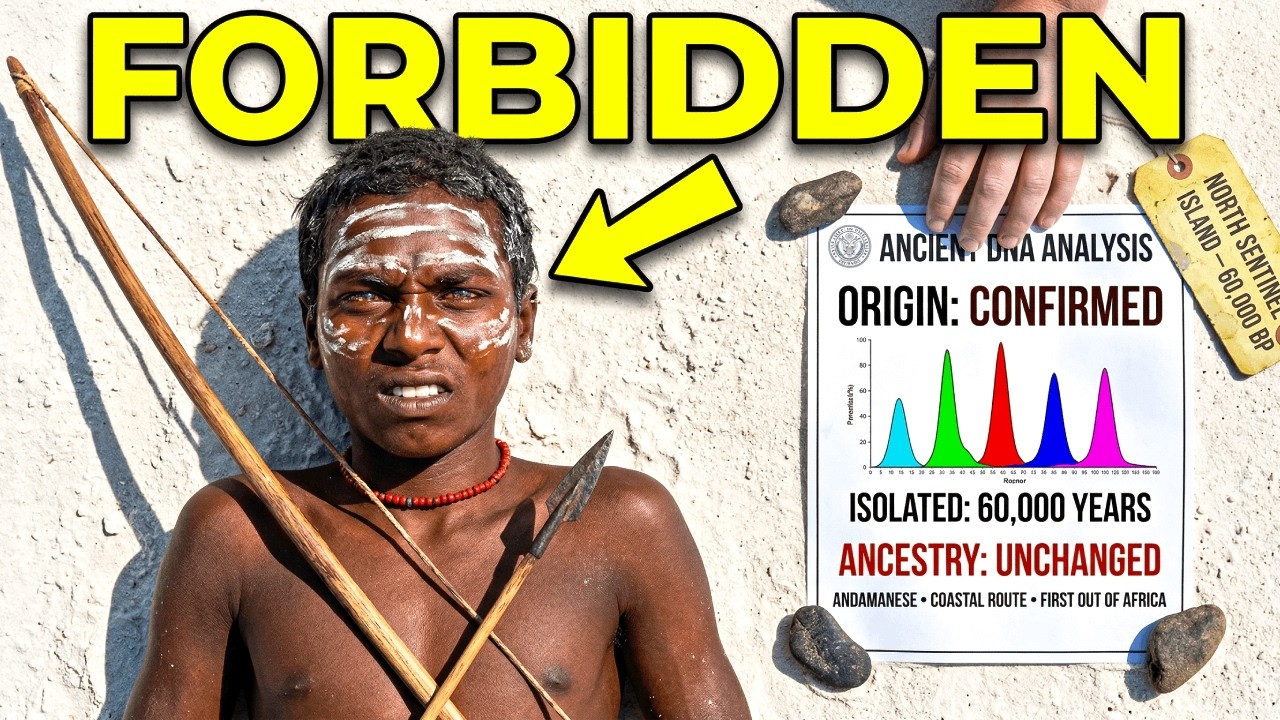
Hidden from the world’s gaze by deadly arrows and impenetrable reefs, a remote tribe in the Bay of Bengal has unknowingly preserved the oldest human DNA on Earth. This astonishing discovery rewrites the story of human migration, revealing ancient roots that predate agriculture, bronze, and all known civilizations by tens of thousands of years.
Off the Indian coast lies North Sentinel Island, a fierce bastion of isolation surrounded by coral reefs lethal to ships. Covered in dense jungle, it houses the Sentinelese, a tribe of hunter-gatherers who have fiercely protected their territory for over 60,000 years. No outsider has survived contact; arrows fly at every intrusion, creating a living fortress lost in time.
Historical attempts to engage with the Sentinelese have ended with violence and tragedy. From early sightings in 1771 to the ill-fated missionary John Allen Chau in 2018, every approach has been met with lethal defense. The tribe’s unyielding hostility is not mere aggression but a deliberate, centuries-old rejection of outside contact.
Their technology, often dismissed as primitive, is ingenious and adaptive. They repurpose iron salvaged from shipwrecks, forging arrowheads with stone tools—a sophisticated craft revealing their intimate connection to their environment and resourcefulness against all odds. Their fishing canoes and hunting methods perfectly suit the treacherous coastal waters they depend on.
Amid this fierce seclusion, modern science found a different way in: genetic analysis from skeletal remains on nearby Andaman Islands. The findings are revolutionary. The Sentinelese and their kin harbor genetic lineages among the oldest surviving outside Africa, untouched by later migrations that reshaped the rest of Asia.
This ancient DNA challenges prevailing theories about human dispersal. Instead of a gradual inland spread from the Middle East, it supports a rapid coastal migration route, tracing a path from Africa’s shores along South Asia’s coast and island chains, reaching Australia 65,000 years ago. The Sentinelese genome is a living relic of this forgotten journey.
Their genetic signature is far from isolated; it connects deeply to populations as distant as the indigenous peoples of Papua New Guinea and Aboriginal Australians. This shared ancestry reveals a migration event erased on the mainland but preserved in these remote islanders, kept intact by geography and tribal defiance.
The Sentinelese’s resistance has done more than repel intruders; it has shielded one of humanity’s greatest historical treasures. Their isolation preserves a narrative invisible in other populations overwritten by waves of migration and assimilation, offering an unparalleled window into the earliest chapters of human history.
Yet the story is also a warning. Neighboring Andamanese tribes, forced into contact and assimilation, suffered catastrophic cultural and health declines. The Sentinelese’s survival and health underscore a critical lesson: some cultures must remain untouched to preserve their identity and invaluable historical legacy.
The world must hear this lesson and respect the Sentinelese’s sovereign choice. Scientific breakthroughs that reveal our shared past do not justify invasion. Instead, they demand profound restraint. The tribe’s arrows tell a clear, uncompromising message—leave us alone, for our story is ours alone to live.
North Sentinel Island stands as a near-mythic refuge, its dense forest and coral reefs safeguarding not only an ancient people but the genetic key to migrations that shaped humanity’s spread. From hundreds of meters above, their thriving community remains unseen, a silent testament to resilience and mystery amid modernity.
The Sentinelese will forever elude detailed study and external interference. Their DNA silently reshapes science while they continue their ancestral way of life, fishing reefs and crafting iron arrowheads as they have for millennia. Their story is both a discovery and a demand: respect isolation as a form of preservation.
This breakthrough reframes our understanding of human origins and migration but also highlights a crucial ethical boundary. The natural fortress of North Sentinel Island is not just a barrier to outsiders; it is a shield preserving a living human link to our deep, shared past that must remain undisturbed.
Scientists urge the global community to recognize the Sentinelese’s unique place in history and genetics. Their isolation preserved the oldest human DNA, a genetic time capsule containing vital clues to prehistoric migrations. The same defenses that have kept them safe now guard humanity’s heritage against irreversible harm.
As geneticists decode ancient secrets hidden within the Sentinelese genome, the tribe’s fierce defense reminds us that human history is not ours to appropriate. Their story, etched in silence and arrows, teaches profound humility in the face of a past that continues to unfold far from the reach of modern civilization.
The Sentinelese are not a relic but a vibrant, living community chosen by history and geography to endure intact. Their genome provides a stark, poignant contrast to global interconnectedness, underscoring the diversity and complexity of human dispersal and the need to honor the boundaries they have drawn resolutely.
In preserving their solitude, the Sentinelese have preserved a critical piece of humanity’s evolutionary puzzle. This discovery commands urgent reflection: the greatest scientific knowledge in this case is the recognition that some mysteries must remain inviolate, protected by the very people who carry them forward unbroken.
The world will never fully know the Sentinelese’s culture or language. Yet, their DNA reveals a journey older and deeper than any written history. They are humanity’s living archive, safeguarded not by science or policy, but by their own unyielding determination to remain the ultimate gatekeepers of their destiny.
As the plane passes overhead, glimpsing through cloud and canopy, the immense significance of North Sentinel Island anchors in stark clarity. Here, isolation has become preservation, arrows have become sentinels, and a fierce independence safeguards the oldest genetic heritage on Earth, waiting undisturbed through the ages.