When astronomers announced the discovery of 3I/ATLAS in 2025, it immediately attracted worldwide attention. As only the third confirmed interstellar object ever observed passing through our Solar System, it offered scientists a rare opportunity to study material that formed around another star.
That alone made it extraordinary.
But as often happens with major astronomical discoveries, sensational claims quickly followed online. Stories began circulating that the James Webb Space Telescope (JWST) had detected signs of life, mysterious internal energy sources, artificial radio transmissions, and even evidence that the object had intentionally changed course.
Those claims are far more dramatic than the evidence actually supports.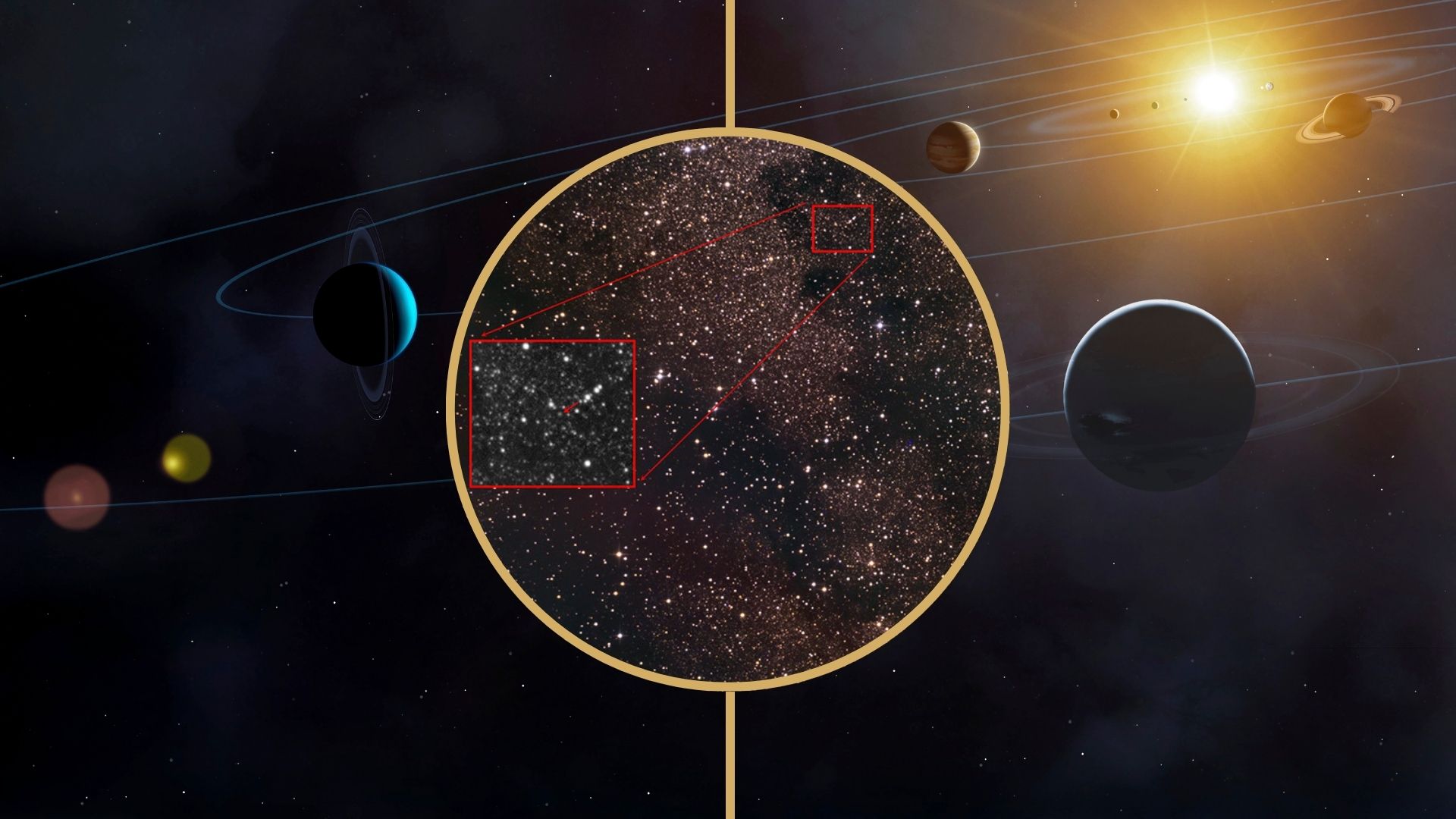
So what do astronomers really know?
3I/ATLAS appears to be an object traveling on a hyperbolic trajectory, meaning it is not gravitationally bound to the Sun. Like its predecessors, 1I/’Oumuamua and 2I/Borisov, it most likely originated in another planetary system before wandering into ours over millions—or perhaps billions—of years.
Because it comes from beyond our Solar System, every observation is scientifically valuable. Telescopes across the world, including space-based observatories, have been studying its brightness, motion, composition, and behavior to determine whether it resembles a comet, an asteroid, or something in between.
The James Webb Space Telescope is expected to play an important role because its infrared instruments can identify molecules, measure temperatures, and analyze the composition of dust and volatile materials with remarkable precision.
However, there has been no confirmed announcement from NASA or the scientific community that JWST has detected life, artificial structures, engineered materials, or intelligent signals associated with 3I/ATLAS.
Likewise, there is no verified evidence that the object emits perfectly timed thermal pulses resembling a “heartbeat,” broadcasts repeating radio messages, replied to human transmissions, altered its trajectory through intelligent control, or contains internal rotating structures visible to Webb.
These claims originate from speculative internet videos rather than peer-reviewed scientific findings.
Natural explanations remain far more likely for any unusual observations.
Interstellar objects can experience changes in brightness as they rotate, release gas and dust when warmed by the Sun, or display complex activity driven by volatile ices beneath their surfaces. Small deviations in trajectory can also result from natural outgassing, a phenomenon previously observed in comets.
Similarly, spectroscopy often reveals unfamiliar combinations of minerals, ices, and organic compounds simply because scientists have never before examined material originating from another stellar system. Finding unusual chemistry does not imply artificial construction.
One reason 3I/ATLAS has generated so much excitement is that every new interstellar visitor expands our understanding of how planetary systems form and evolve throughout the galaxy. By comparing its composition with objects native to our Solar System, researchers hope to learn whether other stellar systems produce similar building blocks—or fundamentally different ones.
If Webb detects water ice, carbon-bearing molecules, silicates, or other complex materials, those findings could provide valuable clues about the chemistry of distant planetary systems. Such discoveries would be scientifically significant without requiring extraordinary explanations.
The search for extraterrestrial life also follows a careful scientific process. Researchers look for measurable evidence such as atmospheric biosignatures, unusual chemical disequilibrium, or reproducible technological signals. Extraordinary claims—especially those involving intelligent civilizations—require extraordinarily strong evidence that can be independently verified.
At present, no such evidence has been reported for 3I/ATLAS.
That does not make the object any less fascinating.
Quite the opposite.
Every confirmed interstellar visitor offers humanity a rare glimpse into another corner of our galaxy. Long before telescopes could image planets around distant stars, these objects began crossing interstellar space, carrying with them physical records of environments we may never otherwise reach.
Whether 3I/ATLAS ultimately proves to be an unusually active comet, a rocky fragment from another planetary system, or something that challenges existing models of interstellar objects, its greatest value lies in what careful observation—not speculation—can teach us.
Sometimes the most remarkable discoveries are not the ones that rewrite science overnight, but the ones that steadily reveal just how diverse and surprising our galaxy truly is.