For generations, humanity searched the stars hoping to find another Earth. Now, the James Webb Space Telescope may have uncovered something even more extraordinary—a distant world whose atmosphere contains some of the strongest signs yet that it could support life.
The planet, K2-18 b, lies about 120 light-years away in the constellation Leo, orbiting a cool red dwarf star within its habitable zone. As the planet passed in front of its star, Webb analyzed the starlight filtering through its atmosphere, revealing a remarkable chemical fingerprint. Astronomers identified water vapor, methane, and carbon dioxide—molecules often associated with potentially habitable environments.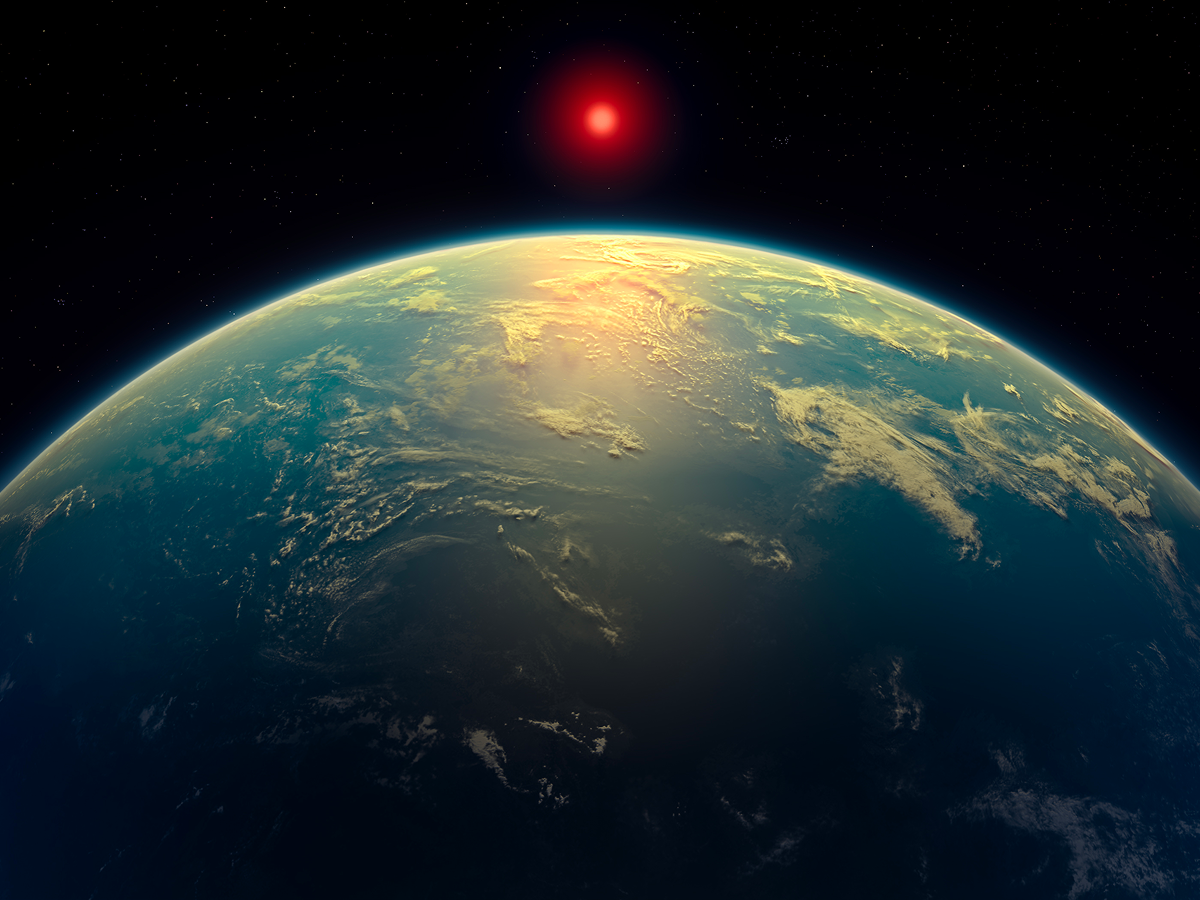
Then came the biggest surprise.
Researchers also reported evidence of dimethyl sulfide (DMS), a molecule that on Earth is produced primarily by living organisms, especially marine microorganisms. While the detection remains tentative and requires further confirmation, it immediately became one of the most intriguing biosignature candidates ever observed beyond our solar system.
Unlike Earth, K2-18 b is a super-Earth, with a mass more than eight times greater than our planet and wrapped in a thick hydrogen-rich atmosphere. Scientists believe it may belong to a class of worlds known as Hycean planets—oceans covered by hydrogen atmospheres that could potentially provide stable conditions for life.
Its atmosphere may help trap heat and distribute temperatures across the planet, allowing liquid water to exist despite orbiting a small red dwarf star. These stars burn for trillions of years, giving any potential life an extraordinarily long window to evolve.
What makes K2-18 b especially compelling is that its atmosphere appears to be in chemical disequilibrium. On Earth, such an imbalance is continually maintained by biological activity. If future observations confirm that the same process is occurring on K2-18 b, it would represent one of the strongest indications yet that life exists beyond our planet.
Scientists remain cautious. The possible DMS signal has not yet been confirmed, and alternative non-biological explanations have not been ruled out. Even so, Webb has transformed K2-18 b into one of the most important targets in the search for extraterrestrial life.
For decades, astronomers believed they needed to find another Earth to find life.
James Webb is now suggesting the universe may have had a very different idea all along.