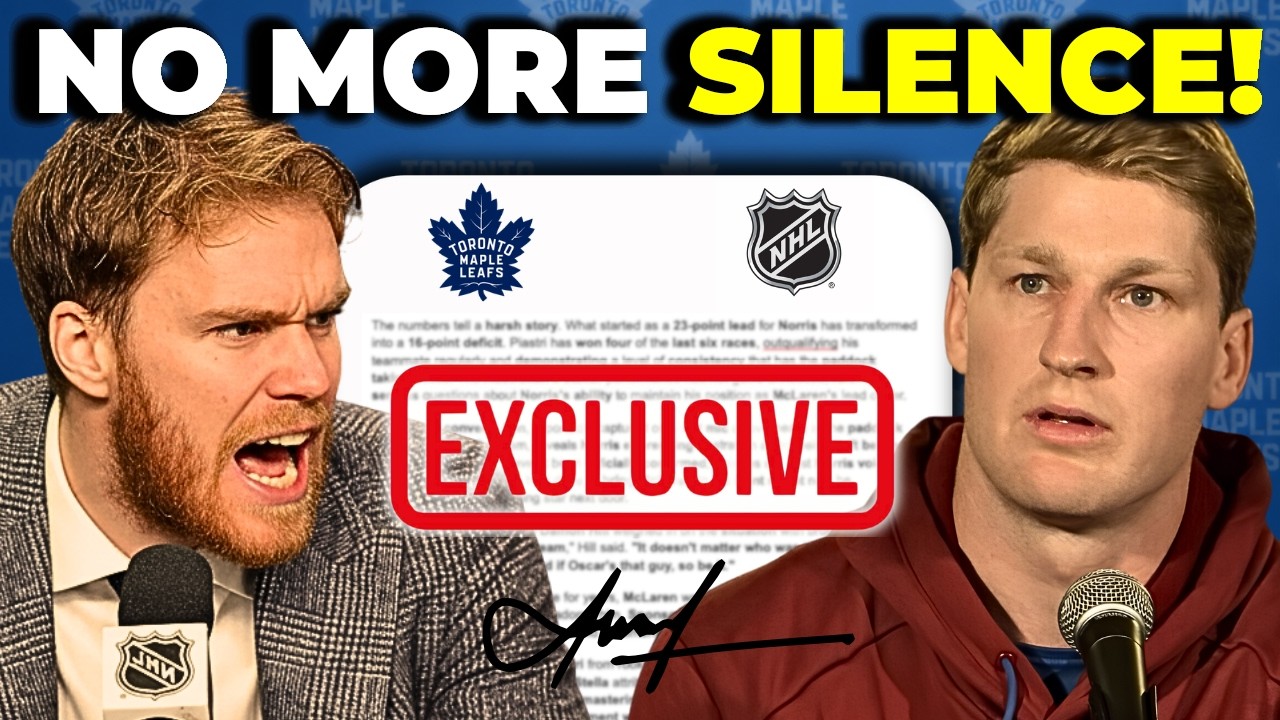
The Edmonton Oilers captain has once again been crowned the undisputed king of the NHL’s center position, but his latest acknowledgment of the rising tide around him has sent shockwaves through the hockey world. Connor McDavid has finally broken his silence on the relentless pursuit of Nathan MacKinnon, and the response is not what anyone expected. While the league’s spotlight has shifted toward the Colorado Avalanche superstar and the emergence of a new generation of talent, McDavid’s quiet confidence reveals a deeper truth about what separates him from the pack.
The 2026-2027 season is shaping up to be a defining battleground, and the conversation has just been ignited.
 The NHL Network’s annual top centers ranking has once again placed McDavid at the pinnacle, a position he has held every year of his career except his rookie season. That singular exception belonged to Sidney Crosby, a passing of the torch that now seems like ancient history. McDavid’s stranglehold on the number one spot is not merely a matter of reputation; it is backed by a statistical resume that borders on the absurd.
Last season, he led the entire league in scoring with a staggering 138 points, a total that included 48 goals and 90 assists across 82 games. He finished eight points clear of Tampa Bay’s Nikita Kucherov, securing his sixth career Art Ross Trophy and cementing another chapter in his legacy of dominance.
For most players, a single season like that would define a career. For McDavid, it has become the expected baseline, another routine entry in a ledger of unprecedented production. His playmaking last year was particularly lethal, as he recorded points in 68 of his 82 games and posted 43 multi-point efforts.
He even strung together a 20-game point streak from early December to mid-January, amassing 46 points during that torrid stretch. These are not just numbers; they are a declaration of intent. They are the reason why, even as Nathan MacKinnon enjoyed a career-defining campaign of his own, the crown remains firmly planted on McDavid’s head.
MacKinnon’s challenge, however, is real and growing louder by the day. The Avalanche center finished last season with 127 points and a league-leading 53 goals, capturing the Rocket Richard Trophy in the process. His plus-57 rating was a testament to his two-way evolution, a facet of his game that has closed the gap between him and McDavid significantly.
The debate over who is truly the best center in the world is no longer a monologue; it is a fierce dialogue. Yet, McDavid’s response to this pressure is not one of anxiety but of quiet, unshakeable certainty. He knows that while MacKinnon can match his scoring, there is an element to his own game that remains inimitable.
That element is the complete package. McDavid’s speed is not just a tool; it is a weapon that can warp the geometry of the ice in a split second. His ability to accelerate from a standstill to full flight leaves defenders grasping at air, and his passing vision transforms routine rushes into high-danger scoring chances.
 Opponents are forced to respect both his shot and his pass, a dilemma that creates cavernous space for his teammates. This dual threat is what makes him so difficult to contain, even when opposing coaches devise game plans specifically designed to shadow his every move. It is a problem that has no easy solution, and it is the primary reason he remains untouchable.
Beyond the individual accolades, there is a heavier burden that McDavid carries, one that transcends personal statistics. He is the face of the Edmonton Oilers, a franchise that lives and breathes championship expectations. Every season begins with the same singular goal: hoisting the Stanley Cup.
Individual awards are nice, but they are not the ultimate prize. McDavid’s career has been defined by incredible regular-season success, but the ultimate validation has remained elusive. This is why the upcoming season is so critical.
The Oilers need his best hockey when the games matter most, and the pressure to convert his individual brilliance into team glory has never been more intense.
The supporting cast around him has also undergone significant changes, adding another layer of intrigue to the narrative. The Oilers made a major splash this summer by signing veteran goaltender Frederik Andersen to a one-year, $2. 8 million deal.
The move was designed to address a glaring weakness, as Edmonton finished in the bottom three in team save percentage last season. Andersen, who backstopped Carolina to a Stanley Cup victory with a stellar playoff performance, was supposed to be the stabilizing force in net. However, a recent injury suffered during off-season training has thrown that plan into chaos, leaving the team’s goaltending situation shrouded in uncertainty.
 The injury to Andersen is just one of several blows the Oilers have absorbed before training camp has even begun. Along with Andersen, forward Matt Savoie, Mattias Janmark, and defenseman Alec Regula are all expected to miss the start of camp. Savoie’s absence is particularly notable, as he just completed a full 82-game season with 37 points and was expected to play a key role in the team’s offensive depth.
The timing could not be worse for a team trying to build chemistry and implement new systems. While the team has not provided a timeline for Andersen’s return, the uncertainty surrounding his health has created a palpable sense of unease in Edmonton.
This unease is compounded by the fact that the Oilers are entering a season where the margin for error is razor-thin. The Western Conference is a gauntlet, and the Avalanche, with MacKinnon at the helm, are poised to challenge for supremacy. MacKinnon’s performance last season was a statement that he is no longer just a challenger; he is a legitimate co-favorite for the title of best in the world.
His blend of power, speed, and tenacity makes him a nightmare matchup, and his ability to take over games single-handedly is reminiscent of McDavid’s own brilliance. The rivalry between these two titans is the defining storyline of this generation of hockey.
But the threat to McDavid’s throne does not end with MacKinnon. The emergence of Macklin Celebrini has added a third dimension to the conversation. The San Jose Sharks phenom had a breakout second season, scoring 45 goals and 115 points, earning him the third spot on the NHL Network’s ranking.
Celebrini represents the future, a player whose trajectory suggests he could eventually challenge the established order. His rise is a reminder that the NHL is a league in constant flux, where dynasties are built and dismantled with alarming speed. McDavid, now 29 years old, is no longer the young phenom; he is the veteran king, and the wolves are circling.
 Yet, there is no sign that McDavid’s offensive game is slowing down. His 138-point season at age 28 was a resounding answer to any doubters. He remains the most dynamic offensive force in the sport, a player capable of producing at a level that seems to defy the laws of physics.
The question is not whether he can still produce; it is whether he can sustain this pace while carrying the weight of an entire franchise on his shoulders. The pressure in Edmonton is immense, and every failure in the playoffs is magnified under the harsh glare of the hockey media. McDavid’s legacy will ultimately be defined by what he accomplishes in the spring, not the winter.
For now, the answer to the question of who is the best center in the NHL remains unequivocally Connor McDavid. The numbers, the awards, and the eye test all point to him. But the word “undisputed” is a fragile concept in a league where greatness is constantly being redefined.
MacKinnon is closer than ever, Celebrini is rising, and the competition is only getting fiercer. McDavid’s recent comments, breaking his silence on the matter, suggest he is aware of the challenge but unbothered by it. He welcomes the competition because it pushes him to be better.
He knows that the road to number one still runs through him, and he intends to keep it that way.
The upcoming season will be a referendum on his reign. If McDavid produces another 130-point campaign and leads the Oilers on a deep playoff run, the debate will be settled for another year. But if MacKinnon explodes for an even more dominant season or Celebrini takes another massive leap, the conversation could shift dramatically.
The NHL is a league of momentum, and the narrative can change in an instant. For now, McDavid sits on his throne, looking down at his challengers with a calm that borders on arrogance. He has earned that right.
But in the brutal world of professional sports, the crown is never safe, and the next challenger is always waiting in the shadows.