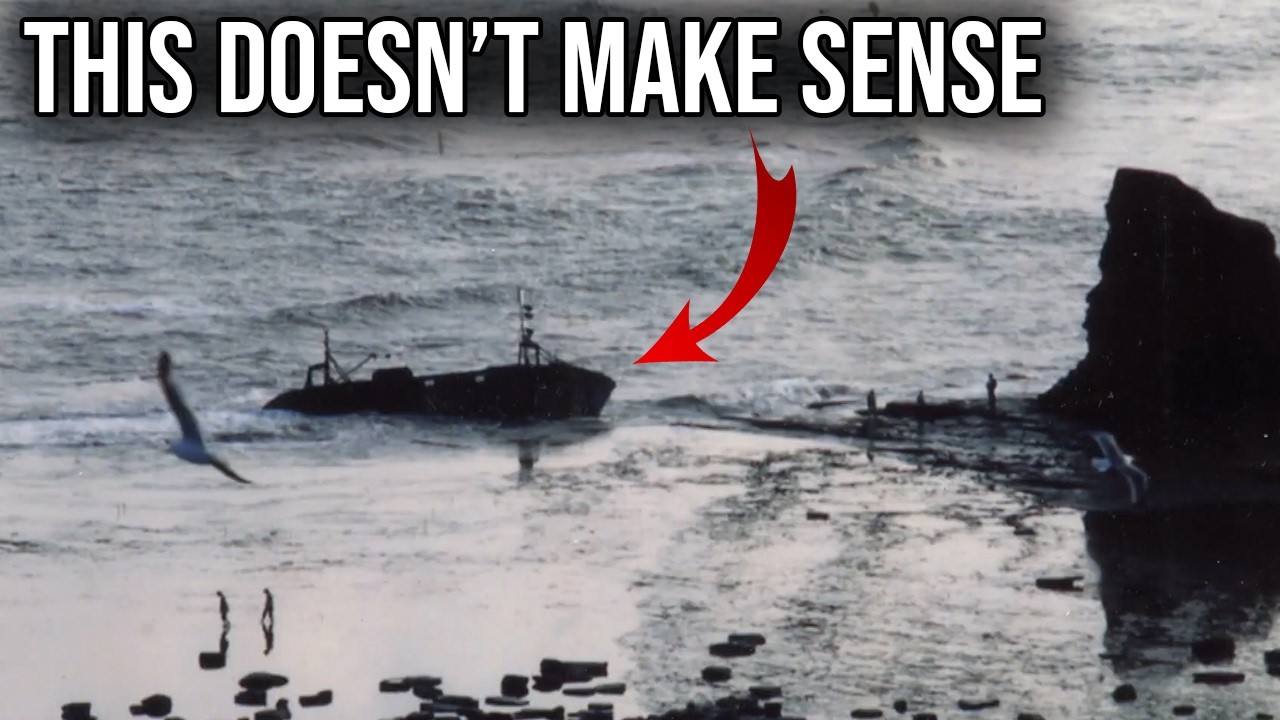
The North Sea gave up one of its most enduring mysteries at 1:00 a. m. on September 30th, 1976, when the fishing trawler Admiral Von Tromp, a vessel laden with decades of combined maritime experience, inexplicably veered off its routine course and drove itself directly onto the jagged rocks of Saltwick Bay, just down the coast from Whitby. The ship, which should have been steaming steadily toward the Barnacle Bank fishing grounds some 45 miles north-northeast of Scarborough, was found hours later smashed against the Black Nab rocks, a victim of circumstances that continue to baffle marine investigators, historians, and the families of the men who perished in one of the most bizarre nautical disasters ever recorded along the North Yorkshire coastline. The voyage began under conditions that were, by all accounts, unremarkable. The weather was calm enough for the area, with only a slight sea fog hanging over the harbor, nothing out of the ordinary for the time of year or the hour of the morning. Visibility was adequate, and the crew, handpicked for their skill and experience, were in perfectly normal spirits as they prepared to cast off from the west pier at Scarborough. Walter Sheader, the pier man on duty that morning, later stated unequivocally that everything seemed perfectly normal, that there was nothing wrong with any of the crew, and that nothing stood out as being particularly abnormal or off at all. The vessel, a modern fishing trawler equipped with the latest navigational technology of the 1970s, was commanded by Skipper Frankie Towl, a man with 23 years of experience at sea. Alongside him were Mate Alan Marston, engineer Anthony Nicholson, fish hand George Edward Eaves, and John Addison, a seasoned seaman known affectionately to his friends as Scotch Jack. It was a crew that inspired confidence, a group of men who knew the treacherous waters of the North Sea intimately. As the trawler cleared the harbor breakwater and set its course due east into the open water, the routine of a long fishing trip began to unfold. The initial hours passed without incident, with the crew settling into their respective duties. Skipper Towl, after ensuring the initial course was set and the vessel was running smoothly, decided to head below deck to the galley for a coffee, leaving John Addison alone in the wheelhouse at the helm. It was a decision that would prove catastrophic, though at the time it seemed the most natural thing in the world. Towl told Addison he would be back later to check everything was okay, and headed downstairs, confident that the straight course out into the North Sea would hold with no problem at all. For a vessel of this era, equipped with advanced navigational aids, the journey should have been routine, a straight line from point A to point B with nothing to impede its progress For the next hour, the Admiral Von Tromp continued to make its way out to sea, cutting through the gentle swells with an ease that belied the tragedy about to unfold. Around this time, Towl, having finished his coffee with the other lads, popped back to the wheelhouse just to check up on Addison. He asked his crewman whether he fancied swapping shifts, offering to take over if so, but Addison seemed perfectly content to stay where he was, perfectly happy at the helm. Satisfied that all was well, Towl decided to take advantage of the quiet hours to grab some sleep. It was the early hours of the morning, Addison was perfectly happy where he was, and someone else would be up in a few hours time to relieve him. So, telling Addison that he was heading below, Towl popped off to his bunk for a nap, leaving the ship in the hands of his trusted colleague. It was a decision that would haunt him for the rest of his life It was around another hour into their trip when something unusual started to happen, something that would shatter the peace of the early morning into a nightmare of grinding metal and splintering wood. Towl, who had been happily napping in his bunk, was woken up to the strangest sound, the last possible sound he could have expected to hear. The boat was making an awful grinding, bumping sound, and felt like it was violently shuddering against something in the water. To both Skipper Towl and Mate Alan Marston, who had also been woken up by these horrifying noises, it sounded exactly like a ship grounding against rock. But they both dismissed that thought instantly, because they were two to three hours out into the North Sea. There should not have been any rocks there, and it would have been incredibly unlikely for them to have hit another vessel. Yet, as unlikely as that was, it was the only possible reason for the noises and the violent smashing they could feel. The reality was far more terrifying than anything they could have imagined More than a little unnerved, Towl leapt from his bunk and stormed up to the wheelhouse to find out what was happening. As he burst through the door, he was greeted by a sight that would freeze the blood of any sailor. John Addison was standing in the wheelhouse, gripping tight to the chart table, not panicking, not crying for help, but simply staring blankly. And outside the windows, looming high above the boat, were the North Yorkshire cliffs. Somehow, instead of being out in the North Sea, they were smashing into the rocks at Saltwick Bay. I went straight into the wheelhouse, but could see nothing but thick fog, Towl would later recall. John Addison was standing in the wheelhouse, gripping tight to the chart table. I said to him, What the hell are we doing here? We were sure. And he never replied. Just stared at me. Addison simply did not respond. He was frozen to the spot. I had to push my way past him to get to the radio. He seemed petrified with fear or shock The ship was now listing further and further into the rocks it was being smashed against, and Towl knew they had very little time to try and save themselves. He managed to send out a Mayday call, a desperate plea for help that would be received by the Whitby Coastguard, triggering a rescue operation that would itself become the stuff of legend. But as the crew desperately fought to try and rectify their situation, Addison turned to Marston and mumbled the last words anybody would ever hear him say. Oh, Alan. It was an utterance fraught with ambiguity, a phrase that offered no explanation, no apology, no clue as to what had just transpired. The men were now in a fight for their lives, with the vessel continuing to list further and further, battered by the waves against the unforgiving rock As the crew desperately scrambled for their life jackets, Towl desperately tried to anchor the vessel to prevent them from being buffeted by the waves more than they already were. But as he fought to release the anchor, the Van Tromp turned broadside against the waves and started to rapidly fill with water. The Admiral Van Tromp was sinking. And as the waves continued to break over her again and again, she began to capsize. As the boat healed over, Towl shouted to the crew to hang on to the starboard side for as long as they could. But one man, Addison, would not move. I told John Addison to go out of the wheelhouse, Towl later said. As I was afraid she was going to turn turtle, he would not go out. And I could not get him out. He is still frozen. The paralyzing shock that had seized him earlier had not released its grip, and it would ultimately cost him his life With the waves continuing to crash over them, the surviving crew very quickly realized that clinging onto the outside of the boat would only lead to them being swept into the sea and probably dashed against those rocks. In a final desperate move, they scrambled to get back into the wheelhouse, seeking relative safety and shelter from those crashing waves. But that shelter also came with another ever-growing risk. As the boat listed more and more, that wheelhouse was slowly filling with seawater. For the next hour, the men slowly watched as the water continued to rise and rise until it had almost reached the ceiling of the wheelhouse, at which point all they had was a heads room between the surface of the water and the top of the wheelhouse. Their shelter from the waves had turned into a death trap. And if they stayed any longer, it would turn into their tomb. In fact, for one, it already had. Jack Addison, who had never recovered from the seeming paralyzing shock, drowned in the wheelhouse. He left behind him a wife and one child. And with nothing they could do but leave him there, the rest of the crew desperately scrambled out of an open window As the crew made it out and scrambled onto the top of the wheelhouse, more tragedy struck. A huge wave crashed into the boat, and as it did, George Edward Eaves was thrown into the sea and drowned. I saw George Eaves body as it was swept past me, Towl would later recount. He was just laid back in his life jacket, not moving. And he appeared to me to be dead. For Frankie Towl, Alan Marston, and Anthony Nicholson, they now had two awful options. Desperately cling to the vessel as it continued to be smashed by those waves and buffeted against those hard rocks, or jump into the freezing waters, desperately try to avoid being smashed against those very same rocks, and try to make it to land. There were no good options. All they could really do was hope that rescue was coming The Mayday that Towl had sent out had indeed reached the Whitby Coastguard, and immediately down the stretch of coast, lifeboat crews were alerted to get to the stations quickly as possible. Twenty minutes after that Mayday was received, the William and Mary Durham was launched into an increasingly rough sea. The coxswain in charge was Bobby Allen, a man whose name would become synonymous with bravery on that stretch of coast. He immediately set his course for the last reported position of the Admiral Von Tromp, somewhere in the vicinity of Black Nab Rocks in Saltwick Bay. Allen would have immediately known how treacherous this was going to be, for the waters around Whitby are notoriously dangerous, littered with hidden reefs and unpredictable currents. At about 3:50 a. m. , in very heavy fog, Allen arrived at Black Nab Rocks. He stopped his engines and desperately listened into the fog to see if he could hear anything, any cries for help or any kind of activity. Not being able to hear anything, he radioed the Admiral Van Tromp and told them to set off fire flares, anything so that he could pinpoint their exact location. But again, there was nothing. So, understanding the risks, he started to head closer in shore to see if he could find the vessel As he got closer and closer to the rocks, the Admiral Van Tromp emerged from the fog. He could immediately see that she was listing heavily to port. But as he got closer, his lifeboat started to get caught by those huge waves, and he had to withdraw. On seven separate occasions, Allen managed to get his lifeboat close enough to the Van Tromp to see her desperate crew trapped in the wheelhouse. At one point, he was so close the two vessels actually collided. On one of these occasions, Allen was able to hear Frankie Towl shout, It is getting desperate. But every single time Allen was able to get this close, things got too dangerous and he had to pull away again. So, anchoring his boat about 60 feet away, he tried to fire three lines over to her. But every single one was washed away by those waves. Then Allens own anchor started to fail. And as it did, he realized his lifeboat was being swept into the same rocks that the Van Tromp was stranded on. In an incredible example of seamanship, he just about managed to turn the lifeboat back out to sea and clear the rocks just before she was about to smash into them. With his own anchor now useless, Allen found a nearby fishing vessel and borrowed hers Now with a new heavy anchor and more lines to try and shoot over to the Van Tromp, Allen tried to make his way back over to her. But just as the lifeboat was getting close to the doomed fishing vessel, it was struck by two huge waves, and two of the crewmen were immediately in trouble. Howard Bedford was knocked unconscious as he fell and his head hit the rails. And Raymond Dent, who had managed to hook his arm around a stanchion, screamed in agony as his shoulder was dislocated. Allen had no choice but to abandon the the Van Tromp again, taking his two crew members back to that nearby fishing vessel so they would be taken back for treatment. However, by the time he reached there, Howard Bedford had come round and decided that nothing was taking him off of that vessel. And despite how desperate they were to get back to the Admiral Van Tromp and do whatever they could, their lifeboat had taken a real beating. And with no signs of life coming from the fishing boat, they decided to back off and wait for daylight. Perhaps as the sun rose, they would have a better chance of helping those men At about 8:00 in the morning, after the fishing vessel had been stranded for about five hours, they were able to move back in. And as they did, Bobby Allen saw something floating past them in the water. What everyone had immediately assumed was a body turned out to just be an empty life jacket. As they surveyed the scene, they received a radio message. And finally, finally after hours of fighting, they had some good news. Alan Marston and Tony Nicholson had made it back to shore. They had somehow managed to swim through the treacherous, wave-torn waters, avoiding being dashed against the rocks, and had dragged themselves to safety. They were now safe. The same could not be said for Captain Towl. And as they floated around 50 yards away from Blacknab Rocks, they saw a man. Clearly stranded and too far up on the rocks for Allen to be able to get the boat close enough. And the man they could see on those rocks was in dire need of rescue, with less than an hour until the high tide came in, and he would have been swept into the sea At this point, welcome back up arrived. The Whitby inshore lifeboat made its way round the coast. Helmed by Richard Robinson, it also had a terrible time fighting against those breaking waves, almost capsizing as it tried to get there. But it successfully made it to Saltwick Bay and came up alongside the rocks. Able to get far closer than the other lifeboat, it went at full speed towards those rocks and that stranded man. And as it made it there, just as another huge wave broke over the rock, the crew on board managed to grab the last survivor from the Admiral van Tromp. Skipper Frankie Towl. And with this last daring rescue, the only man left aboard the Admiral van Tromp was the body of Scotch Jack Addison. The only man who might have been able to explain why they had ended up on Blacknab Rocks The investigation that followed only deepened the mystery. One of those in charge of the investigation even stated that had they set their course and left Scarborough, that even if no one had been in charge, even if the boat had say just been left adrift to go wherever it wanted, there was no way it would have ended up here. Left to its own devices, it would have drifted anywhere else. There was just no way it could have made it to Saltwick Bay. And that the only way it could possibly have made it here is if it was under direct, deliberate control. And the only man who could have been controlling the vessel at that time was Scotch John Addison. In the report, Skipper Frankie Towl finished his witness account with a chilling statement. I can give no explanation as to how the shipwreck came about. Had been no drinking on the boat and uh John Addison was an experienced seaman who had been at sea all his life Addison body washed up and was discovered three weeks later. The coroner report showed no signs of alcohol or drugs, removing one of the only theories that had really been going around that Addison was drunk at the wheel. It left only the most disturbing conclusion. That Addison had deliberately steered the boat into the rocks. But why? What could possibly have driven a seasoned, experienced seaman, a man with a wife and child at home, to deliberately drive his ship into a rocky bay, killing himself and another innocent crewman in the process? … Read more